
Solidarity is Strength: From the Ontario Days of Action To Building the Fight Against Ford
We are living in a moment where working people are under attack in various ways: Trump’s tariffs, Prime Minister Carney’s military investments, pipelines, cuts to social spending, the sell-off of Canadian resources to wealthy investors, businesses laying off workers, and the increasing cost of living. In Ontario, the Ford government is seeking to maintain austerity and has been attacking public services and the workers who staff them.
The province is undermining the integrity of the education system, cutting funding, threatening the unions, and in particular targeting teachers, school boards, school board workers, and other workers in the education system. They have removed caps on class sizes for grades 4 to 8, and, in the Toronto District School Board alone, are planning deep staffing cut in 2026, including 600 teaching positions, 40 vice-principals, nearly 200 support-staff positions, and 300 central staffing positions. That doesn’t include similar moves throughout the entire province of Ontario!
These are the workers who staff our children’s schools and make public education work!
Defence of Public Education
Public education workers, through their unions, are building resistance in defence of public education and the jobs and working conditions of the workers. They have been using deep organizing methods, seeking to build power and leverage in solidarity with parents, students and other working people in a province-wide, strategically co-ordinated movement that values public services.
Broad solidarity from across sectors, unions, and locals can make this fight to defend public education unstoppable. In the process of defending our public schools and our kids’ futures – a foundational issue for the entire working class – we can also build a crucial wedge and blueprint for a very different Ontario.
Building such a movement requires patient organizing, education, and learning from previous struggles and movements to challenge austerity and attacks on the social rights of working people, and to protect our public services.
On September 26th, an ad-hoc team of rank-and-file workers, local union leaders, left organizers, and the Socialist Project are organizing a day to discuss, debate, collectively strategize, learn together, and organize for a collective fightback in a number of areas. It will include speakers, panels, and workshops [see information below].
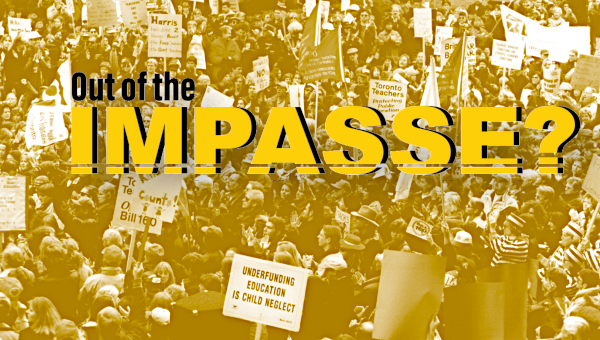
A key component of the day will be a launch of an important book by Paul Kellogg on the Ontario Days of Action when, in 1995, the Ontario union movement and community activists organized a series of 11 one-day general strikes and rallies in cities across the province to challenge the radical austerity policies of the Mike Harris government. We will look at the lessons of that experience together, what we succeeded in accomplishing, but more importantly, what we did not – and what was needed to move forward and build.
We will consider how such a movement was built and how we might build toward a more strategic collective response today.
As well, we will participate in a series of workshops on the lessons of the Days of Action, building solidarity between parents and education workers, organizing to win in struggles with school boards, connecting labour and community struggles, and building solidarity across unions and sectors.
What were the Ontario Days of Action and what can we learn from them?
From time to time, there is an upsurge of labour militancy and that often comes with a surprising degree of creativity. In the 1930s, workers – confronting high unemployment, and therefore, large numbers of potential scabs sat-down in their workplaces to demand union representation and improvements. In the sixties and seventies, with companies squeezing workers for more output, workers resorted to sudden wildcat walk-outs if companies didn’t deal with oppressive production standards and health and safety problems. In the 1980s, when there was a rash of plant closures, workers took over plants to win some legislative protections.
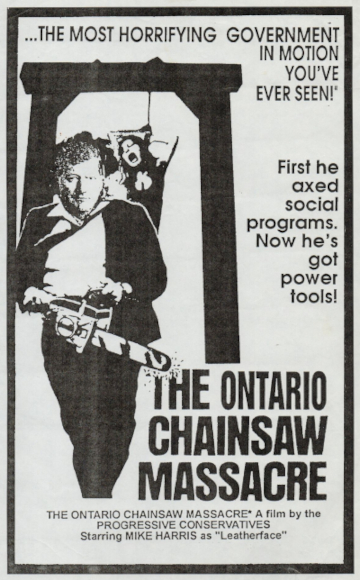
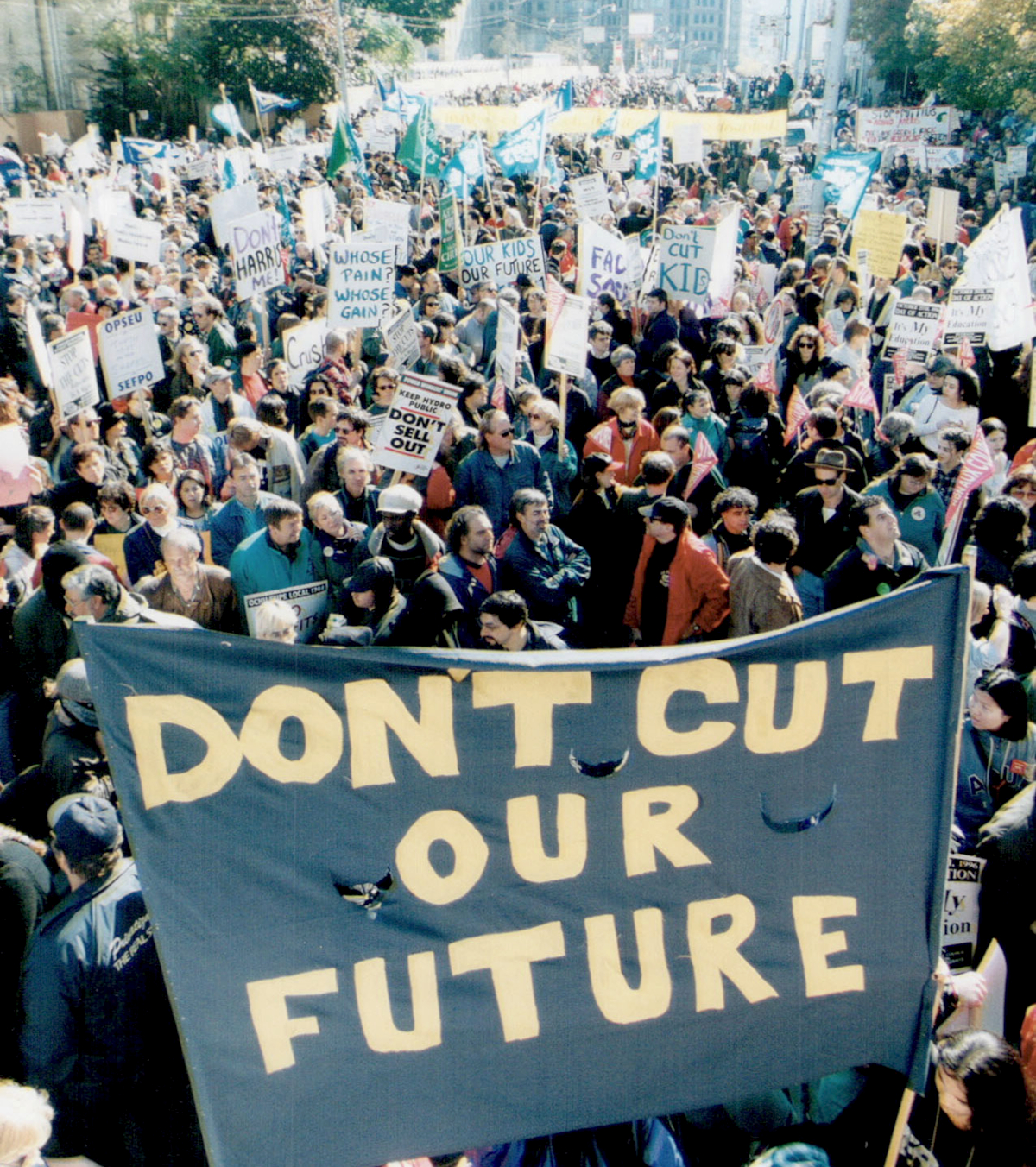
In the mid-nineties, in the Ontario Days of Action, facing an ultra-conservative government determined to radically roll back social gains and union rights, the labour movement and social movements joined together to do something no labour movement had ever tried anywhere: rotating general strikes, one community at a time – 11 such strikes spread out over 2.5 years with mass marches/demonstrations in each community. The Hamilton demos totaled over 50,000 private and public sector workers, surpassing the famous anti-globalization “Battle-in-Seattle,” and the Toronto March counted an incredible 200,000 people (some claimed 250,000).
The particular tactics included joint community movement-labour chairs of each general strike, moving the labour movement’s best organizers from city to city, cross-picketing (since workers might be liable if they picketed their own plants in the midst of a collective agreement). Autoworkers picketed the post office, postal workers picketed assembly plants, retirees picketed airports, and roving movements like the Ontario Coalition Against Poverty moved to wherever they were needed.
All labour struggles are, at best, partial victories. They eventually end, workers return to work, and the bosses still rule, even if somewhat chastened. A critical question to always ask is not just what was gained but what was built? This is so central because building increases our options next time. It means we don’t have to keep starting over each time.
What Can We Learn from This Event?
First, we have seen the potential of working people (both unionized and non-union) backed by and in solidarity with community activists and movements to stop the wheels of the economy and second, we recognise the need for deep organizing to pull this off.
In this regard, the organization was impressive, but it fell short in a very important way. The workplace and community energy that emerged had nowhere to go when the demos ended. Unions did not have projects in mind for young workers excited by fighting for change and there were no longer-term links made by unions and community movements. This was strategically important, as unions represent workers in their workplaces and centres of public service delivery and the economy, while community movements represent other key components of working class life. They need to build in solidarity together.
But once the organizers left one community to go to another, no-one remained to continue organizing. Like many inspiring protest movements of the past decades, nothing was built to take the struggle to the next level.
This poses a critical question. How should we organize ourselves so we can again carry out comparable protests today, when the moment demands it? And, learning from the limits of the Days of Action, how can we make sure that when the events end, our organizing is only beginning? The other side is organized and, with the help of the state, constantly building its power. If we don’t come to grips with how to not only protest, but also sustain and build the protests to new levels, then the treadmill that working people are on in the workplace and in the community will keep dragging us back. •
FEATURED SPEAKERS
- Paul Kellogg – Author of Austerity and Resistance: The Ontario Days of Action, 1995–1998
- Nas Yadollahi – President – Canadian Union of Public Employees (CUPE) Local 79.
- John Clarke – Activist and writer – former organizer with the Ontario Coalition Against Poverty (OCAP).
- Joe Tigani – President – the Ontario School Board Council of Unions (OSBCU-CUPE).
- JP Hornick – President – OPSEU/SEFPO
- Sam Gindin – Former research director at the Canadian Auto Workers (CAW)
- Herman Rosenfeld – Former autoworker and education staff at the Canadian Auto Workers (CAW)
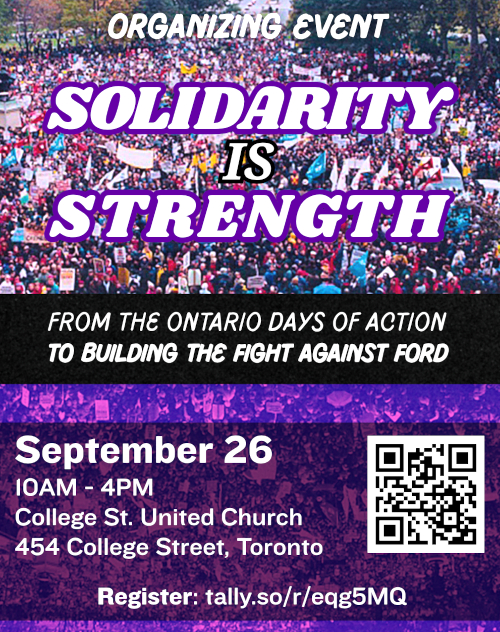
Register for the Solidarity is Strength event – a day of organizing and collective learning:
September 26, 10:00 AM – 4:00 PM (check-in at 9:30am)
College Street United Church
454 College Street, Toronto
Lunch will be provided