
Justice For Kaleym Solidarity Statement
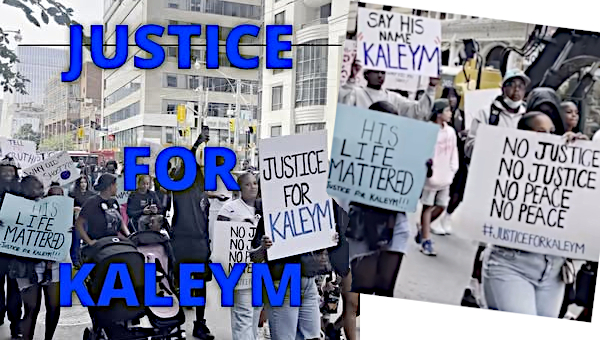
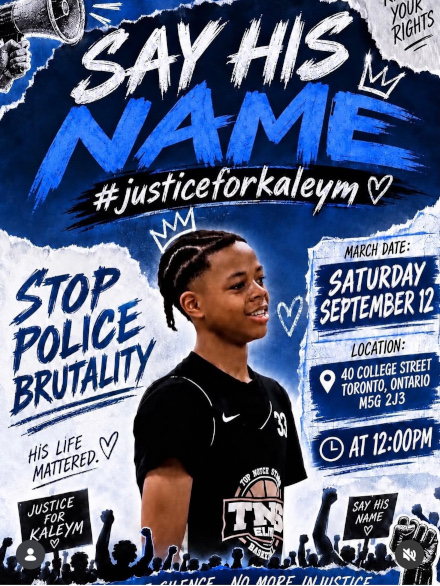
In the early hours of August 6, 2026, Toronto police shot and killed a black 19-year-old named Kaleym Davy while he was driving a vehicle. Headlines announced his death with a widely repeated statement from Ontario’s Special Investigations Unit (SIU) that the car was stolen. The chief of police has since clarified that the car was not, in fact, stolen but was rented by a family member. This is in line with the police pattern of initially releasing non-factual information that benefits their preferred narrative and downplays potential police abuse.1
Police have not provided evidence that use of force was necessary and lawful. As one family member stated bluntly, “How could the family trust the SIU? How are we supposed to have trust in police?” The Socialist Project stands with those demanding accountability for Kaleym’s death. At the same time, we know full well that the accountability Kaleym’s family is seeking is elusive and unlikely to be found without a strong public pressure campaign.
Although the SIU was formed in response to public calls for civilian review in the wake of police killings of black men, the SIU has proven to be just another exercise of cops investigating cops. Likewise, the Law Enforcement Complaints Agency too often is an exercise in police justifying the abhorrent actions of fellow officers. Current public oversight of police is minimal. This is by design.
Lack of Police Scrutiny
The Ford government actively celebrates the lack of police scrutiny that accompanies a law–and–order culture, and has passed legislation modifying police structure and oversight bodies to this end. Whenever the Solicitor General Michael Kerzner gives an address to officers, he says that the government will not stop having their backs and that the provincial “government will stand with you [police] every single day.” Others may genuinely desire stronger civilian oversight but backtrack when confronted by the power of police. Take, for example, Toronto city councillor and police service board member Lily Cheng, who signed a public letter in April 2024 in response to police violence at public demonstrations in solidarity with Palestine, only to backpeddle under police and police union pressure.
In shielding their members from public oversight and accountability, the police unions share the blame for the absolute impunity officers have in their exercise of force. Following the police killing of Eric Garner in New York City in 2014, in response to the firing of the officer, police initiated work-to-rule. Toronto Police have taken similar action in response to budget cuts, drastically dropping city revenue collected through police enforcement. This leverage limits the ability of authorities to discipline officers and control misconduct. Such impunity was on full display in the aftermath of the 2012 G20 summit, when officers who intentionally hid their identification badges received essentially no discipline. Police corruption flourishes in this culture of officer impunity and lack of oversight – as has been made clear in the “Project South” scandal currently roiling the Toronto Police Service. The solution to the problem of police misconduct and brutality is a political one.
We must recognize the police and police unions as non-neutral political actors that act in their own interest in maintaining a system of unaccountable police discretionary power, including in decisions to use force.
Ultimately, genuine civilian oversight will require elected officials who are committed to accountability. However, electing the right people is not sufficient. Any effort at meaningful police reform will require the backing of a popular force that can match the strength of police departments and police unions – as well as confront the economic and political forces that buttress law–and–order ideology.
The police mainly exist to enforce the existing social order. Our society is one of deepening inequality, in which the social problems it produces – poverty, housing precarity, inadequate mental health care – remain largely unaddressed. The police are the state’s answer to the people discarded from the economy by deindustrialization, the opioid crisis, and lack of jobs and housing. These populations are disproportionately racialized, and the policing practices they face are imbued with racism. Until we achieve a more just and democratic society that transforms the unequal foundations of the current order, police will continue their historic practice of abuse.
We need a popular movement capable of imposing real civilian control over the police–control that we must win as part of a broader movement for social, economic, and racial equality. We are committed to such a project. •
Endnotes
- This was most consequential in the high profile murder charges laid against Umar Zameer who was later acquitted. See also the case of Adam Melanson and the false statements police made that he “pushed an officer off his bicycle” in response to video circulated online of an officer kneeing on his neck.