
A Tale of Two YMCAs (Part two)
Thirty years ago, Halifax’s YMCA collaborated with partners in Palestine on a bold outreach initiative, but a few months ago, the same Y caved to pro-Israel pressure to demean a peacemaker.
Part 1 tells the shameful story of the Halifax YMCA’s capitulation in 2025. This is Part 2, thirty years earlier: the joint Halifax-East Jerusalem project.
Thirty years ago, we saw a different YMCA. Despite the then miniscule Muslim and Arab presence in Nova Scotia, the Halifax YMCA launched a daring and unique program in the mid-90s. The program was a partnership with the Y’s counterpart in Palestine, something almost unprecedented for the organization at the time.
The project was an exchange of personnel between Halifax’s YMCA and the Y on the Nablus Road in East Jerusalem and its satellites in Beit Sahour (a Christian suburb of Bethlehem), Jericho, and Ramallah. (It also had a branch in Gaza, since closed.)
The exchange project involved several people from the Halifax Y going to East Jerusalem and several from East Jerusalem coming to Halifax to both learn and impart knowledge and experience. The project also included the Ottawa YMCA.
Among the East Jerusalem Y officials who came to Halifax were General Secretary Kamil Nasser (YMCA’s General Committee for Refugees and the Middle East Council of Churches’ Department on Service to Palestine Refugees); Culture Department Head Michel Asfour (also active in the Ma’an Development Centre); and Nidal Abu Zuluf (now director of the Joint Advocacy Initiative of the Palestine YMCA and an author of the renowned Kairos Palestine document).
Halifax – Jerusalem Exchange Program
Abu Zuluf describes his experience thus:
“The purpose of the visit was to get introduced to the Canadian Vocational Evaluation System and check its compatibility to the Palestinian Context, to help unemployed people and people with disabilities find a proper job.
“In Halifax, we had the opportunity to meet Board members of the YMCA and be introduced to the YMCA activities in Nova Scotia at large. We also gave a presentation on the Palestinian context and the East Jerusalem YMCA Rehabilitation Program. We also had the chance for sightseeing and enjoyed the kindness of people (especially the YMCA staff) and the beauty of the country.
“We were very satisfied with the visit. We learned about and implemented a valuable rehab assessment tool and became the first organization using this system in our region. The EJ YMCA Rehab Program is still using this evaluation system which was proven to be very helpful to our beneficiaries.”
The East Jerusalem YMCA touts the importance of such exchanges:
- “[The goal is] to support justice in Palestine through all possible means;
- “to enhance awareness concerning the Palestinian situation among international YMCA/YWCA movements and other partners and friends through the activities of the Free Palestine Campaign;
- “to build bridges of understanding between Palestinian and foreign youth from various cultures through encouraging young people with potential for leadership from YMCAs and YWCAs to visit Palestine in order to share their experiences of youth development and social justice.”
One focus of the joint project was the similarity between East Jerusalem and Halifax in development among local colonized communities.
Halifax has the largest historic Black community in Canada, with roots going back over 400 years, but with the accompanying racism, discrimination and denial of opportunity one would expect. Urban renewal, like the destruction of Africville in 1964 would in later years be justifiably labeled “ethnic cleansing.” Later that decade, Halifax’s Black youth angrily emulated the civil rights protests of their US cousins. Subsequent remedial community development schemes were not enough to slow the exodus of Black youth in the traditional “going down the road” to Ontario and westward.
Also of interest to the Palestinians, Halifax is also home to a comprehensive physical rehabilitation centre, partnering with the Y in several programs.
In Palestine, an ancient population had for 100 years been subject to Israeli settler colonial violence, punctuated by the “Nakba” of 1948, where three quarters of a million Palestinians, 75% of the population was forcibly displaced and the 1967 “Naksa” with a further 300,000 ousted. Those remaining, both under occupation and Israeli citizens, were subject to repression, a regime called even by some trusted Israeli sources “apartheid.”
Even after the Oslo Accords gave limited autonomy to some parts of Palestine, Israelis controlled many important aspects of locals’ lives, employing surveillance, physical punishment and incarceration.
The “First Intifada” or Palestinian uprising of 1987-1993 in Gaza and the West Bank was an attempt at mass resistance. But the Israeli government cracked down harshly. Israeli soldiers were issued truncheons, and according to reliable Israeli sources, Minister of Defence Yitzhak Rabin gave the infamous order “Go in and break their bones. If they will be beaten, it will hurt them, and the demonstrations will stop… You do the work. I’ll take care of the media.”
Compared to the Second Intifada (2000-2005) the First Intifada is remembered as relatively non-violent. But the impact, (especially on Palestinian youth who were the main protagonists) was grim, with a total of 1,300 killed, 120,000 injured, 15,000 arrested and 1,882 homes demolished. Around 200 Israelis lost their lives as well. The physical, emotional and occupational trauma toll was huge. Shut down by the Israelis during the Intifada, the East Jerusalem YMCA re-opened afterward, developing an impressive program of rehabilitation, including psychosocial counselling, remedial education, vocational training, physical and environmental adaptation, medical assistive aid, community engagement and awareness raising, and capacity development.
Three Factors
Three factors contributed to Halifax’s YMCA decision to link with East Jerusalem in this fortuitous exchange project:
1. A new attitude to international links. YMCA Canada and its affiliates, especially in Halifax, were changing their approach to international relations within the worldwide Y network. According to Halifax Y CEO in the 90s, George Rodger, the old outlook, focusing on what might be called organizational tourism, was shallow and apolitical. He and then Halifax Y Board Chair John Lindsay Jr. had a new perspective that would be more politically engaged.
We tried a real helpful partnership where both groups got to know each other and had things to contribute to the partnership and learning. I did not want a partnership that was patronizing.
2. Said Ayyash. A key catalyst, with links to both localities was Said Ayyash. A native of the embattled Silwan neighbourhood of East Jerusalem, he became a youthful political activist and spent four years in Israeli prison in the 1970s; a common story for Palestinians, of whom 40% have been incarcerated since 1967. He later worked at the YMCA. Founded in 1948, the East Jerusalem YMCA was long run as almost a private club for the comparatively economically-advantaged Christian Palestinians and expatriates. Ayyash set about to open the Y up to greater participation by his Muslim co-religionists and was a key player in the rehabilitation program mentioned above.
Faced with the avalanche of post-First Intifada damaged youth, Ayyash was instrumental in the Y’s program of rehabilitation. The program gained international attention, especially in the worldwide Y network.
One of Ayyash’s sons was deaf and no suitable high school was available for him in Palestine. Through contacts with Canadians he had met at the Y, Ayyash was able to emigrate to Canada in 1993. Rather than a larger city, he chose Halifax as a more intimate place to raise a family. He first tried his hand in the sports equipment business and was active in sports, especially soccer. Ayyash introduced and facilitated the exchange program between the YMCAs of his old and his new city.
3. The Oslo Process. The ravages of the First Intifada spurred a liberal faction of the Israeli power structure, led by the selfsame Yitzhak Rabin, and Palestinian leader Yasser Arafat, exiled in Tunisia, to seek for their own separate reasons, a rapprochement that would promise an end to hostilities. This was so-called Oslo Process, which resulted in a tenuous accord in 1993, with the Palestine Liberation Organization recognizing Israel, and allowing Arafat to return to Palestine as leader of the “Palestinian Authority,” a miniscule “return” of refugees, and the establishment of some Palestinian autonomy in some parts of the occupied territories.
As we now know, and as some Palestinians, like Edward Said, warned at the time, the Oslo Accords vastly favoured the Israelis and were designed never to lead to a true Palestinian state. As well, even amid the Oslo process, Israelis were busy enhancing their occupation with scores of new settlements and hundreds of thousands of Israeli settlers, many of them fanatically inimical to their Palestinian neighbours.
Nonetheless, the “Oslo Period,” in Palestine, in Israel, and in most of the world, was a time of fervent hope and optimism, an ardent, if misguided, belief that the Palestine/Israel conflict was on its way to resolution.
It was upon this feeling of political buoyancy that the Halifax-East Jerusalem project floated.
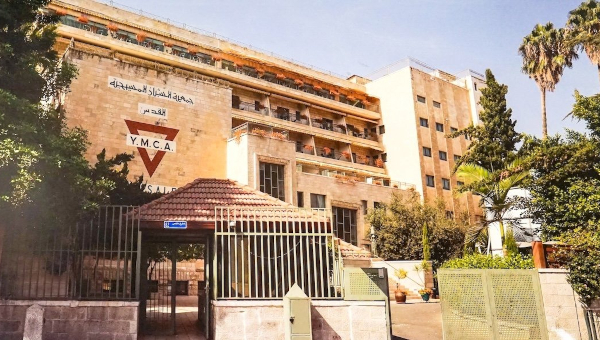
Spirited by that aura of exuberance, those who took part in the project found it transformative. Not only did the Palestinian visitors commune with Y members and volunteers, they also visited local churches and synagogues.
Then Halifax YMCA CEO George Rodger and Board Chair John Lindsay Jr. were two of the leaders who traveled to Palestine. Amid the Oslo Process, they were in Gaza on July 1, 1994, when PLO leader Yasser Arafat arrived celebrating the return to his homeland after 27 years in exile.
As the BBC reported it: “In Gaza City Mr. Arafat gave a triumphant address from the balcony of the former headquarters of the Israeli military governor to a Parliament Square packed with 200,000 Palestinians. Says Rodger:
“[Arafat] was saying, I will make peace and the Israeli prime minister was saying, we will make peace.”
Rodger says the whole exercise of exchanging personnel fulfilled their dreams:
“It wasn’t patronizing to them; it wasn’t dependent upon gifts of money. And it was based on a mutual respect and mutual power and had some depth to it, because I believe there is no Y in the world that can survive without this kind of outreach. It kind of gives hope that this is a big enough thing. If we join it, we can change society. And all people in Canada, it becomes a dignified and safe place where everybody lives in peace.”
One of the other Haligonian YMCAers to go to the East Jerusalem Y was Scott MacMillan, then working as a manager in the Y system and later a professor of business administration at Halifax’s Mount Saint Vincent University. MacMillan helped the Palestinian Y in expansion of its mission. He says of his experience:
“When I first went to the East Jerusalem YMCA, I was a naive young man with very little experience of the world at large. Reading or watching the news about Palestine and Palestinians, Israel and Israelis is one thing. Actually working and living there is quite another. I met Palestinians; I worked with Palestinians; I made life-long friends; I saw all around me the impact of the Israeli occupation. It forever changed my life.”
A Great Disappointment
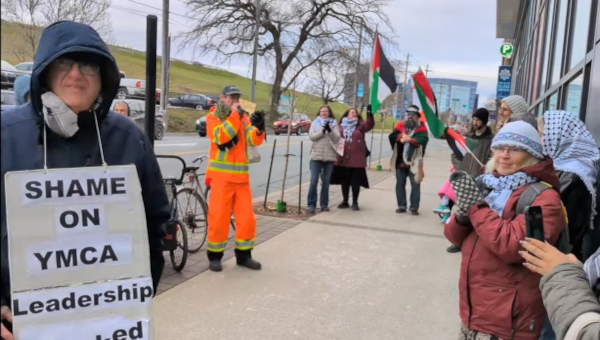
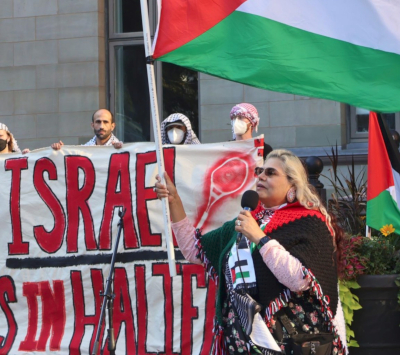
Indeed, MacMillan attended the December 2025 rally outside the Halifax YMCA protesting the cancellation of Rana Zaman’s award. He noted the irony of that disappointment in light of his experience three decades earlier.
Here’s another irony: YMCA Canada held its once-every-eight-years national conference in Halifax in July 2024, hosting four hundred delegates from across the country and internationally. One of those international guests was Peter Nasir, general manager of the selfsame East Jerusalem Y, and son of Kamil, who as then general secretary had come to Halifax on the exchange three decades before.
Peter gave a presentation to the 2024 assembly in which he did not hold back in recounting the political situation of the Palestine YMCA and its needs from the international Y community:
“The end of colonization – both our community at large and our YMCA are under threat. We continue to be a safe space for our community, most notably youth. We focus on the YMCA Network promoting exchanges and inviting youth to visit Palestine.
“No other YMCA in the world has the programs with the impact and quality of programming of the East Jerusalem YMCA. How will we succeed in spite of our subversion and erasure? We look to love those pushed to the fringe, the ones everyone easily labels and blames. Peace is not found among the privileged. Our body is bruised, our mind is traumatized, but our spirit can never be broken.”
The 2024 conference gave Nasir a standing ovation. But just over a year later, the Halifax Y dishonoured Rana Zaman.
When Said Ayyash learned of the Y’s revocation, thirty years later, of Rana Zaman’s Peace Medal, he insisted on a meeting with CEO Posavad and other Y officials. He reminded them of the Y’s project of the 1990s and warned them that they were currently dealing with a very different Halifax.
“The Muslim population of Halifax is growing very fast; it is one of the most important features of the city. It is the future of the YMCA. The Y’s decision [re: Zaman] was so shortsighted. I see it and other Muslims see the Y’s treatment of Rana Zaman as a huge insult. If the Y’s goal is to serve the community, it must serve the whole community.”
In many ways, the issue of Palestine is two steps forward, one step back. After two plus years of Israel’s brutal rampage in Gaza and the West Bank, for the first time ever, more Canadians now support the Palestinians than the Israelis. Even among Canadian Jews, only half now self-identify as Zionist and that falls to 37 percent among American Jews, especially those between 18 and 36.
The privacy of a polling questionnaire is one thing. Public opinion has changed, probably forever. But the public relations and political battleground is another. The issue is more divisive than ever, particularly due to the scorched-earth strategy of Israel’s supporters weaponizing the accusation of antisemitism and the price that any individual or group pays for criticizing that country. Despite the surge in public opinion, would organizations like the YMCA be able to repeat the spirit of adventurous enterprise they followed thirty years ago? The Rana Zaman story tells one tale. But perhaps not for much longer.
What is needed? How about a campaign urging the Halifax YMCA to repeat its old initiative of thirty years ago? The East Jerusalem Y is open to new (or old) partnerships. Now, more than ever.
As Rifat Odeh Kassis, a distinguished Palestinian Christian leader, with a long career at the Palestine YMCA and also with the ecumenical group Kairos and Defence for Children International Palestine, says:
“These exchanges are vital in breaking the isolation imposed by the Israeli occupation on Palestinian society and civil institutions.
“They create spaces for genuine human connection, mutual learning, and solidarity. They also allow Palestinians to share their own narrative directly, beyond political distortions and stereotypes, while helping international partners better understand the daily realities on the ground. Such relationships strengthen global advocacy for justice, human rights, dignity, and peace, and help mobilize people of conscience around the world.”
Let’s do it. •
Part one of this article is available here.