
The Realpolitik of the new Combatting Hate Act
How Israel supporters play police, prosecutors, courts, to suppress free expression
On June 18, 2026, the Canadian Parliament passed the Combatting Hate Act, which revises the Criminal Code in unnecessary but dangerous ways. Subject to intense lobbying by pro-Israel organizations, the lawmakers succumbed to a carefully curated moral panic. Though authorities and police already have many instruments to battle hatred, the new changes give them greater discretion to interfere with the freedom of expression of Canadians without making us any safer.
And the legal revisions render those authorities increasingly vulnerable to a concerted campaign of dissembling by an interest group determined, in a odious attempt to protect Israel from criticism, to sacrifice constitutional freedoms.
Even if the new provisions are eventually struck down by the courts under the Charter of Rights and Freedoms, they will undoubtedly leave a chilling legacy on peaceful protest, not only against Israel’s apartheid and genocidal regime but in other areas as well.
And that, it appears, is precisely what pro-Israel organizations want.
Status of Human Rights
The irony and tragedy is that the Canadian Jewish community, a once-immigrant group that rose through the years from disadvantage and prejudice to full enfranchisement (aided by our accruing “whiteness”) and which championed and thrived under a regime of civil and human rights, has now become one of the main destroyers of that very rights regime.
Of course, Jews are not a monolith. We are now globally a deeply fractured community, especially since Israel’s massive slaughter of Gazans, the ongoing pogroms on the West Bank, and other depredations. We are a family riven by an ongoing battle of sister against brother, children against parents, institutions against individuals.
I am a founding member of Independent Jewish Voices Canada. IJV and organizations like it represent a growing proportion of Jews, especially young Jews, avidly seeking ways to be Jewish differently, rather than by unquestioning support for the State of Israel and every murderous action it takes.
Recent surveys confirm this. Though establishment Jewish organizations claim to speak for all Jews and insist other organizations are marginal, only about half of Canadian Jews self-identify as Zionist. This statistic is highly significant, shown by how energetically Jewish leaders have attempted to counter-spin the result and condemn those who cite it. Authenticating the Canadian results are similar US studies, where a mere 37% of Jews self-identify as Zionist. What’s more, 32% of young American Jews (18-34) actually self-identify as the opposite: non-Zionist or anti-Zionist. The writing is on the wall.
As the late Abe Foxman, former national director of the US-based pro-Israel Anti-Defamation League, said in the film “Israelism,” Israel-supporters have “already lost a generation” of young Jews due to Israel’s brutal treatment of the Palestinians.
Perhaps because of that, powerful forces are busy weaponizing accusations of antisemitism to block discussion of the Israeli atrocities and violations of international law. Pro-Israel organizations are attempting to sanitize the discourse by their own policing methods in civil society and by getting the real police to do more of the work for them. Whether police are happy with their growing role as patsies for a particular interest group is an open question.
Modifying the Criminal Code
The new Combatting Hate Act modifies our Criminal Code in three ominous ways. You can read about it in more detail at the Centre for Free Expression, and there is a recent Legal Centre for Palestine webinar (in which I was a panelist) on this law:
- It is now a criminal offense simply to display a flag or other symbol associated with a listed terrorist organization. For example, depicting the hateful Nazi Hakenkreuz (also known as the Swastika) is now an opportunity, not only for further investigation and possible condemnation but for prosecution, even if used only to compare some elements of the Nazi regime to the current Israeli regime. Could wearing the watermelon symbol or the keffiyeh worn by supporters of Palestine be next? After all, the Israeli government has labeled as terrorist six organizations including Defence for Children International Palestine and Al Haq Legal Support Centre. Pro-Israel organizations take their cues from such designations and are likely to push for inclusion of these symbols in Canada.
- There is a new hate crime: “an offense motivated by hatred.” Under the old law, evidence of hateful motivation could be an aggravating factor at sentencing for a hate offence. Under the new provisions, even non-directly involved offences, criminal or civil, even like spitting or jaywalking, if done adjacent to an allegedly ”hateful” act, can be punished much more severely than otherwise.
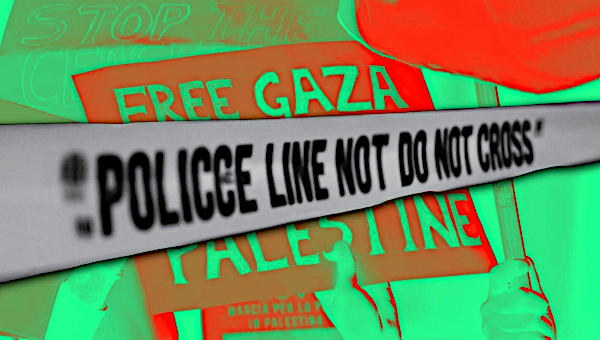
- Another part of the new act denies Charter-protected freedom of expression and freedom of peaceful assembly rights near designated buildings, i.e., “bubble zones.” This gives official legal blessing to protest-restriction measures already enacted by municipalities across the country and encourages more of the same.
But it’s not the new law alone that presents the threat. More menacingly, it’s how interest groups can, and do, use them to initiate, enable, and amplify the attacks on free expression. The pro-Israel organizations have effectively self-deputized as adjuncts to the police, prosecutors, and the judiciary and ply that role with a vengeance.
Crowded Ecosystem
Pro-Israel groups and Canadian governments and other authorities dance together on this project; here’s how they do it:
The pro-Israel lobby isn’t one group but a now crowded ecosystem from the big players like CIJA, B’nai Brith, Friends of Simon Wiesenthal Canada, etc. to the smaller, more impecunious, less respectable, “burner” groups. These range from individuals working independently to groupuscules like Leviathan, the Jewish Defence League (in various incarnations and titles), Herut Canada, Canadian Women Against Antisemitism, Honest Reporting Canada, the Alliance of Canadians Combatting Antisemitism, Stand With Us, and many more, as well as those that operate in specific environments like the Canadian Jewish Labour Committee (in trade unions) or the Jewish Public Servants’ Network (among federal employees.)
They also range from minimalist to maximalist in their scope of attack on freedom of expression.
Minimalists focus on broader goals, like enhancing the Jewish community’s standing and maintaining a seat at “the table” of power; maximalists basically seek to shut down all public Israel-critical or pro-Palestine activity (rallies, speeches, and possibly written material).
Some of these groups can dissociate themselves from the actions of others if such actions are embarrassing.
But by and large, the ecosystem works in a harmonious division of labour. There are things that some groups shy away from but others don’t. For instance, they sue, doxx, report, facilitate the dismissal of, or otherwise harass and even physically attack opponents. In a process that can be called “civil terror,” some do the more “dirty work”; others do the more “clean work.”
Yet, all work to divert attention away from Israel’s actions through the narrative of a Jewish community under siege and scared for its physical and emotional safety.
Despite growing right-wing white supremacist bigotry and egregious attacks on Black people, Muslims, Indigenous folks, queers, women, the disabled, LGBTQ2+, etc., rather than forming common cause with these potential allies, the pro-Israel Jewish groups outrageously want people to believe that the Jewish community, separate and distinct from all the others, is the mosttargeted. Deep behind this is the divisive inference that antisemitism is a bigotry with a valence greater than any other, including anti-Black racism.
Some of these pro-Israel groups are more content to trash freedom of expression, some less, but all would prefer that public critique of Israel stop, or be stopped, period.
A Canadian Jewish studies scholar has described the long evolution of our Jewish community’s relations with non-Jews thus:
“Canadian Jewish communal resources increasingly moved away from what was once called ‘community relations’ (and is now called ‘allyship’). Instead, we invested in vertical alliances: forging strong ties with police chiefs, university presidents, Members of Parliament and Members of Provincial Parliaments, and other officials. This made sense at the time: Jews were entering the highest echelons of power and elite institutions and had more access to these officials. But the focus on vertical alliances came at the expense of horizontal ones – with labour unions, teachers’ federations, municipal councils, churches, temples, mosques, and grassroots organizations. And so, we arrive at today’s condition: Canadian Jews are politically enfranchised but socially estranged; powerful in official circles but uncertain of our neighbors.”
In other words, we have moved from partnering among equity-deserving minorities to solidarity with the power elites, from multilateral engagement to isolationism, fuelled by the self-centred delusion (and self-fulfilling prophecy) that everybody hates us, has hated us, will always hate us.
Dealing With Hate
Before the new Hate Act, authorities, including police, already had powerful legal and other instruments at their disposal to deal with hate and violence promotion, and have used (or abused) them liberally. For example, police already effectively impose bubble zones (such as disallowing banner drops from a bridge over a Toronto’s highway, disallowing rallies at some buildings and streets). Pro-Israel lawyers in Montreal have sought and received injunctive relief in the courts against pro-Palestine protests.
Anti-hate provisions have existed in the Criminal Code for more than half a century before the new changes and, surmounting the freedom of expression hurdles, these provisions have been used successfully to punish scores of hate-promoters like Malcolm Ross, Arthur Topham, Don Andrews, and James Keegstra, whose history-making Supreme Court decision came 45 years ago. (Personal note: I attended the original Keegstra trial in Red Deer, Alberta, as an observer in 1985.)
But Israel-supporters want even those constitutional guardrails removed.
At the hearings into Toronto’s proposed “bubble-zones,” even Toronto police spoke against the severity of the bylaw, insisting that it could seriously offend Charter rights and that police already have less intrusive powers to ensure public safety. Toronto police Staff Supt. Frank Barredo told city council:
“In all honesty, a bylaw would be somewhat low on the range of things that we would be looking at. Public safety is our paramount concern, but of course Charter rights weigh very heavily as we wrestle with the limitations on Charter expression with reasonable enjoyment of the city by other people not involved in demonstrations.”
The fact that a senior officer testified against Toronto’s bubble-zone legislation is evidence that even the police consider these new initiatives alarming, which should make civil libertarians doubly alarmed.
As far as disruption of synagogues, churches, and mosques is concerned, Section 176 of the Canadian Criminal Code already forbids the disruption of religious worship.
Yet, never satisfied with the old provisions, pro-Israel lobby groups have consistently urged governments to widen and further widen the definition of antisemitism and give police, prosecutors, and the courts more and more discretion to punish opponents of Israel.
An example is their touting, to the exclusion of other definitions, the International Holocaust Remembrance Alliance’s Working Definition of Antisemitism, in which seven of eleven examples involve criticizing the State of Israel. IHRA supporters abjure the Jerusalem Declaration of Antisemitism, a far more precise definition, endorsed by over 400 international scholars of Judaism, antisemitism, and the Holocaust, which allows for such critique.
Another example of pro-Israel groups attempting to kick out the legal crash barriers is this: one safeguard heretofore always part of that law is the necessity to obtain approval for prosecution from provincial attorneys-general to provide for a forum for sober second-thought in a highly contentious legal terrain. But in the run-up to the current Combatting Hate Act, these groups lobbied for casting away even that protection for public prosecutions. Fortunately, they weren’t entirely successful, though they succeeded in many other parts of the new Act.
And even if the new Act fails to pass Charter scrutiny, and even if the old and the new measures don’t result in court convictions, there’s still a steep price to pay for those coming under the law’s gaze. As activists say, “The process is the punishment.” Merely to be accused becomes its own penalty. Frequently, suspected offenders have their homes raided (often in the middle of the night, sometimes involving their children), their personal and electronic items are seized, they are dragged before the courts, and they must pay lawyers, sometimes court costs As well, conditions of pre-trial release often include the promise to avoid protests and associations, not to mention that their reputations are often destroyed. For example, the “Indigo Eleven,” despite eventually beating criminal convictions, were all run through the above criminal “process” for a year and a half. Eventual extrication from that process brought but scant relief.
The Playbook
With regard to initiatives like the Combatting Hate Act and its predecessors, here’s how the playbook works in more detail as pro-Israel groups and individuals attempt to weave themselves inextricably into the machinery of the carceral state:
- They insist that they alone represent and speak for Canadian Jews; one-stop shopping, as it were.
- They carefully curate panic discourse about Jewish unsafety, e.g, the deeply flawed B’nai Brith annual so-called Audit of Antisemitic Incidents, or the recent highly-suspect Campus Antisemitism and Student Experiences (CASE) report, often with junk methodology. But despite these irregularities, such reports are red meat for the sensationalist media.
- They attempt to expand the definition of antisemitism beyond acts of hatred toward Jews as Jews, to include political rejection of Zionism and criticism of Israel in public discourse, and then, in law, if possible.
- At the same time, they disparage and lobby against the designation of other forms of bigotry, e.g., Islamophobia and anti-Palestinian Racism.
- They insist that existing legal and public policy instruments are always inadequate.
- They complain that police and governments are never doing enough to combat antisemitism.
- They lobby governments to do studies, hold commissions of inquiry, and/or pass new or modified laws to facilitate curtailing of freedom of expression.
- They attempt to widen the scope of the courts, Human Rights Commissions, and Tribunals to interpret antisemitism.
- Canadian governments, in their turn, respond by trying to appease these groups by what they believe are merely ”performative” concessions, e.g., the Senate antisemitism hearings and the new Combatting Hate Act.
- But by giving police more discretion, governments thus render the police more vulnerable to pressure from interest groups.
- Pro-Israel groups then respond by taking these concessions and weaponizing them, e.g., urging police and judiciary to activate their growing legal discretion to interfere, prohibit, charge, detain, convict, punish, etc.
- Groups and individuals record (possibly using facial-recognition software and other surveillance technology), report, and amplify incidents of antisemitism, real or imagined, and report them to police, insisting police “do something.” In the US, such software has been deployed, groups report political opponents who are students or hold a green card to Homeland Security and ICE and attempt to have them deported. How long before this comes to Canada? Or is it already here?
- They selectively ignore or downplay incidents of hatred or violence against other groups, and they selectively ignore and downplay hatred coming from the right while obsessing about the left because right-wing antisemites tend to love Israel.
- They flood the speakers’ list at municipal or legislative committees or hearings to support increasing restrictions on protest, e.g., Toronto bubble zones, federal Bill C-9.
- They seek recognition as “expert witnesses,” if possible, at these committees and hearings.
- They volunteer to testify as “expert witnesses,” if possible, in trials on charges under anti-hate laws, especially to insist that critiques of Israel, anti-Zionism, etc., are, by definition, antisemitic.
- They volunteer to testify in “victim or community impact statements” for sentencing in these trials. Among other things, the new Hate Act allows for more liberal attachment of hate charges to other, often independent, offences. For example, Adham Diabas was convicted of obstructing police at a venue in an incident distant from a pro-Palestine rally, but because he was involved in the earlier rally, a pro-Israel group argued his sentence, under the new Act, should be heavier than usual.
That’s how it works ‘on the ground’, as we say in the advocacy-carceral complex.
All of this in the name of ‘safety’. But where does the real threat to safety come from? We could do no better than quote from US commentator MJ Rosenberg. Rosenberg knows whereof he speaks. He worked for the American Israel Public Affairs Committee (AIPAC) and then was director of policy at the Israel Policy Forum. Now, he is an unrelenting critic and truth-teller, as the following passage, criticizing the establishment Jewish organizations, shows.
The message, repeated endlessly, is unmistakable:
Israel is us. We are Israel. Attack Israel politically and you are attacking the Jews.
Well, you cannot spend decades telling the world that Israel and the Jews are one and the same and then express shock when some people – including dangerous people – believe you.
That is what scares me.
After Gaza, millions of people around the world have come to despise the Israeli government. And Israel itself. And there are violent people among them, just as there are violent extremists in every population.
What happens when one of those people takes the organized Jewish community at its word?
What happens when someone decides that if Israel equals the Jews, then some random Jew walking into synagogue on Rosh Hashanah is somehow responsible for what Israel does in Gaza?
That would be monstrous.
It would also demonstrate precisely why the conflation of Israel and Jews is so dangerous.
And we Jews ought to understand this better than anyone.
There’s an apt quotation attributed to Benjamin Franklin that goes “They who can give up essential liberty to obtain a little temporary safety deserve neither liberty nor safety.”
Amid a rising tide of right-wing white supremacism that threatens all minority groups, our only alternative is to unite to fight that real threat, together. Privileging the interests of one group only, among many targets, divides and weakens us all and renders us all open to the real hate-mongers. •