
‘Many vs the Money’ Counter-Summit and the ‘Anti-CEO Summit’ Counter-Protest: Old Patterns or New Opening
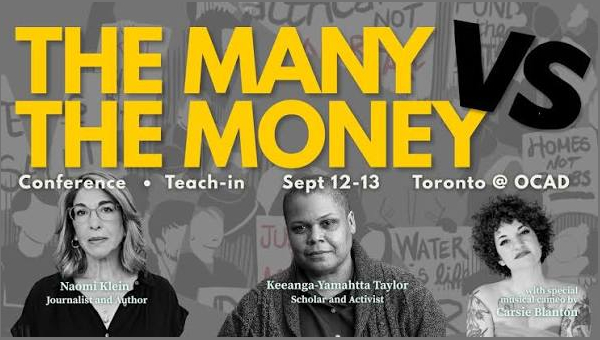
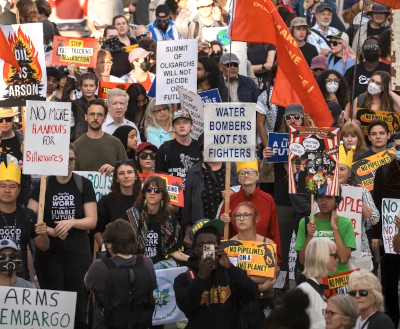
The weekend of September 11-14th marked an important step toward building a movement against Prime Minister Mark Carney’s neoliberal agenda, with its anti-worker, extractivist, export-oriented, pro-business model of development. A number of left and social movement groups collaborated to organize a weekend of panels, educational sessions, teach-ins, and demonstrations against Carney’s Toronto summit of the largest financial titans of capitalism. The weekend of activities was called “Many vs the Money,” as a counterpoint to Carney’s ‘money over the many’ approach.
The sessions and protest were early steps in defining alternatives and popularizing left opposition to Carney’s false promises of sovereignty and economic prosperity, while discussing in an open dialogue ongoing differences and problematic divisions that remain in our efforts to move forward and build stronger social fronts and left organization. This all needs to be addressed and become part of a larger and programmatically and politically diverse movement that fosters solidarity, collective respect, and a spirit of healthy debate.
The Bullet (and others) published an article by Bianca Mugyenyi on September 29th that exemplifies some of these issues and concerns. As with the others at the counter-summit, it critiques the Carney agenda and the summit of finance and extractive capital, and reports on a demonstration that culminated the weekend of protest activities. But it makes unwarranted charges about the demonstration and the role of Mugyenyi’s organization, and disparages the role of those who initiated the Many vs the Money series of educationals who were part of mobilizing for the demonstration.
Two Impressions
The article leaves a number of mistaken impressions for readers. It suggests for example, that the Capitalism Can’t Be Fixed (CCBF) organization was the initiator and leading force behind the counter-summit and demonstration. But the Council of Canadians had drafted a proposal for the weekend protest activities three weeks before the founding meeting of the CCBF (at the end of May 2026 in Toronto). The proposal from the Council was the basis of the weekend’s activities. Further, the CCBF did not contribute to the counter-summit, which featured an array of workshops, teach-ins, and panels, attracting 800 registrants and 400 participants; 50 other left, activist, and other groups did contribute. The demonstration was promoted at all the Summit’s events. Many vs the Money also organized a Monday morning press conference that generated massive media coverage (to which the Mugyenyi article does not clearly ascribe proper credit).
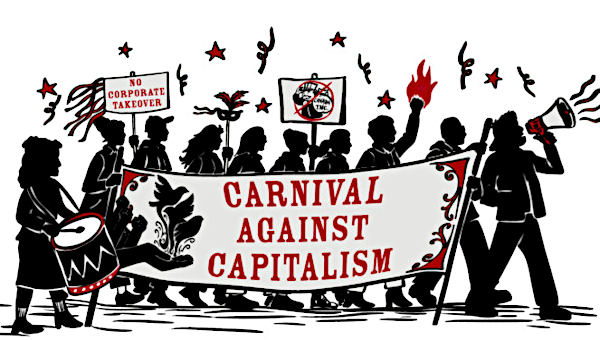
The CCBF did publicise the upcoming demonstration and also organized their own separate Sunday meetings. But the weekend was seen as a way to build their own organization with their separate events, around the themes of ‘Anti-CEO Summit’ and ‘Carnival Against Capitalism’. But the article slights all the other individuals and organizations who helped to organize the demonstration, especially the chairs of the Many vs the Money action subcommittee, without whom much of the Monday demo planning (sound systems, marshalling, street tactics, deep connections to Toronto activist and left political groups) simply would not have happened.
The tone of the article was, therefore, contradictory: on the one hand, it asserts the need for solidarity, praising “movements that do not always work together marching side by side.” On the other hand, it is implied that they were the ones responsible for what they considered to be the key political event – the main mass demonstration (while organizing separately). They also imply that they represent the voice of the anti-capitalist left, neglecting the large number of participating organizations in organizing the demonstration and counter-summit. Credit was due to the Many vs Money organizers for attracting the large media attention, rather than the CCBF’s attempt to highlight their own leaders as spokespeople. The political claim in all this is that the CCBF demands and analyses were clearly anti-capitalist, while those from the Many vs the Money were middle of the road and reformist. But this is blatantly misleading, given the vast number of organizations and plurality of platforms presented. In reality, any sober judgement would see much overlap and few differences. Such a judgement is missing.
The article that The Bullet was based on was also sent out to numerous left and progressive voices, looking more to publicize the role of the CCBF than open a dialogue of solidarity. (It was published in some spaces while left to the side by others.) The Many vs Money counter-summit and demo opened such spaces for debate. Others preferred to try to close them.
Different Components of Resistance – Political Differences
Clearly, there is a need to build a large and vigorous resistance movement to the Mark Carney agenda, and ultimately, to integration and dependence on the US empire – with or without US President Donald Trump in power – and the capitalist system in Canada that underpins and sustains it. One feeds the other, and we can’t challenge one without the other.
Carney’s policy purports to develop a more autonomous role for the Canadian state and capital in the US empire, crafting a false narrative of independence while pushing a less savoury economic agenda. The latter includes increased fossil fuel development and export; military investment as a key component of industrial strategy; infrastructural development serving those ends, and extractive intensity, also for export. Shopworn neoliberal orthodoxy, with sell-off of public assets to big capital, deregulation, and attacks on union rights and on the poor and social assistance recipients are the essence of his plan to project Canada as “economically strong.”
Building a movement against this agenda in an environment of strong Liberal popularity is a critical and difficult task that is in its early stages and requires a massive amount of political education and organizing. In reality, it will take years and major difficulties and challenges to break from the US empire and capitalism (and not just neoliberalism).
The counter-summit assembled a broad spectrum of activists associated with Indigenous, anti-militarization and anti-war, environmentalist, anti-capitalist, feminist, pro-Palestinian, and socialist efforts. All of us were asked to participate and made to feel like partners in organizing these events, right from day one.
Many of these groups provided workshops for education and strategizing. I helped to organize one of these and served on the larger program committee. Over 40 people attended that workshop, putting forward their take on challenging Carney and the politics underpinning them. Our work there followed on the Socialist Project (SP) having published a number of essays that went beyond tariffs to pose what breaking the underlying dependence on the US would really mean and require, and raising this dilemma in the Leo Panitch School for Socialist Education.
The Friday panel provided analyses of the larger political environment in Canada and the US. The Sunday morning panel featured some in-depth presentations on key elements of Carney’s policies as they affect working people, the environment, war, Indigenous people, and some of the economic underpinnings of Carney and Trump.
The Many vs. Money summit and demonstration were important events, but they did have weaknesses that need to be addressed over time. Overall, there was some support but little participation (at Many vs the Money or the demonstration) from the trade union movement, and in particular, the private-sector unions. Building within the unions is a central task in order to broaden this movement. Efforts to defeat Carney from the left cannot succeed without the labour movement playing a leading role. Previous movements, like the anti-free trade movement and the anti-globalization movements had similar weaknesses in their early stages. This is yet to be built.
The Many vs the Money organized a day of collective strategizing on Saturday that was very large and diverse but concentrated too much on the search for immediate collective actions – seeking short-term ‘wins’ – without creating space and time to debate and discuss how each of the possible activities and movement building would affect the medium- and longer-term prospects of defeating Carney.
There are also political differences that will affect the growth of this movement, for example, residual bitterness from the NDP leadership contest, particularly from one of the defeated factions. The formation of the CCBF group is associated with the latter. Their work contains a mix of a kind of isolationism and self-importance, which can be seen in the Mugyenyi article. But the CCBF has also completed some solid research and provided incisive political analysis, particularly of Canadian foreign policy and western imperialism, that many of us agree with. And a number of other activists are associated with this group.
The Avi Lewis leadership of the New Domcratic Party (NDP) clearly is a move to the left for the party. With a left social democratic orientation taking shape, they certainly can be part of the movement to oppose Carney. Their strength lies with some of the left policy positions associated with the Lewis campaign and a commitment to building support for its perspective through its base and with social movements. Their weakness is their dependence on electoralism and a social democratic ideology which accepts and works within the limits of capitalism and, after the Third Way, has incorporated these ideas in its policy agenda. During the last few decades, it has erratically flirted with the market and neoliberalism. This is for the members to grapple with and address. The broader challenge in Canada is a need for a political project of class formation. And the imperative to build the broader working class as a force for socialism linked to a program of structural reforms necessary for a series of ruptures with and economic system of endless capital accumulation and climate and ecology damaging development. This entails a disengagement from the primacy of the US empire in Canadian politics and also in the empire’s world order western imperialism and militarism.
Many activists on the left were attracted to the Lewis campaign, and the NDP has brought in new members, many of whom wish to transform the party in the spirit of a brand of US-type ‘democratic socialism’, similar to the left social democratic movement in the US, associated with Bernie Sanders and Zohran Mandami. And, in a sign of the times, a number of Trotskyists and Maoists, anarchists and green socialists, communists and independent leftists of various sorts, immigrant rights activists and Indigenous rights defenders have taken part in this movement.
Socialists, as with the Socialist Project, argue for building this movement in the spirit of challenging the capitalist system in Canada, fighting to disengage from the US empire, supporting the building of indigenous self-government, and working toward an ecosocialist transformation of Canada. That kind of an agenda will require years of building, deep educational work, and organizing with this longer-term perspective. We hope to continue building this movement in solidarity with others. The Council of Canadians and the other organizers behind the Many vs the Money counter-summit deserve wide credit and support for the organizing they undertook. And for the open and democratic way they organized the debates and discussions. At a time that has left so many stuck in old ways and habits, these groups and the counter-summit provided glimpses of the ways we might expand our political horizons. •