
Missing Link: Economics as Lingua Franca of the Left
Leftists struggle with economic issues. In a bygone era, such issues were the subject of endless debate between intellectuals, activists, and the working masses. These debates were not without conflict and reservations. Intellectuals often accused the masses of ignorance, while the masses considered the intellectuals out of touch with reality. Activists found themselves in a perpetual mediating role between intellectuals and workers. In doing so, they created a language in which life-and-work experiences could be expressed, demands for a different life formulated, and strategies for the struggle for that different life developed.
As a matter of fact, everybody involved in these debates played the roles of intellectuals, activists, and workers to different degrees, some specializing in producing ideas, some specializing in organizing, and most specializing in producing life necessities. What came out of the debates among these specialists was a lingua franca that expressed proletarian class consciousness. Gripping the masses, economic ideas became a political force.
Misunderstandings and conflict often hindered the strengthening of the forces of labour but were also necessary to adapt the common language to different conditions depending on time and place. Marx’s analyses of wage labour and factory regimes provided factory workers with a compass, enabling them to grasp their position as members of an exploited class but also the possibilities of collective production without capitalist bosses. This insight left much room for the question of whether the crises Marx derived from his analyses had to be awaited before capitalism could be overcome by revolution, or whether social reforms would ease the lives of workers before crisis and revolution, perhaps even allowing a peaceful transition to socialism.
Those who worked for wages in the countryside could perhaps partially understand these ‘factory-centered’ debates. Those who worked on their own land, or, as in the case of subsistence production, on land cultivated collectively, certainly did not feel addressed.
It took a long time before not only factory workers but also agricultural labourers and peasants could raise their voices in the economic language of socialism. It took even longer before unpaid domestic labour, almost always performed by women, found its economic voice.
Communication Breakdown
As a result of all, sometimes bitter, controversies over strategy and tactics and over the question who belongs to the working classes and who doesn’t, the economic lingua franca of the left was spoken with different accents. Its grammar had adapted to different conditions. Different accents and grammars caused all sorts of communication problems, but exchanges between social democrats, communists, and national liberation movements never completely broke down, even though, at times, dissident currents were pretty much the only ones maintaining communication between these three lefts. What didn’t come about was the international united front that activists on the left wing of these three movements hoped for. What did come about, following the economic crises and class struggles of the 1970s, was an international of capital.
With the promise of increasing the prosperity of nations through free trade, capitalists were able to mobilize support even among the working classes of this world. Whatever proletarian consciousness had developed since the days of the First and Second Internationals, and however much it had globalized and transformed since then, neoliberal globalization dissolved it all in the world market. Now that it is clear that policies pursued in the name of free trade almost exclusively increase the wealth of the capitalists of all nations, people of all classes are rallying under the new banner of competition between nations and ‘races’. Fear of decline and ruin has replaced the hope for prosperity through free trade. But the ideological core – ubiquitous competition – remains the same. In the real world, the wealth accumulation of capitalists continues despite a more or less stagnant economy.
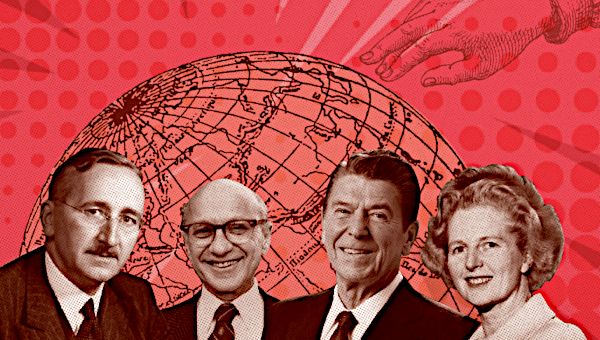
Proletarian class movements that could curb inequality, perhaps even completely abolish the exploitation of people and nature, no longer exist. They dissolved after the failure of communist modernization in the East, the consolidation of neocolonial exploitation in the South, and the dismantling of the welfare state in the West. The suppression of the Prague Spring and the coup in Chile, and the elections of Margaret Thatcher (UK) and Ronald Reagan (US) symbolize turning points beyond which conflicts within the left no longer led to a redefinition of effective organizational practices and political strategies but rather to a breakdown in dialogue between intellectuals, activists, and the working masses.
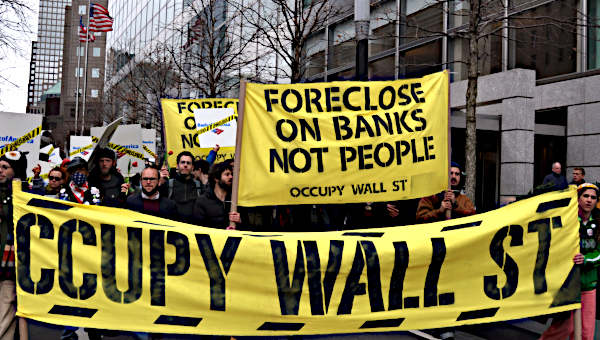
Since then, left-wing intellectuals have largely turned away from economic issues, while large numbers of workers have embraced neoliberal answers to these questions. Economic populist slogans allow activists occasional successes in mobilizing. “People Over Profit” addressed a widespread unease with a world where everything revolves around money, but it offers no political orientation comparable to the concrete demands for an eight-hour workday, Lenin’s “Soviet power + electrification,” or colonial liberation with which socialists of earlier times were able to mobilize the masses. Recent successes in left-wing mobilization have not contributed to the re-emergence of proletarian class consciousness. In terms of lasting mass appeal, they cannot compete with the market populism of capital, whether in its free-trade or nationalist-racist form.
Economic Populism, Technocratic Politics, and Abstract Theory
In 2011, Occupy movement started with thousands, if not millions, protesting under the banners “Our World Is Not a Commodity” and “We Are the 99%.” In doing so, they expressed a widespread unease with a world in which trade-and-exchange value are everything, humanity nothing, and wealth is concentrated in the accounts of a few. The protests against the World Trade Organization in Seattle in 1999 marked the starting point of a global movement against neoliberal economic policies, with which capitalists in every country pursued a redistribution of wealth from the bottom to the top. Mobilizing around classic left-wing themes, the movement against neoliberal globalization claimed “Another world is possible.”
But the movement didn’t get far on its path to a different world. While the 2003 war against Iraq triggered protests that surpassed anything previously achieved by left-wing globalization critics, it didn’t lead to the movement’s further development; instead, it marked the beginning of its demise. Mass protests didn’t resurface until 2010, when banks and capitalists, plagued by the global financial and economic crisis that started in 2008 with the US mortgage fiasco, were showered with government bailouts while the working classes were subjected to austerity measures. The Arab Spring of 2010 was followed a year later by Occupy Wall Street, then by the founding and subsequent rise of Podemos in Spain, Syriza in Greece, the presidential candidacies of Bernie Sanders, and a temporary leftward shift of the British Labour Party under Jeremy Corbyn.
The anti-austerity revival of the left didn’t last. Right-wing critiques of globalization turned out to be much more successful than those of the left in mobilizing global discontent. The latter lacks the ‘theoretical and ideological basis’ and a language to re-establish the broken dialogue between intellectuals, activists, and the working masses. There are no proletarian class movements in the making. This contrasts with right-wing critiques of globalization, which offer the masses the escape into a dream world of national prosperity, while the global operations of capital reproduce the causes of widespread unease day in and day out.
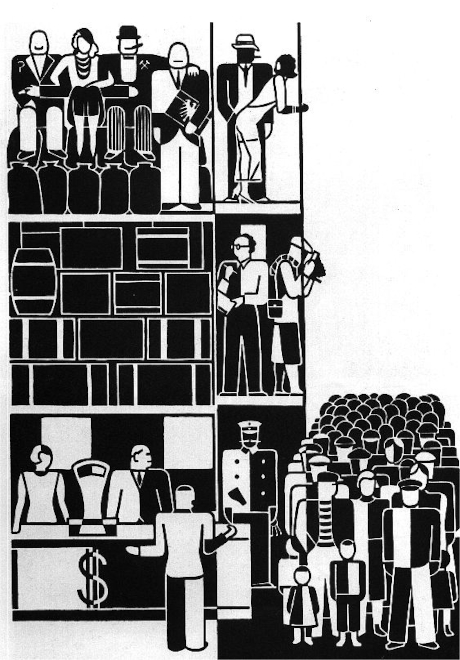
At a time, when the masses cannot be mobilized around left-wing populist economic slogans, very few on the left are interested in economic issues. Those that are often engage in a rather unappealing manner. Economic populism aimed at the masses is isolated, by and large, from the expertise of left-wing economic circles, where, in matters of economic policy, Keynesian programs are reinvented over and over again. Throughout its existence, Keynesianism was suspected to replace democratic decision making with technocratic control of the economy and society at large. These suspicions provided a perfect opportunity for neoliberal propagandists who promised freedom from bureaucracy. No matter they were really after lower social standards, not liberation of the people from top-down control. In fact, neoliberal politicians use the state apparatuses built under Keynesian principles to implement austerity as taken for granted and limit democratic control even further than Keynesian-inspired governments had done.
Marxist theoretical circles are hung up in esoteric debates, for example, whether the profit rate is falling, possibly causing an economic breakdown, or not. The hope once associated with falling profit rates, that crises and class struggle from below would follow, plays, at best, the role of melancholic reminiscences of missed opportunities. Anyone seeking evidence of the detachment and economism of Marxist theory will find ample evidence here. To be sure, accumulation and crises can also be understood as a result of class struggles. In this sense, Marx’s Capital can be read politically. But in most theoretical debates, class-struggle, not to mention the individuals involved in it, disappears behind what Marx called the “law of motion of modern society.” This kind of left-wing theoretical debate mirrors the neoliberal incantations of the natural laws of supply and demand. Yet, where neoliberal propaganda successfully builds hegemony around such incantations, the left remains politically ineffective. This is despite the fact that capitalist interests and market forces have been worsening the living conditions of the working masses for decades, and the promise of prosperity for all, tied to rising profits, has been broken time and again.
The Lingua Franca of the Market: the Rationalization of Powerlessness
Long before economic ideas, or more precisely their socialist variants, became the basis of proletarian class consciousness, liberal ideas played a crucial role in the constitution of the bourgeoisie as a class. The lingua franca of labour associated with socialism could, at times, challenge the rule of the bourgeoisie. However, the ideological justification of the rule of capital functioned (and still functions) differently than its socialist challenge. There was no line of communication between liberal economists and politicians and the working masses comparable to the one the latter maintained with left-wing economists and activists from the time of the First and Second Internationals until the 1970s.
The moment that working-class movements emerged, liberals turned from class, figuring prominently in the works of David Ricardo, to individuals. The difference between workers and capitalists was dissolved into the equality between the factors of production, labour, and capital, each paid according to their respective contributions to the value of production. The sphere of consumption was governed by consumer preferences and purchasing power determined on individual decisions to work, invest, and save, neither of which had, according to liberal doctrine, anything to do with class. Theoretical denial of class was very much driven by the bourgeoisie’s real-world fears that working classes might actually fight against their exploitation and oppression.
Socialist theories, especially Marxism, subjected liberalism to a radical ideological critique. In an effort to expose capitalist exploitation in the labour process, the sale of labour power and the purchase of consumer goods were often treated as a veil to be swept aside. The fact that these market activities are as much a part of the lived reality of wage-dependent workers as the expenditure of their labour power in the production process was all too frequently overlooked. This omission offered liberal propaganda an entry into proletarian class consciousness.
However, without the left-wing lingua franca of labour, the alienation experienced in everyday working life – being bossed around and looked down upon by superiors – no longer finds expression. In contrast, the experiences of selling labour and buying consumer goods can be expressed through liberal ideas, old and new, which are disseminated via countless media channels. The powerlessness of individuals deprived of their collective forms of expression and organization in the face of the demand for labour and the supply of consumer goods is not only adequately expressed by the postulates of the laws of supply and demand but also rationalized in a Freudian sense. And thus perpetuated.
If the Left wants to limit or overcome the class interests of capital, presented as the rule of economic laws, it must first and foremost critique the belief in these laws in a comprehensible way, instead of relying on the crisis-prone nature of capital and the irony of history. Such economism from the left fails to mobilize those whom Marxist theory has chosen as the historical heirs of capitalism. Conversely, economism serves the bourgeoisie because it presents their rule as eternal and natural. This perception is further reinforced by the subjugation of politics to the demands of capital after the dissolution of the working class as a political force. The political safeguarding of market laws by a technocratic elite has replaced the power-struggles between contending classes. As with economism, what serves the rule of capital harms the left. Claims by left-wing vanguards to pave the way to a socialist future have all too often stood in the way of the self-empowerment of the working-class. If leftists present themselves as vanguards who claim to lead the struggle on behalf of the working masses, they will not win the trust of these masses.
The dual power of economistic and technocratic ideology renders class and class-struggle unthinkable. If the only choice is between the political will and power of technocrats and the blind rule of economic laws, the working masses will remain passive, will not make themselves into a class. Without the making of new working classes, the class rule of capital cannot be addressed; its effects are passively endured or diverted into an equally impotent rage against perceived external enemies. This does nothing to diminish the class rule of capital. For that to change, a dialogue must be reestablished between intellectuals, activists, and the working masses, enabling an exchange about everyday experiences and life expectations. This dialogue must provide answers to economic questions that reflect the realities of working people’s lives, instead of simply pointing to the unfolding of economic laws or the vicarious problem-solving of technocratic elites.
Reestablishing dialogues requires analyses that reveal the individuals (or groups) behind major developments and their ruptures. It requires understanding economic laws as solidified ideological forms of a history of class struggles, thereby revealing starting points for future struggles. Furthermore, it requires spaces, both literal and metaphorical, where intellectuals, activists, and workers can exchange ideas and develop political strategies. This won’t happen without conflict and misunderstanding, but it is a prerequisite for creating a lingua franca of labour that resonates with the masses who can then become a political force. •
This article first published on the Jacobin website.