
Cyprus in the New World Disorder: Resisting the Logic of “Geopolitics”
Since 7 October 2023, Cyprus has moved from the margins of Middle Eastern conflict into its operational geography. British bases on the island have supported Israeli and US military activity across the region; the Republic of Cyprus has expanded defence cooperation with the United States, Israel, France, and Greece; and Northern Cyprus has been integrated more deeply into Turkey’s military infrastructure. The March 2026 drone strikes on the island exposed the consequence: Cyprus can no longer host the machinery of regional war while assuming that war will remain elsewhere.
This militarisation is usually presented as an unavoidable response to external danger. Yet this reverses the causal relationship. Cyprus is exposed not simply because it lies in a dangerous region, but because partition has made the island available to competing external powers. British sovereign territory, the Republic’s Israeli alignments and Turkey’s military control of the north turn Cyprus into a fragmented security space. Partition facilitates militarisation; militarisation deepens partition. This cycle has accelerated since the collapse of the last substantive settlement talks in 2017, and even the latest attempts by the UN to revive negotiations risks reproducing it. They are subordinating reunification to the security calculations of external powers and placing Cyprus’s future under NATO tutelage.
This circular logic is reproduced by an entourage of security experts, politicians, and geopolitical commentators, who translate the interests of ruling classes into the language of necessity. Many have little knowledge of the society they designate as the other: they do not speak its language, have rarely visited it, and encounter its people mainly through official threat narratives. Yet they confidently prescribe deterrence, armament, and alliance on the basis of pseudo-scientific, game-theoretical models of geopolitical competition. “Geopolitics” thereby ceases to be an analysis of historically produced power relations and becomes a means of naturalising them. The priorities of ruling elites are presented as if they followed automatically from geography itself, while alternative political possibilities – demilitarisation, cooperation, and regional solidarity – are dismissed as naïve. The language of the powerful is thus circulated as neutral expertise, making the reproduction and escalation of conflict appear as common sense. In this brief commentary, we seek to demystify this geopolitical logic in Cyprus.
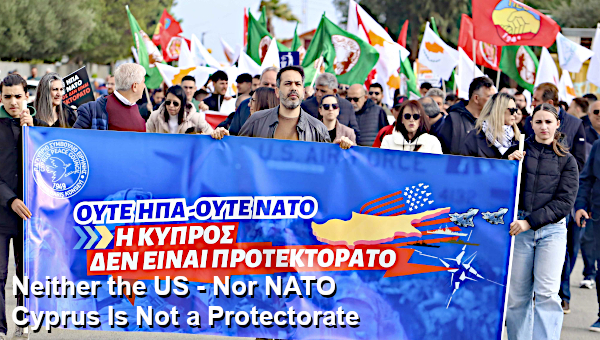
The Republic of Cyprus: Israelization as a Class Project
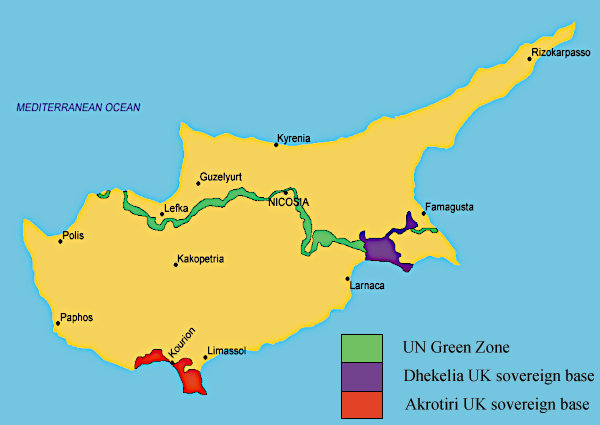
From independence in 1960, the Cypriot state emerged in a fragile and highly constrained postcolonial form. The anti-colonial movement had contained strong intercommunal and left-wing possibilities, yet these were weakened and suppressed by the rise of Greek-Cypriot nationalism. Following British colonial rule between 1878 and 1960, the Republic of Cyprus became independent under constitutional arrangements involving three guarantor powers – the United Kingdom, Greece, and Turkey – while Britain retained 3 per cent of the island as “sovereign base areas.” The breakdown of the constitutional order in 1963, the intercommunal violence of 1963-74, the July 1974 coup organised by the Greek junta, Turkey’s subsequent invasion, the mass killings and displacement of both communities, and the later declaration of the so-called “Turkish Republic of Northern Cyprus” (TRNC) in 1983 entrenched an unequal and internationally contested order.
The Republic of Cyprus’s foreign policy has shifted markedly from the non-aligned and pro-Palestinian orientation of earlier decades. Over the past fifteen years, and especially under the Anastasiades government between 2013 and 2023 and the Christodoulides government since 2023, Cyprus has presented itself as a dependable node in a US-aligned Eastern Mediterranean security architecture. The 3+1 framework with Greece, Israel, and the United States, the Cyprus–US Strategic Dialogue launched in 2024, the bilateral defence roadmap for 2024–29 and increasingly regular military exercises have institutionalised this direction. The British bases remain important operational infrastructure, but the more consequential change from the earlier period is that the Republic itself now actively markets its ports, airspace, intelligence capacity, geographical location, and political reliability as strategic assets.
Security cooperation is only one part of this project. It is linked to hydrocarbons, electricity interconnection, shipping, technology, tourism, property, and infrastructure. American energy companies participate in offshore gas development; the proposed electricity connection to Greece and Israel is promoted as both an economic and geopolitical corridor; and Israeli firms and citizens have become increasingly visible in property, hospitality, technology, and services. Even setting aside the ecological costs of these activities, none is inherently sinister, nor does every investor participate in a coherent geopolitical plan. The point is structural: defence cooperation, energy diplomacy, and private accumulation increasingly reinforce one another. Cyprus’s value to Israel and the United States strengthens the position of Greek-Cypriot elites able to broker land, licences, contracts, services, and political access. They, in turn, translate commercial and strategic opportunities into a single “national interest.” The promise is that geopolitical usefulness will deliver investment, diplomatic protection, and deterrence against Turkey.
The cost is that security becomes detached from reunification. Instead of asking how Greek Cypriots and Turkish Cypriots might share sovereignty and reunite the island within a bizonal, bicommunal federation – the model negotiated by both parties since the 1970s – these elites ask how the Republic can increase its value within an anti-Turkish regional balance. The relationship with Israel exposes the contradictions most clearly. While claiming neutrality through its operation of a humanitarian maritime corridor to Gaza, Cyprus has simultaneously deepened military cooperation with the state carrying out the destruction of Gaza. Alongside strengthening diplomatic ties, it purchased Israeli surveillance drones in 2019 and began taking delivery of an Israeli-made air-defence system in December 2024, intended to complement and eventually replace its ageing Russian systems. Meanwhile, the lifting of the longstanding US arms embargo has opened access to American military equipment. Arms procurement thus ties the Republic ever more closely to the Israeli and American defence industries. The Iranian drone assault on Cyprus in March 2026 demonstrated the broader danger: once the island’s infrastructure becomes part of a regional war, official declarations of Cypriot neutrality cannot prevent Cyprus from being treated as part of the battlefield.
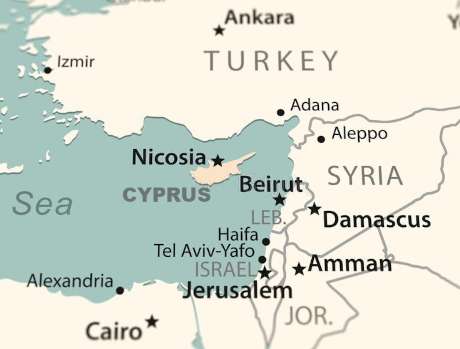
This shift is unfolding within a wider regional reordering in which Turkey and Israel are increasingly constructed as strategic adversaries with Cyprus positioned as a military outpost in their emerging confrontation. At its root lies the erosion of US hegemony, which has weakened the regional order it once imposed and intensified competition among states seeking to fill the resulting vacuum.
The Wider Context: Turkey and Israel as Enemies in the Making?
US foreign policy under Trump has been confusing, to say the least. Yet one thing is clear: its erratic oscillation between restraint and escalation registers deeper crises of social reproduction at home and geopolitical reproduction abroad. “Make America Great Again” (MAGA), which initially promised a form of isolationism, could not sustain it in practice. Faced with a crisis of legitimacy at home and the rise of China abroad, while unable – or unwilling – to address the underlying causes of American decline in any meaningful way, MAGA has been pushed almost inevitably toward a more strident projection of power abroad. It has intensified the “moral asymmetry” that has traditionally sustained American exceptionalism by presenting US power as uniquely legitimate, its violence as necessary, and its interventions as the defence of order itself.
This increasingly aggressive dynamic is inseparable from the perpetuation of American supremacy through the petrodollar order in the Middle East. As the productive foundations of US power have weakened, strategic control over oil and gas routes, and over the dollar-denominated circuits through which energy moves, has become even more central to the reproduction of American primacy. The wars on Gaza and Iran must also be seen in this light. They are not only Israel’s wars, justified and fought by the US; they are also wars over the political and military conditions under which the wider US-led energy and monetary order is secured. Even if the war on Iran ended in a major failure for the US, the broader project of weakening Iran, consolidating Israel as a regional military bully, disciplining Europe into deeper dependence on American energy and security structures, and militarising the Eastern Mediterranean remains part of this wider process.
But a US-led redesign of the region does not only produce a coherent camp beneath it. It also sharpens rivalries among the very middle powers Washington hopes to align. One of the most important is the emerging rivalry between Turkey and Israel over the future of the Middle East, particularly post-Assad Syria. Both Turkey and Israel worked to topple the Assad regime, but they did so for different reasons and with different endgames in mind. It was Turkish-backed, Idlib-based neo-jihadi forces that brought Assad down, a development the United States openly praised on several occasions. The fall of the regime also created an immediate opportunity for Israel to expand its influence in Druze-dominated southern Syria and to destroy much of the military hardware and naval capacity that the new regime would otherwise have inherited from Assad. What is emerging is a distinctly American-dominated Syria: a new regime backed by Turkey, aligned against Iran and Hizbullah, and keen to maintain workable relations with Israel despite Israel’s continuing expansion in the Golan Heights.
However, this apparent stabilisation has also generated new contradictions. Even as Syria is being reintegrated into a US-aligned regional framework, that process has opened the way for a more direct Turkish–Israeli rivalry over who will shape the new order on the ground. Since December 2024, Turkey’s relationship with Israel has deteriorated sharply, as Syria has become the site where Ankara’s search for regional influence collides directly with Israeli fears of any neighbouring order it cannot control. Israel wants to preserve its freedom of action in Syria and the wider Levant; Turkey seeks to consolidate its influence in northern Syria, now openly declares that its security begins in Aleppo, Damascus and Beirut and increasingly presents itself as a counterweight to Israel’s attempt to reshape the regional order.
Furthermore, Turkey and Israel are also advancing competing infrastructure corridors: Israel seeks to establish itself as a pivotal link in the India–Middle East–Europe Economic Corridor (IMEC), while Turkey – excluded from IMEC – promotes the Iraq–Turkey Development Road and its wider Middle Corridor as alternative routes connecting Asia and Europe. That is why Israeli rhetoric has increasingly recast Turkey not merely as a difficult regional actor, but as an emerging strategic threat—indeed, as what several Israeli politicians and commentators call the “next Iran.”
These statements reflect both a real concern and an amplified threat perception. The threat is amplified because Turkish–Israeli relations continue to contain significant areas of overlap. During the Arab Spring and even at the height of Turkish geopolitical adventurism in Syria, the two sides still had incentives to repair ties. They held normalisation talks in 2015-16 after the Mavi Marmara rupture and restored full diplomatic relations in August 2022. More importantly, political confrontation never eliminated practical interdependence. Turkey has not stopped the flow of Azeri oil through the Baku–Ceyhan pipeline, which covers roughly a third of Israel’s oil needs; it has allowed indirect or disguised trade to continue despite the political theatre of sanctions; and it has remained embedded in a US-led regional order whose strategic infrastructure, including the Kürecik radar site in Malatya, materially strengthens Israel’s security environment, even if Ankara denies any direct bilateral role. In this sense, confrontation at the level of discourse has coexisted with indirect commercial and logistical ties, preventing the relationship from hardening into outright rupture.
That said, threat perceptions are also real and increasing on both sides. From Israel’s standpoint, the problem is less that Turkey threatens its immediate security than that Turkish influence might gradually narrow Israel’s freedom of action in post-Assad Syria. Israeli pre-emptive strikes, such as the bombing of the Palmyra airbase, which had reportedly been promised to the Turkish air force by the new Syrian regime, were early signs of this logic. Calling Turkey the “next Iran” is therefore part of a strategy that magnifies present risks and prepares the ground for a harder line should Turkish influence in the region increase. On the Turkish side, the starkest sign of this intensifying threat perception is the way the Kurdish question has been drawn back into the regional equation. Ankara fears that Israel could use the Kurdish card in Syria to unsettle Turkey and increase pressure on it indirectly. Precisely because the Kurdish question has once again acquired wider geopolitical significance, it has pushed Erdoğan and his ultra-nationalist allies toward seeking some form of peaceful, democratic resolution to Turkey’s long-standing Kurdish question – something that was unthinkable only a few years ago.
In that sense, the threat is not merely rhetorical inflation but a real struggle over the distribution of influence within a reordered regional space. Nor has this rivalry remained confined to Syria: Somalia already points in the same direction from the south. In this wider setting, Cyprus also stands out as a particularly dangerous flashpoint, since it brings together several fault lines at once: Greek–Turkish rivalry, Israeli strategic alignments, energy competition in the Eastern Mediterranean, militarisation, and unresolved questions of sovereignty.
Northern Cyprus: Turkeyfication as a Class Project
The north is incorporated into regional power through a more direct form of subordination. Turkey remains the decisive military authority and the sole state that recognises the Turkish-Cypriot administration. It also underwrites public finance, supplies the currency, dominates trade and tourism, and increasingly shapes energy, communications, and education. In 2023, Turkey accounted for roughly 80 per cent of northern exports and 70 per cent of imports, while Turkish citizens formed the overwhelming majority of tourists. Financial protocols negotiated with Ankara reach deeply into budgets, public administration, infrastructure, and privatisation.
This relationship sustains a particular model of accumulation. Construction, casinos, tourism, private universities, and property sales connect Turkish-Cypriot elites and business groups to Turkish capital, contractors, and regulatory protection. Development on Greek-Cypriot property seized after 1974 – estimated to constitute nearly 80 per cent of the immovable property in the present-day TRNC – turns the unresolved property question into a source of profit. Every new hotel, residential complex, or infrastructure project can make restitution and territorial adjustment more difficult, while also generating constituencies with a direct interest in permanent separation. Ankara’s support is therefore not only military protection; it is the framework within which political authority and profit are reproduced.
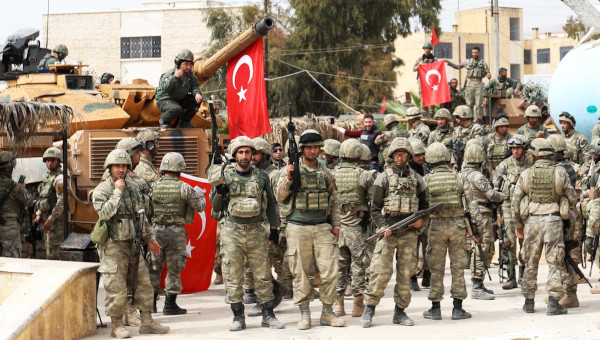
Militarisation consolidates this dependence. Turkish forces remain across the north, while the Geçitkale/Lefkoniko airbase has been incorporated into Turkey’s advanced drone and broader military infrastructure. These developments connect Northern Cyprus to Turkey’s maritime claims in the Eastern Mediterranean and its expanding rivalry with Israel. In this respect, the Turkish-backed “two-state” doctrine, rather than federation, performs a double function: it translates Turkey’s regional ambitions into a claim of Turkish-Cypriot sovereignty, while protecting a local governing bloc whose power depends on Turkish recognition, money, and coercive backing.
Turkey, Israel, and the Regionalisation of Partition
The emerging Turkish–Israeli rivalry binds these two complexes together. Ankara views the Greece–Cyprus–Israel relationship as an attempt to confine Turkey to its territorial waters in the Eastern Mediterranean and block its access to international waters. Northern Cyprus thus gives Turkey territorial and military depth close to the Levant, as well as leverage over maritime and energy disputes. It also protects Turkey’s access to international waters to the south. The Republic offers Israel diplomatic depth, training space, logistical proximity, and a partner inside the European Union, all within a wider alignment directed against Turkey.
The danger therefore lies in the regionalisation of the Cyprus conflict. What began as an intercommunal and postcolonial conflict is increasingly inserted into a broader contest over the Middle East, maritime zones, energy corridors, and regional hierarchy. The Greek-Cypriot ruling bloc interprets Israeli and American support as compensation for the failure of reunification; Ankara and its allies in the north interpret that alignment as proof that Turkish military guarantees and separate sovereignty are indispensable.
The stronger the Republic’s military relationship with Israel, the easier it is for Ankara to portray the south as a hostile forward platform. The more Turkey militarises the north, the easier it is for Greek-Cypriot leaders to present alignment with Israel and the United States as unavoidable. Threats are real, but they are also politically counter-productive: they discipline dissent, legitimise military expenditure, increase the bargaining power of security institutions, and conceal the private gains attached to strategic projects.
Beyond Competing Dependencies: Can NATO be a guarantor of peace?
The challenge is not to choose the stronger patron but to prevent Cyprus from being reduced to a bargaining chip in a larger geopolitical game. Balancing Turkey against Israel and Israel against Turkey does not protect Cyprus; it ties each half of the island more tightly to the rival ambitions of others. Ukraine offers a painful warning of the dangers of such strategies: smaller states can become front lines in conflicts among larger powers. The alternative is not neutrality as passivity but rather reunification as an active project of shared sovereignty, social transformation, and regional solidarity.
A solution must, therefore, reach deeper than constitutional engineering. A bizonal, bicommunal federation remains the only plausible framework for reunification. The social basis for such a project exists in movements that have resisted war, austerity, authoritarianism, and nationalism on both sides. Their task is not to deny insecurity but to redefine it. Housing costs, ecological destruction, precarious work, displacement, and the absence of democratic control are security questions too. Greek Cypriots and Turkish Cypriots are made less secure when their rulers trade sovereignty for protection and turn the island into infrastructure for powers whose conflicts they cannot control. The central divide is, therefore, not between East and West, nor simply between Turkey and Israel. It is between ruling blocs that reproduce power through partition and a Cypriot society that can become sovereign only by overcoming it.
In this sense, we are skeptical toward the most recent attempts intending to solve the Cyprus question through NATO. The current initiative of the UN Secretary-General must not be allowed to become another missed opportunity. However, the suggestion that NATO could somehow function as a new guarantor of a Cyprus settlement is deeply problematic. The advocates of these packages are depicting NATO as offering a convenient answer to the old security dilemma: Greek Cypriots want the abolition of the 1960 guarantee system and the end of unilateral intervention rights; Turkish Cypriots want credible security safeguards against domination by the Greek-Cypriot majority; Turkey wants to retain strategic influence; and Western actors want Cyprus more firmly embedded in the Euro-Atlantic security architecture.
It is misleading, to the say the least, to assume that NATO can resolve the communal security dilemma. Turkey is already a NATO member. Greece is a NATO member. The United Kingdom is a NATO member and retains sovereign military bases on the island. The history of Cyprus shows that shared membership in Western security structures does not prevent conflict, intervention, or partition when strategic interests diverge. To imagine NATO as an impartial guarantor is therefore to forget that the Cyprus problem was itself shaped within the orbit of NATO power and its staunch anti-communism, and regional military calculations. Likewise, NATO cannot be expected to defuse the intensifying rivalry between Turkey and Israel when its own regional architecture is increasingly implicated in producing and militarizing that confrontation.
Making NATO the guarantor of a settlement would, therefore, embed a reunified Cyprus more deeply within the very militarised regional order from which it needs to escape. It would also reinforce the ecologically destructive accumulation models developing on both sides of the island and reward the elites that have treated our island as an asset to be monetised, its ports and airspace as strategic commodities, and its foreign policy as a brokerage mechanism connecting Western power, Turkish-Israeli militarisms, and regional capital. Reunification should restore the capacity of Cypriots to determine their collective future, not transfer the supervision of that future from one set of external powers to another. •