
The Canadian Auto Industry and Dependence: Polarized Options
Along the northern shore of the Great Lakes, across the water from Rochester, Cleveland, Toledo, and Detroit, the Canadian manufacturing industry has long been part of the greater industrial archipelago of metal-bending communities – out of which American brand-name equipment, toolmakers, and vehicle companies grew in the early decades of the twentieth century.
Since General Motors consolidated some of these companies under one roof in the era of World War I, the Canadian auto industry has increasingly operated as part of a continentally integrated whole. Since the 1980s, the industry’s geographic center has descended from Detroit and Windsor along the Great Lakes to the hinterlands of the Gulf of Mexico – Tennessee, Georgia, and Alabama to the north; the central Mexican states of San Luis Potosi, Guanajuato, and Puebla to the south; with a large amount of production in the Mexican border states of Sonora, Chihuahua, and Coahuila. This reconfiguration of the geography of auto production has stretched out the North American supply chains, within the United States, along two highways – I-65 and I-75 – and is known as “auto alley.”
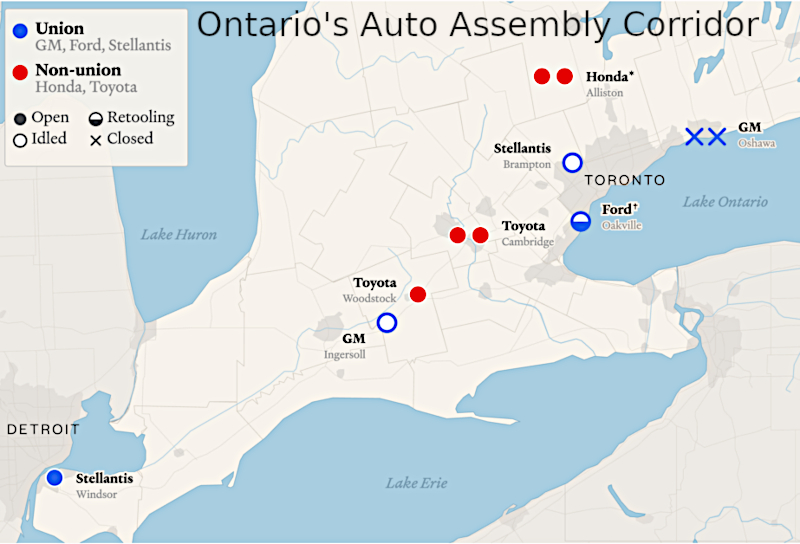
In Canada, the effect of these transformations was long muted by the country’s US trade agreements – a duty-free import quota available to auto makers that agreed to produce in Canada, tying their Canadian sales to their Canadian employment. This type of agreement has been unraveling at a rapid pace since the first Trump administration, when industrial restructuring began to accelerate. From eleven assembly plants in Ontario and one in Quebec during the mid 2000s, employing some 170,000 workers, the industry has shrunk in two decades to 120,000 jobs entirely in Ontario – 65,000 in assembly, 36,000 in parts, and 18,000 in bodies and trailers. Over 90 percent of these vehicles, and 60 percent of these parts, are sold in the United States.
The majority of the decline has been in assembly. The corporate decisions to relocate this final stage of production reflect a larger transformation of the structure of the industry. Whereas nine of Ontario’s eleven assembly plants were owned by the Detroit Three – GM, Ford, and Chrysler – before the global financial crisis, four of these have since closed. At the same time, Toyota has opened two new plants. Since the tariffs began, two additional Detroit Three plants have closed. Thus, while Canada today has seven assembly plants, for the first time ever a majority are non-union.
In February 2026, in response to US tariffs on Canadian vehicles and parts, Canadian Prime Minister Mark Carney announced a new economic program for the auto industry. The program proposes to increase Canadian electric vehicle (EV) production through deductions and credits on corporate taxes, and a $5,000 credit for consumers – with a goal of selling 850,000 electric vehicles in Canada. The consumer credits will not apply to vehicles from countries without a trade agreement with Canada; the proposal comes as the governments of the United States, Mexico, and Canada renegotiate their continental trade agreement.
To analyze the condition of the Canadian auto industry and where it might be headed, Phenomenal World’s Andrew Elrod spoke to Sam Gindin, the former research director for the Canadian Auto Workers (CAW), which in 2014 merged with the Communications, Energy and Paperworkers (CEP) to form Unifor. Gindin is the author of many books including The Canadian Auto Workers (1995) and The Making of Global Capitalism (2012), co-written with Leo Panitch.

Andrew Elrod (AE): There are roughly 130,000 workers employed in auto production in Canada, concentrated in Ontario. Forty thousand of those are across nine assembly plants, another 70,000 in parts-production shops, and a little less than 20,000 in body and trailer plants. How would you describe the economic condition of the industry?
Sam Gindin (SG): The industry and its union are in an existential crisis, facing recently imposed tariffs and American pressures to move facilities to the US as well as a transition to EV’s which the North American companies and the American state have botched and which China now completely dominates.
The recent closures – General Motors in Ingersoll and Stellantis in Brampton – are reflective of longstanding features of the Canadian auto industry. Historically, auto manufacturing was not an industry in which Canada could compete on the basis of free markets. The US industry emerged much earlier and also had much greater economies of scale. Canada’s auto industry was, from its beginning, dependent on a tariff policy.
By the mid-sixties, which was already the sixth round of post-World War II tariff reductions, Canada’s auto industry had become a major economic and political problem. Even with the tariff wall, Canada was running a very high trade deficit, and increasing tariff rates further would have triggered consumer rebellions and reduced sales. Canada needed a solution to prevent a collapse of its currency, and Americans were interested in finding a solution as well – perhaps because they were concerned about Canada introducing, out of necessity, a more radical alternative, and perhaps because of an interest in greater access to Canadian oil.
The solution they found integrated the auto industry across borders. Canadian plants could specialize in certain models which would sell on both sides of the border, and the overall industry would be more competitive against imports from overseas. American companies had to commit to a certain amount of production in Canada – Canadian assemblies had to roughly match Canadian sales.
Companies that met these conditions could remit their duties on cars brought in from the US. The focus was on protection for assembly plants, with the assumption that if we had the assembly plants, we could get jobs also for the parts plants. This at first worked very much in Canada’s favor.
But protectionism for the auto industry was difficult to sustain in the face of growing trade liberalization in both countries. Eventually, pressures to remove the guarantees in this one sector prevailed. Today, there’s an agreement between Canada, the US, and Mexico, which is being renegotiated soon, allowing for duty-free trade across the borders. The agreement applies to all vehicles that have a certain amount of North American content, so foreign-based companies can’t easily step into the free-trade agreement without major production commitments on the continent. But in practice, Mexico has gotten a very large share of the investments in the auto industry, and Canada’s surplus has now turned into a small deficit.
AE: When did the Canadian auto surplus turn into a deficit?
SG: Canada’s surplus was always uneven – we had a surplus in assembly, but we had a deficit in large components. Research and development took place in the United States, and a disproportionate number of the engines and transmissions and stampings were made in the United States.
After NAFTA, Mexico got lower-value manufacturing and we became a middle-technology sector. We got some significant engineering that we would do in components, and overall, we ran a surplus, because to meet the Canadian production minimum the companies weren’t going to build a fraction of a plant. So, we got full-capacity plants that assembled more than the minimum required and sold the surplus into the US market.
That surplus shrank over time, and then became a deficit after the 2008 financial crisis. Since then, there hasn’t been much of an economic case to protect the US from Canadian auto production; the most recent Trump tariffs last year came when the US trade balance in the auto industry was in surplus with Canada by the largest amount it’s ever been. Preliminary data for 2026 have our exports to the US very substantially down. One interesting feature of the most recent wave of Trump tariffs is that, while further damaging the Canadian industry, which was in deficit with the US, it avoided attacking the Mexican industry, which does have large surpluses in auto trade with the US. That’s because Trump is looking for US companies to shift production from Canada to the US. This involves some restructuring costs, but they are not decisive. Since the industry is already integrated, the supply networks are in place and wage standards are roughly comparable, this would be comparatively easy.
Mexico is, however, a different ballgame. Mexican wages are so much lower than in Canada, and the US and the auto companies want the cost advantages of Mexican imports. The magnitude of the wage differential, depending on the exchange rates, is nearly ten to one. As the equivalent of the global South right next door, Mexico gives North American companies like GM, Ford, and Stellantis a way to respond to Asian competition. So, despite having an enormous trade surplus with the US, Mexico hasn’t been impacted much by the Trump trade policy, while Canada is getting hammered despite already being in deficit.
AE: The way I’ve come to understand the continental situation in the auto industry is that there is, in general, overcapacity. Part of this since the eighties has been the growth of the Japanese, Korean, and European companies you just mentioned. But as the industry’s overall capacity has expanded, the consumer market for new cars has plateaued at around 15 or 16 million annual sales for the past decade.
How does the experience in Canada fit into this picture? Did Canada adapt to the rise of imports the way the US did, by setting quotas and requiring foreign companies to build production facilities inside the country?
SG: The simple answer is yes. Competition in the industry leads to the creation of excess capacity, and then as some factories lose out, we get downsizing and job losses. The job losses have been concentrated at GM, Ford, and Chrysler. When I came to work for the Canadian section of the union, for example, General Motors would’ve had about 450,000 unionized autoworkers, both Canadian and American. GM’s UAW/CAW workforce stands today at about 50,000 – a decrease of almost 90 percent.
Some of that is technology, because with the consumer market relatively flat, productivity increases decrease employment. Two percent or a bit higher per year, for example, adds up quickly over time. Some of the job loss was outsourcing – companies contracting major sections of their work to suppliers offshore. But most critical for the Detroit Three has been the loss of market share to the Koreans, the Germans, and especially to the Japanese auto manufacturers, first via imports and then increasingly due to new non-union facilities in the US south.
The UAW has just organized Volkswagen in the US, which has one assembly plant in Chattanooga, Tennessee. They hadn’t organized Toyota, except for a joint venture plant with General Motors in California that closed in 2010.1 The overall industry on the North American continent appears to be healthy because it is receiving investment from Japan and Europe. But this obscures the restructuring and its devastating impact on unionized autoworkers. And as the non-unionized plants became more prominent, they began to set standards for the industry more broadly. That’s very significant. Today, Toyota and Honda are the two top assemblers in Canada. Last year, Toyota alone actually assembled more vehicles than GM, Ford, and Chrysler combined.
It is difficult to appreciate the extent of these changes and their impact on unionized workers. For most people, the auto industry is identified with GM, Ford, and Chrysler, (now Stellantis) with foreign-based companies as secondary. But the growth of the industry in the non-union American south and among companies other than the “Big Three” has transformed the industry in a way that popular consciousness culture has not quite kept up with.
The Japanese-based companies at first went to the US because Reagan had imposed quotas to protect American jobs. These companies didn’t, however, go to where the job losses were occurring, in Detroit and around the Great Lakes, but to the US South. So, in addition to not replacing lost jobs, the new Japanese plants actually competed with the existing industry Reagan claimed to be protecting. This pushed the Canadian government to do much of the same, and over the years, it put a lot of effort and funds, with occasional border threats, into getting a share of the new Japanese investments. But it’s made union workers, in both the US north and Canada, even more insecure and also threatened their standards.
AE: Do you have a recollection of when you came to understand that the non-union parts of the industry were setting the terms for the overall pattern of growth and employment?
SG: We long knew the US south would be a problem for the continent as a whole, particularly with the growth of the Japanese companies. But there were a few particular moments where this became very significant to the industry as a whole. During the deep crisis in the auto industry of the Obama years, GM and Chrysler asked the US government for subsidies, and part of the agreement that was consequently signed stated that the workers could not get higher wages than those paid by Toyota. That is, they explicitly named Toyota as the new standard-setter.
Earlier, in the 1980s, the first time Chrysler declared bankruptcy, Paul Volcker, the Chairman of the US Federal Reserve, was on a board deciding whether Chrysler should receive subsidies to keep it going after its reorganization. Volcker insisted that a condition for subsidies was both wage concessions from the UAW and commitments from Chrysler to outsource more of its work because Chrysler could get parts cheaper this way, both inside and outside of the country. This had an obvious effect in empowering Chrysler and the other automakers in their wage negotiations, as the industry ended up threatening workers with their jobs. This was the US state taking leadership over the auto corporations, sending a message to the employer class as a whole.
In the US, the autoworkers union thought that if the Japanese and European companies had to come here, then US autoworkers wouldn’t be competing with lower wages abroad. Forcing the competitors to produce in the US was thought to remove that advantage. This, of course, implied that the union would organize these new factories. But the union had by then come to focus primarily on wage bargaining, and it was facing a much tougher employer environment more generally. This was the beginning of the long decline and loss of purpose in that union, which culminated in the scandals that brought Shawn Fain to power. Work rules, the pace of work, control over staffing and production were at best secondary union concerns, even though these were critical to why workers joined unions in the first place. This set the stage for the Japanese companies to match union wages and, with the union itself having come to downplay struggles over the work process, this undermined union organizing.
AE: How has the transformation of the industry in the US affected Canada?
SG: The Canadian industry is even more dependent on Asian-based auto assemblers than the US is. For example, GM used to have three assembly plants just in Oshawa, which alongside its component facilities once made it the largest auto complex in North America and perhaps the second largest in the world, after Volkwagen’s complex in Wolfsburg, Germany. It now has one vulnerable assembly plant left in Oshawa. Its Quebec plant is long gone, and its CAMI facility, which was assembling electric vans, recently closed.
Stellantis had a big operation in Brampton, which they also just closed since Trump’s tariffs. So, Stellantis’s assembly operation is now reduced to the plant in Windsor. Ford closed two of its three assembly plants over the years, leaving it with only the Oakville plant, which is in the process of converting into large pickup truck EVs and seems safe for now. We still have significant engine plants at GM (St Catharines) and at Ford (Windsor).
We used to have maybe 80 percent of the parts industry unionized. Today, it is perhaps half that. Unifor has had some success in organizing large component plants. Before the financial crisis, for example, in the course of an organizing drive at a Magna seat plant, with the company carrying out a vicious anti-union campaign, we used our strength at the Chrysler assembly plant receiving the seats to tell Chrysler we would not install the seats unless Magna left workers free to choose who would represent them without the company’s interference. We ultimately got a neutrality letter from Magna stating that it would no longer fight the unionization efforts at that site. Unifor has continued these gains, but not in breaking through at Toyota’s three assembly plants and at Honda’s assembly facility.
One of the changes that has been underdiscussed is the strategic power that used to reside in assembly plants has now shifted to parts producers. This is the result of the outsourcing of work from the companies to independent parts suppliers, often in rural areas, supplying both Japanese and American assemblers. Outsourcing components like seating or breaks also outsources potential bargaining power. One seat plant might, for example, supply five different assembly plants. Shutting down that seat plant would significantly impact the industry.
The non-union sector obviously weakens the unionized sector, but the problem goes deeper than competition in the product market from non-union producers. Canada’s unionization rate is nearly 30 percent – three times as large as the US, yet this doesn’t translate into the Canadian labour movement being that much more dynamic than the unions in the States. It’s the quality of unions, and not just their density, that is decisive. A union movement that isn’t fighting for working conditions is going to have a problem organizing Japanese plants because the Japanese companies can easily equal the wages to maintain control of the workforce. If the unions don’t argue over working conditions, health and safety, and so on, they cannot point to these workplace gains that bring leverage against the employers. These are what win over workers in unorganized plants.
AE: How do you see these different parts of the industry trying to shape the trade negotiations between the governments in the US, Canada, and Mexico?
SG: Corporations in Canada will use the uncertainty arising from Trump’s tariffs in collective bargaining with workers. For example, it gives them an excuse to ask workers to open their collective agreements early and agree to concessions in order to save jobs. This is par for the course for employers, and their promise of job guarantees in exchange for concessions on wages, work rules, and benefits are not to be trusted. For one, corporations can’t promise anything in the present context. For another, they will cut jobs no matter the promises if it serves corporate interests.
The point is not to fall into the trap of trying to solve large issues like tariffs and economic crises through collective bargaining. These demand political responses – a government ready to mobilize Canadians to forcefully challenge Trump in spite of the risks, since giving in will only encourage him. Since Americans are themselves critical of the tariffs and a significant number of American states are concerned with the tariffs and Canada’s response impacting them negatively, Canadian resistance can reinforce resistance within the US, too.
The UAW has an important role to play here. Shawn Fain has been a progressive trade union leader. Fain’s commitment to organizing has put a healthy pressure on Canadian unions. But he supported the tariffs on Canada. Historically, Canadian and American auto workers were always very careful about being played off against each other this way. But Fain got elected on a narrow margin and is wary about the fact that a good number of his membership believe that tariffs protect jobs. In some cases, tariffs can be positive. But to really matter they would have to be combined with far more regulations and serious planning that challenge corporate control over the industry – the failed transition to EV’s is an example. No such regulations or planning is on Trump’s radar. American workers also have the history of the impact of tariffs; it is worth recalling that the end result of Reagan’s quotas, as emphasized earlier, did not help the workers facing job loss (the Japanese companies invested elsewhere) and the new plants ending up undermining standards for all workers.
Something that the union and its workers – not just Unifor but the UAW also – are not confronting is the limits of auto being the job producer it was in the past. Saving existing jobs is, of course, vital. But the industry as a whole is not going to expand much. Let’s go back to EVs: the American companies looked at the short term and tried to delay moving to EVs as long as they possibly could so they could make a fortune off of internal-combustion engine vehicles. And the US federal state, because Trump has been completely supportive of expanding the oil industry, has essentially undermined the shift to EVs. China is not just ahead here but miles and miles ahead. And it’s not just because of lower cost labour. China subsidized research, subsidized consumers buying vehicles that were socially more beneficial, built the recharging infrastructure, and as the industry grew, benefitted from spreading the costs across large volumes – to the point that Chinese EVs are now offered at less than half the price charged for North-American-made EVs.
Trying to save the American-based companies has failed as a strategy. The crucial focus should be how we save the productive capacities the auto companies are rejecting – the machinery, tool and die, the engineering and skills in the components sector – and apply this potential to addressing private and social need. For example, if we are serious about addressing the environment, this will mean changing everything about how we live, work, travel, enjoy leisure – we will have to reconstruct offices and homes, rebuild and expand mass transit infrastructure, modify equipment, radically expand solar and wind power. If we take all this on, we’ll find that we actually have a labour shortage.
AE: Would a former internal-combustion engine auto plant provide a basis for producing this great variety of new energy products and materials that you’re talking about?
AG: During COVID, General Motors produced masks at a Michigan assembly plant because they didn’t have enough masks for their own employees, not because of some concern about everybody else. The equipment and skills in assembly plants might not be the best place to make mass transit vehicles, but converting a factory making warplanes might. And, if converted to addressing energy systems and the environment, military equipment and technological expertise offer important fits. In auto, the conversion to EVs is one waiting project, but the larger question is: what do we need? Can we meet those needs in existing facilities? Can those facilities and their machinery, tooling, engineering, management expertise be adapted as they have been throughout history? And, if not, can we build new facilities that can meet those needs and are located in communities where they can employ workers otherwise threatened by job loss?
There is a social value to repurposing our existing infrastructure toward new aims. In every community there should be hopes of engineers who can convert infrastructure to suit the changing needs of those communities. There are all kinds of things that people need or that could replace imports or that could be used for the environment. Every municipality has projects that they want to run that are sitting on their shelf. We need to be asking ourselves whether the facilities can be adjusted and people trained to support changing needs.
If we don’t seriously take on such questions, restructuring will continue to take place in an undemocratic, unplanned way geared toward profit maximization.
AE: You said that this is ultimately a political question, but the kind of politics that would involve converting existing manufacturing facilities into alternative uses seems like a very different kind of politics than where we began this conversation – about what the Canadian government can do vis-à-vis the United States in terms of trade negotiations.
SG: The kind of politics that has to be developed in the Canadian case is to say: we tied our wagon to the United States because it was the dominant power, but there has been a cost to that. That cost is becoming evident. The problem isn’t tariffs; the problem is that the Americans can do whatever they want to intimidate Canada. Canada has to reduce this dependence. What will its manufacturing industry produce to facilitate this? That question forces us to think about how to restructure our industries to serve other needs and other markets. So, the two things are related.
But this demands building a social force that can fight to make good ideas a reality. The problem isn’t primarily developing good policies but an alternative politics. What happens in the absence of that alternative is the politics of Carney. A liberal central banker, Carney has a sense of the importance of responding to this dependence in some way. But his alternative is to go whole hog on exporting our raw materials. His program for independence is to support and build up our oil exports. His position on manufacturing is that we have to subsidize purchases of EVs. But if China’s offering a $22,000 EV and North America is offering $50,000 one, consumers are going to import it if they can.
This means you need a policy for domestic EV manufacturing. But this gets complicated if you lack the technology. Canada has just agreed to let 50,000 EVs in. It’s nice to have 50,000 EVs as a gesture, but it’s a tiny part of the market and doesn’t address our capacity to make things here. They could demand that the Chinese build in Canada in order to sell to the Canadian market, but even then, we would still not reach those economies of scale. These are difficult questions, but ignoring them or being overwhelmed by them is giving up.
AE: Presumably the Chinese firms would want to be able to sell into the US consumer market.
SG: That would be the first thing that China would say. The first thing the Americans would say is if Canada’s making a deal with China to ship cars into the US, we’re gonna put a hundred percent, two-hundred percent tariff on it, or we’ll just ban it. Trump could have come to office and immediately said that: we want TVs, China’s making them, we want them to make them here. If China comes and makes them here, we’re happy. If they don’t, we’ll keep them out.
AE: Which is what Reagan did.
SG: Which is what Reagan did with the Japanese. But what kind of a Chinese company would risk coming to the United States and investing a billion dollars? The politics is crucial because, when you’re thinking small, you’re always stuck. You’re defensive. If you don’t actually act at some moment so that you can start changing your options, nothing happens.
AE: The last time Trump was president, the orientation of the Canadian government to China seemed to be very different than it is today. How do you interpret Carney’s trip to China and the changes underway?
SG: What Carney really wants, above all is to go back to the old status quo. He is resisting Trump because of obvious economic interest and popular pressures. His nationalism is quite politically appealing, and he is using it to his advantage. He is not, however, truly challenging the politics that Trump stands for, or the structure of the Canadian economy. Ultimately, we do not want to be dependent on the US or China. But Carney is walking a delicate line that doesn’t challenge key aspects of these economic relationships, in part because of how reliant on the US we really are.
Part of the deal with China getting 50,000 or so EVs to come into Canada was that China would import more agricultural products from Canada. It was a gain for the farmers who were selling those agricultural products. And the Canadian auto workers thought that letting in the 50,000 vehicles was a loss. Those kinds of divisions certainly exist. You are always dealing with competition between farmers in the agricultural sector because there are all kinds of subsidy programs on both sides of the US-Canada border.
But everything is more complicated than it appears. Farmers in the US are finding out that some of the components that they need, equipment or components for equipment, is costing more. They’re starting to lose their market. So, Trump is having a lot of problems in the rural areas because just protectionism isn’t enough – you have to really think about how you restructure rural life in the US, which has been in crisis for decades.
AE: While China can provide a consumer market for Canadian agriculture, it doesn’t seem like it will be a major consumer of Canadian automobiles.
SG: Yes, and Canada is still part of NATO. The Cold War mindset is still there, and we would prefer to have an ally next door. So, the government is just hoping that Trump goes away and is catering to nationalist sentiments in the meantime. They are also tripling our defense spending. Who is going to pay for that? Down the line, we are headed for a big deficit driven by defense spending that will trigger cuts to other parts of the public budget. Canada can’t just increase its deficits without harming the Canadian dollar and having to increase interest rates to borrow, the way the US can. Ultimately, workers will pay for this.
We cannot just be responding moment by moment – we need a broader and more long-term vision. What was so striking about the 1960s was that the mood in society generally had a major impact on what was happening in the plants. With the Civil Rights Movement and the events of 1968, there was a sense of a broader political fight that challenged authority. This encouraged people in the auto plants. So, the external climate is very important, and at the moment, it does not seem to be there.
AE: What would you say to someone who argued that, in the upheavals of the sixties and seventies, it was the weakening of company discipline that promoted companies to restructure and outsource labour?
SG: I would be impressed that they asked that question, which is a very good one. One of the lessons from the sixties is that popular militancy is necessary, but it is not enough. We need to have a labour movement that asks: why do corporations have the right to move these plants in the first place? Why does democracy stop at the door of corporate property?
If you’re not ready to ask those larger questions, the result is the restructuring we saw in the late 70s and 80s. People eventually become exhausted of the militancy, allowing the state to step in under other leadership – in that case, neoliberalism. When Leo Panitch and I worked on The Making of Global Capitalism, we interviewed the head of General Motors North America and asked him why they remained silent when Volcker raised interest rates to 18 percent. The Volcker shock meant that people stopped buying cars, because they couldn’t buy them on credit. It had profoundly injured the industry. He said they didn’t object because they learned it was necessary.
What he meant was that there was a crisis which had to be solved. And if breaking the labour movement required a period of pain for the firms, they were ready to take it, because it was a solution in permanently breaking workers’ expectations of constant improvements. So, we should admire the militancy of the 1960s – and recognize that it wasn’t enough. If we are not joining with workers around the world to ask who gets to make economic decisions and why, we will always be left on our back feet. The whole point of class politics is to broaden our choices for action.
Today, we are in a political moment in which capitalism is facing a deep crisis of legitimation. People don’t trust governments, they don’t trust political parties, they don’t trust political institutions at all. The challenge this poses is first to appreciate that this is a moment of polarized options; the middle ground has failed. Second, to channel this into organizing and building a social force up to the task. These are intimidating but absolutely essential. •