
Feminist Economy as a “Cure” for War
“The government fears alternative economic models and suppresses them by attacking women’s bodies.” Marcella Corsi, Professor of Political Economy at La Sapienza University in Rome, one of the founders of the magazine inGenere.it and president of the International Association for Feminist Economics (IAFFE), explains the reasons behind the 8 March feminist strike and related mobilisations across Italy.
Il Manifesto (IM): Why call this strike feminist?
Marcella Corsi (MC): We need to remember that 8 March (International Women’s Day) arose from a popular movement, led by women, in various parts of the world. It isn’t a festival; it is a demand for women’s rights, in particular, for working women. Strike as a tactic is more necessary than even today in the face of the frontal attack on these rights. Just consider what happened in Italy with the failure to pass mandatory paternity leave or the Bongiorno bill on rape, which ended up focusing on dissent rather than consent. The example of Iceland, where the high-profile women’s strikes in 1975 and 2023 led to significant reforms, shows that women’s work – which is often invisible – can actually bring a country to a standstill. This work must be given the recognition it deserves.
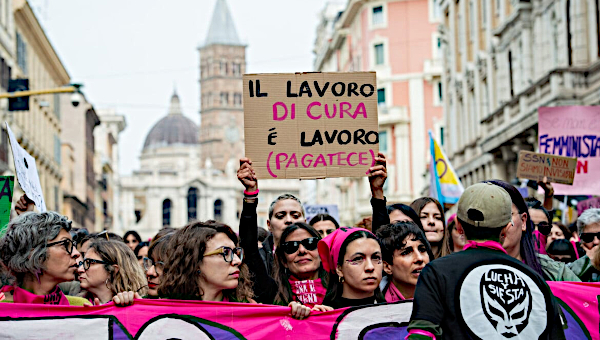
IM: Abroad, too, the situation is troubling. The issue of militarism is a central theme in the call for the strike.
MC: Because wars and crises are part of the logic of capitalism, which is a system of production based on exploitation and inequality. It is a system of power wielded by the few against the many. Conflicts, such as those we see today, serve to maintain the status quo and pursue new avenues of profit. One might even be surprised at how long we’ve managed to live in peace, if that’s what it is. But peace was achieved through international law – the very law that is now being trampled upon by the right. To achieve peace, it is essential to adopt an alternative economic paradigm, such as that proposed by feminist economics, based on mutualistic relationships and on care understood as a different way of viewing human relationships – as a “concern for the world” as a whole.
IM: In recent years, governments and transnational organisations have portrayed the war economy as inevitable.
MC: There are various examples of feminist economics around the world, from South America to India, which confirm that a different approach to the economy is possible. I have just returned from Argentina, where I met with women’s cooperatives active in the outlying neighbourhoods of Buenos Aires, involving women who are facing severe economic and social hardship. One would expect to find a purely conflict-driven dynamic, where people compete for the few available resources; instead, the women have organized themselves to manage community services, such as waste collection, while also finding a source of income. These are forms of mutual aid-based economy that emerge from the grassroots but need to be supported by institutions. The state must play a proactive role that enables a different model of human interaction based on care.
IM: Would experiences like these be possible in Italy?
MC: Of course, and there have been some. But there are two intertwined issues: the lack of social spaces and repression. Alternative social and economic models can only emerge if there are spaces in which to run them. In Italy, there is a lack of places where people can meet and organise. The right-wing attacks on social centres – most recently Leoncavallo in Milan, Askatasuna in Turin, and Spin Lab in Rome – as well as those on neighbourhood committees, such as Quarticciolo in the capital, or the Caivano decree, are making the situation worse. The Meloni government is trying to portray these evictions as a crackdown on illegality, but the people who have lived with these communities for decades – using community gyms, family support services and food banks during the pandemic – know full well that these are not hotbeds of criminal activity but places of well-being. Even the security decrees targeting dissent are part of this plan and prove that the right-wing is afraid of these forms of alternative economy. They know they are possible but that they certainly do not fit into capitalist or neoliberal logic.
IM: Several trade unions also joined the trans-feminist strike, particularly those in the education and knowledge sectors and the service sector. This is no coincidence.
MC: These are the sectors with the highest concentration of women: education has always been one, partly due to educational segregation. They are also the sectors that have been hit hardest by the policy decisions of recent decades. Research and schools have come under heavy attack from this government and didn’t receive much support from previous ones. The service sector is still feeling the repercussions of the pandemic. The jobs that have been created in the meantime are mainly precarious and hyper-feminised, in the sense that they are not decent. So, they have every reason to strike and to do so on 8 March. •
Originally published in Italian in the independent Italian daily Il Manifesto. English translation by Eric Canepa.