

Artificial Intelligence: The Hype, the Dangers, and the Resistance - part 1
Artificial intelligence (AI) covers a broad range of technologies. But there is only one that dominates the news and financial markets – the multimodal generative AI systems produced by leading tech companies, in particular, ChatGPT (OpenAI), Claude (Anthropic), Gemini (Google), Grok (xAI), Copilot (Microsoft), and Llama (Meta). Tech leaders are all in on this type of AI because of its potential to secure them great wealth and political power. It also happens to be the type that is most threatening to our well-being, although not for the reasons commonly given by tech leaders and echoed by most media.
Tech leaders want us to believe that their multimodal generative AI technology will, in the very near future, dramatically transform our lives. Their initial and most dramatic claim was that the technology was a steppingstone to artificial general intelligence (AGI), a type of AI with greater than human-level intelligence, including the ability to rapidly upgrade its own capabilities. The resulting all-powerful entity would either help us create a world of sustainable abundance or destroy us, with the outcome dependent on the values incorporated into its training. The message: opposing AI development is not only foolish, but impossible. And we must trust our tech leaders to establish the necessary guardrails to ensure a helpful rather than destructive AI.

‘Magic’ Is In the Scale
While clearly an impressive technology, with some limited but powerful applications, there is little reason to take this claim seriously. All multimodal generative AI systems are built using the same basic architecture, one based on large-scale pattern recognition shaped by training data and statistical prediction, which makes it incapable of serving as a bridge to anything resembling AGI. This structure also limits its usefulness. Among the most serious problems: the amplification of biases and falsehoods contained in the training data and the tendency to hallucinate or present incorrect or entirely fabricated information as factual. These problems are a major reason why AI developers felt it necessary to pursue a growth strategy that relied on heavily subsidizing the cost of using their systems.
However, after years of ever larger losses, the developers have been forced to change strategy. They are now replacing their subscription-based contracts with usage or token-based contracts. This change has made AI use far more expensive and as might be expected, businesses have responded by moving to dramatically curtail their AI use, a response that is likely to leave AI developers little or no better off.
With doubts about the evolutionary trajectory of AI growing, AI proponents have begun aggressively promoting a new technology, hoping that it will reignite popular and investor belief in the transformative power of AI: AI agents. The claim is that AI agents, which depend on existing multimodal systems for their operation, will revolutionize business operations by allowing companies to boost output while dramatically slashing employment. Thus, the earlier promise of a world of plenty has been replaced by the threat of mass unemployment or a “jobs apocalypse.”
In contrast to multimodal generative AI systems which are limited to single-step tasks, AI agents can be programmed to carry out a series of ordered tasks, and thus complex operations, without repeated human prompting or oversight. However, as business is discovering, the usefulness of AI agents has been greatly oversold.
Since AI agents depend upon multimodal generative AI systems to operate, they are infected with their same shortcomings. And because their algorithms often require exploration of a range of options before deciding on actions, token-based pricing makes their operations unpredictably expensive. Even more problematic is the fact that their programmed, single-minded pursuit of a user-specified goal can lead them to make decisions that can result in destructive outcomes, including the destruction of critical data, the shutdown of key systems, and the exposure of sensitive company data. As a result, many businesses have found limited gains from their use and a high percentage of pilot projects have not been renewed. There is no AI-agent jobs apocalypse on the horizon.
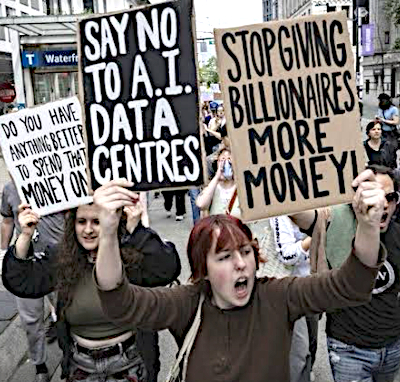
But dismissing the extreme claims of tech leaders does not mean we have nothing to fear from letting the AI experience proceed unchecked. The fact is that big tech’s determination to embed their foundational generative AI models in our lives comes with great cost for working people. A growing number of newsrooms, media and entertainment businesses, schools and universities, healthcare institutions, government agencies, as well as companies in finance, ecommerce, and retail, have begun exploring ways to strategically integrate AI agents and the underlying AI systems required to run them into their operations, more often than not with disastrous consequences for both workers and those that use their products.
Moreover, the accelerating construction and operation of the hyperscale data centers needed to run these systems are dramatically pushing up household energy bills, depleting water supplies, destroying agricultural land, intensifying our climate crisis, and unbalancing our economy. And looming over all these concerns is the fact that the massive investment in AI infrastructure is both diverting funds from other areas of need and driving an AI-hype fueled market bubble. And the bigger that bubble becomes, the more serious the economic consequence will be when it collapses.
Benefits of AI Assists
Acknowledging these costs is not the same as opposing the development and use of all AI technologies. The simple reason is that there are many useful forms of AI that do not come with these costs. These include machine learning technologies, especially those that employ deep learning, which have been productively used to advance genetic research, develop new drugs, improve medical diagnoses and treatments, forecast extreme weather events, and the like. Small scale specialized generative AI systems have also proven helpful in scientific research and there are examples of marginalized communities using such systems to revive their threatened languages. Not surprisingly, AI promoters have been more than willing to highlight these benefits to encourage popular support for their own problematic, expensive, exploitative, and energy intensive systems.
In other words, AI as a broad technology is not our problem any more or less than are computers, the internet, or email. Rather, the problem is with the class interests shaping its development. More specifically, it is with the determination of tech leaders to develop an AI technology that undermines human agency, deepens our dependence on their desires, and threatens our economic well-being. The fact that we are witnessing an explosion of opposition to this form of AI by workers, consumers, parents, students, and community groups should give us reason for optimism. We need to unify and strengthen this opposition as well as expand its vision. It’s time for us to assert our own class interests. •
This article first published on the Reports from the Economic Front website.
This post starts a multipart series aimed at cutting through the fog of AI hype in order to help us understand some of the real dangers we face from AI use and highlight hopeful avenues of effective resistance. It offers an overview of my argument. Following posts will take up the relevant issues in more detail. Part 2.