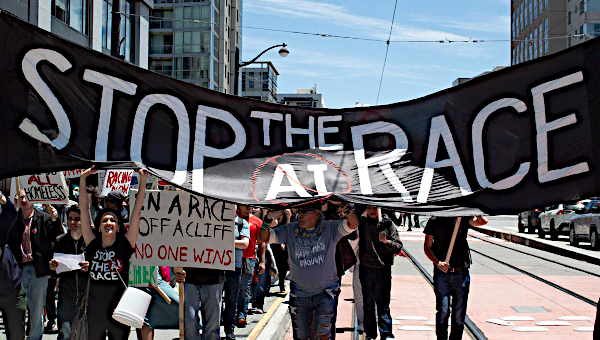

AI and the Class Struggle
The notion that so-called Artificial Intelligence (AI) technologies are destined to degrade human labour, if not destroy it altogether, has become a commonplace. In a report published in 2023, Goldman Sachs even claimed that 300 million jobs could disappear in the coming years!
One might well doubt the scenario of widespread automation put forward by these investment banks. It is even refuted by (real) economists and by the capitalists themselves, when they are among themselves. Since the early 2000s, the number of jobs worldwide has been rising, and productivity gains have been falling, despite the digital revolution. Why? Because capitalism devalues labour.
Through a series of structural reforms and employer harassment, humans always end up costing less than machines. And indeed, in the textile industry, for example, human labour has not been eliminated – far from it; it has been relocated to countries where labour is cheap and factories are barely automated, such as Bangladesh.
Obviously, the arrival of ChatGPT and the like is disrupting different professions, particularly among the rank-and-file workers in the service sector, and protective measures must be put in place. But one need not know anything about the work of a secretary, a web developer, or a receptionist to claim that they are replaceable, that humans are useless.

Disrupting Technology
“The truth is that the bourgeoisie is at war with workers; AI serves above all as a pretext – and a tool – to drive us into a corner.”
For example, Optifye.ai recently launched an AI system for industry that films workers, compares their productivity in real time, and generates automatic reports to put further pressure on them.
The Optifye.ai case is striking, but it may also be misleading. One could argue, not without grounds, that AI actually diminishes Taylorist constraint for those who use it: the secretary who once had to transcribe dictation by hand, the programmer who had to remember every API, the analyst buried under routine queries… for them, the new tools genuinely expand what is possible in a working day. Alienation lies elsewhere: in what this discourse conceals.
For the real assembly line of AI is not where its outputs are consumed, but where its inputs are produced. The sociologist Antonio Casilli, whose recent work has focused precisely on these hidden workers, has shown that the development of AI systems rests on the labour of what he calls data workers. Annotation, content filtering, reinforcement learning from human feedback: these tasks, which allow models to become usable, are performed by a global workforce numbering in the hundreds of millions, according to the World Bank. They work through micro-task platforms, paid by the piece, often for a few cents per task, with no contract and no recourse.
Casilli and his colleagues have documented these workers in Kenya, the Philippines, Venezuela, Madagascar – countries chosen not for their digital infrastructure but for the cheapness of their labour. In his 2025 documentary Les sacrifiés de l’IA, he shows that this workforce is not a marginal feature of the AI economy but its structural condition: the spectacular autonomy of the machine is, in fact, continuously produced and maintained by precarious human labour rendered invisible by design. The big names of AI actively obscure this dependency, classifying data-worker expenditure as infrastructure costs rather than wages, a legal fiction that prevents collective bargaining and conceals the true scale of the workforce.
Deepening and Extending of Taylorism
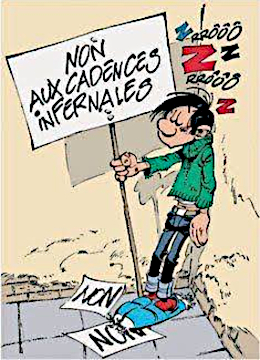
What emerges, then, is not the end of Taylorism but its displacement and deepening. The cadences infernales [speedup] have not disappeared; they have migrated, geographically and juridically, to where workers have the least protection. The AI that frees office workers, programmers, analysts, and other knowledge workers in Paris or San Francisco is manufactured, in part, by click-workers in Nairobi or Manila who have never heard of them.
The autonomy of AI is, in the strict sense, an ideological effect. What presents itself as a self-operating intelligence (generating, deciding, predicting) is, in fact, the crystallised product of an enormous quantity of human labour: the labour of those who labelled the data, the labour of those who wrote the texts from which the models learned, the labour of those who rated the outputs to make them palatable. The machine does not think; it compresses and redistributes what workers have already thought, written, and judged.
“What is called intelligence is intelligent indeed, because it is the accumulated labour of millions, laundered through a statistical process and handed back to us as the product of no one in particular.”
Yet this mystification contains, despite itself, a material truth. For the first time in history, the productive forces of intellectual labour have been socialised on a planetary scale. The corpus on which these models are trained is not the property of any individual or firm; it is the sediment of centuries of collective human thought, science, literature, technical knowledge, and ordinary language. Capital did not produce this; it expropriated it. And expropriation on this scale carries a contradiction it cannot resolve. The more powerful the model, the wider the base of social labour is required; the wider that base, the more glaring the narrowness of the property relations through which its product is captured and sold back.
A handful of corporations now hold, behind API paywalls and commercial licences, what is, in substance, the crystallised intelligence of humanity as a whole. This is not an anomaly of the digital economy; it is the fundamental contradiction of capitalism stated in its sharpest contemporary form: the forces of production have become irreversibly collective; the relations of production remain stubbornly private. The question this raises is not whether AI can be useful to workers – it evidently can – but whether the expropriation it embodies can itself be expropriated. Socialised production, collectively owned and democratically governed: this is not a utopia projected onto new technology; it is the demand that the technology’s own conditions of existence make inescapable.
So, what can be done? Fight back, of course! If there are any ‘jobs’ we could well do without, they are those of boss, trader, or minister in the Fifth Republic [and indeed similar positions in states around the world]. The ruling class has long consolidated and justified its power through access to information: those who know, who have understood, versus those who have only their hands to live by. And indeed, AI was designed to facilitate the processing of information flow: written queries, documents, real-time data feeds, and so on. What does Bernard Arnault [CEO of LVMH, the world’s largest luxury goods company] do that a piece of software would be incapable of doing? It is not clear. It is undoubtedly time for workers to manage public life themselves, including the economy and businesses, and they can rely on AI to do so. •
This article first published on the Transform! Europe website.