

Stella and Michel – A Revolutionary Love Story
My mother-in-law was a big reader and bought most of her books second-hand at the local Salvation Army for $.25 to $1.00 each. Over the decades she amassed a huge library. She kept a journal with brief notations about each book: whether she liked it or not, its main theme, and details about the author, with quotes or salient points from the book. She was always generous, offering to the family any book we wished to read. When we visited her, I usually came home with a handful.
One of the books I ended up with was War of the Classes by Jack London, first published in 1905 by Macmillan, but this edition was from April of 1912. It was hardbound, as were all books at that time. (The first mass paperback was Pearl Buck’s The Good Earth, published in 1935.) As its last chapter, War of the Classes contains London’s famous essay “How I Became a Socialist.”
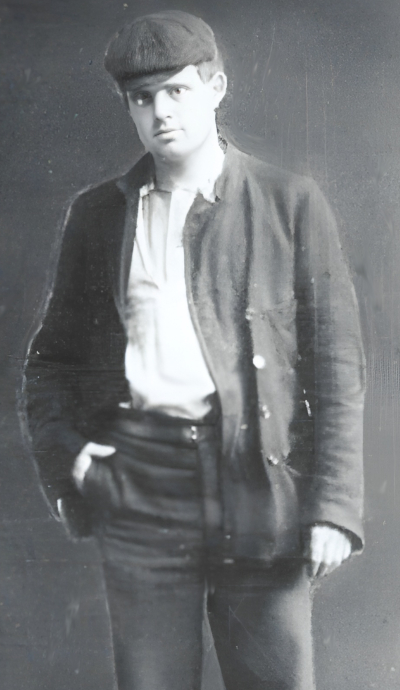
I read the book, and it’s especially interesting since London became a socialist by way of the hard life he led. At thirteen, he was working twelve to eighteen hours a day in a cannery. At seventeen, he signed on as a sailor on a sealing schooner to Japan. When he returned, the country was in the depression of 1893, and Jack joined a protest march to DC called Coxey’s Army, which demanded jobs, and effectively, made Jack a tramp. He spent thirty days in a penitentiary in New York for vagrancy.
Making of a Socialist
These experiences in the working class made Jack a radical. In 1896, he joined the Socialist Labor Party of Daniel De Leon. (Later, De Leon was also one of the founders of the Industrial Workers of the World.) Jack traveled north for the Klondike Gold Rush in the Yukon in 1897. He was a huge animal rights advocate, and his experience in the Yukon became the context for some of his most famous animal adventure stories: Call of the Wild and White Fang. In 1901, Jack left the Socialist Labor Party and joined the Socialist Party of Eugene V. Debs. Reading London’s political works, and even his animal stories, I’ve always detected in his work an element of social Darwinism – survival of the fittest applied to human society, first noted by George Orwell, by the way. Nevertheless, London was an innovator of hard-to-put-down, gripping tales that would make your palms sweat.
Out of curiosity I perused eBay and antiquarian book sites to see if the book was worth anything. The 1905 edition in good condition is worth several hundred dollars; not so much the later editions. But there’s something else about this book that would make it basically worthless to a collector. There are handwritten inscriptions on the outside of the front and back covers, on the title page, and on the last page. Now, if these were made by Jack London, that would make the book invaluable. But instead, they were made by an anonymous man to a woman he appeared to admire.
As I thought about this, I wondered why a man would give a book called War of the Classes to a potential sweetheart. I decided he wouldn’t, unless both of them had an interest in the content and were themselves socialists of some stripe. So, I looked closer at what I had.
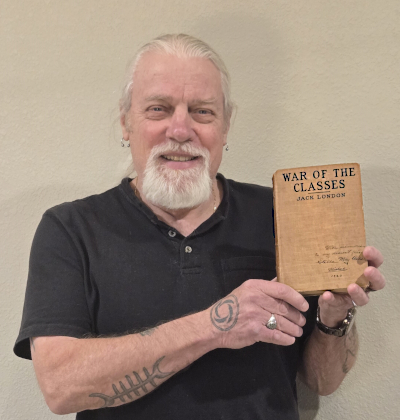
The cover is inscribed in a beautiful cursive script, reading, “With memories to my dearest friend Stella May Asher.” It was signed “Michel,” and dated “1923.”
The signature on the last page, in the same hand as the inscriptions, was “M. P. Isakovich,” which struck me as possibly a Russian name. So, I hypothesized that perhaps there was a political connection to the Russian Revolution.
The back cover was completely inscribed, in the same cursive hand, with a poem called “The Mood” by “Douglas Maloch [sic].” Malloch (1877-1938) was a working-class poet from Michigan who grew up working in the lumber industry as a lumberjack and a sawyer, and was eventually an editor of The American Lumberman trade paper. He was known as “Brother Malloch,” perhaps referencing trade unionism, and he was also known as “the lumberman’s poet.” His most famous poem is “Be the Best of Whatever You Are,” which still turns up today in inspirational contexts. I can’t find his poem “The Mood” online, but I was able to transcribe the text from Michel’s handwriting. Here is the text of the poem:
The Mood
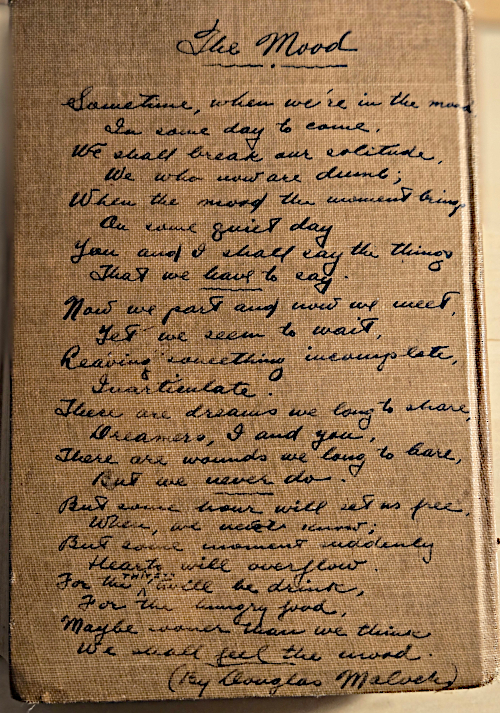
Sometime, when we’re in the mood,
In some day to come,
We shall break our solitude,
We who now are dumb;

When the mood the moment brings
On some quiet day,
You and I shall say the things
That we have to say.

Now we part and now we meet,
Yet we seem to wait,
Leaving something incomplete,
Inarticulate.

There are dreams we long to share,
Dreamers, I and you,
There are wounds we long to bare,
But we never do.

But some hour will set us free,
Where, we never know,
But some moment suddenly
Hearts will overflow.

For the thirsty will be drink,
For the hungry food.
Maybe sooner than we think,
We shall feel the mood.
From this lovely message to Stella, it seemed clear to me that Michel was in love with Stella but had not yet told her. The provenance of this wayward book had now become a political mystery and a love story.
Just to further underscore the politics of Michel, on the inside front cover of the book was pasted a newspaper clipping with the final two paragraphs of an article by the editor of the Weekly People. The Weekly People was the official organ of the Socialist Labor Party from 1900 until 1979. The Socialist Labor Party was the first socialist organization that Jack London joined until he later joined the Socialist Party. This must have left the Socialist Labor Party disappointed or even bitter to lose someone like London who was famous. Eventually, Jack also resigned from the Socialist Party.
In the article pasted in the front of the book, the editor of The Weekly People, with some obvious and snarky glee, as if to say I told you so, Jack, quotes from London’s scathing resignation letter from the Socialist Party in 1916. London died later that year which is why the editor refers to him as “the late Jack London.” Here is the editor’s comment along with the quote from London:
In conclusion permit us to quote a passage from a letter by the late Jack London (his resignation from the compromising Socialist party [sic]), wherein he expresses with felicitous phrase a thought we would convey to you:
“My final word is that liberty, freedom and independence are royal things that cannot be presented to, nor thrust upon, races or classes. If races and classes cannot rise up by their strength of brain and brawn, wrest from the world liberty, freedom and independence, they never in time can come to these royal possessions … and if such royal things are kindly presented to them by superior individuals, on silver platters, they will know not what to do with them, and will be just what they have always been in the past … inferior races and inferior classes.”
Fraternally yours,
Editor
WEEKLY PEOPLE.
There’s that hint of social Darwinism again in Jack’s statement, but it’s also redolent of the famous dictum against substitutionism attributed to Marx and Engels, “the emancipation of the workers must be the task of the working class itself.”
All of this was fascinating to me, but it was the tentative love affair of Michel and Stella that captured my imagination. So, I decided to see what I could find out about them, if anything, on the internet. I was able to draw on skills I had developed researching my family genealogy. Nothing came up initially for Michel. But I got a hit for Stella May Asher on Ancestry. She was born on January 16th, 1899, in Mglin, Ukraine. Closer research indicated that Mglin is actually in Russia, near the Ukrainian border. Stella died on August 7th, 2004 in King County, Washington. She lived to 104!
Ancestry also indicated that she had married Michel Propal, who was also born in Mglin in 1891, and died in 1968. They had one child, Sonia “Sonny” Propal, eventually Sonny Fisher, who was born in Elyria, Ohio, near Cleveland, in 1929, and died in 2012.
I was ecstatic. This had only taken five minutes to discover. And with Sonny’s information, I was quickly able to find her obituary with her surviving family listed. But the great unknown was this: Was Michel Propal the same Michel or “M. P. Isakovich” from the book? Did the “P” stand for Propal? And could it be that, if this was indeed the correct Michel, he had dropped the Russian surname when he emigrated to the United States?
My instincts told me it had to be the same two lovers, but the only way to find out for sure was to contact a descendant and ask. I had already decided that if I found Stella and Michel’s grandchildren, I would offer the book to the family. It was worthless on eBay, but in my humble opinion, it would probably be invaluable to their family. It’s what I would want if someone found something as revealing about my grandparents.
Sonny’s obituary indicated she attended Stanford and the University of Illinois and earned an MA in Guidance and Counselling. She moved to the Seattle area in 1968 and had a distinguished career as a school psychologist. She was a musician and an extraordinary pianist. And she had two sons.
I found both sons on LinkedIn. One was a retired physician in Tennessee; the other was a retired systems engineer at Bell Labs. The hard part was finding working phone numbers for them online, but I got lucky on my first attempt when Dana Fisher, the engineer, answered the phone.
Given all the spam calls we receive daily, most people are reticent to even pick up a call from an unknown number. But I had reached a landline, and I figured I had about thirty seconds to explain myself well enough to prevent him from hanging up on what could easily be interpreted as a scam. I quickly mentioned Michel and Stella’s names and told him who I was and why I was calling about the book, and Mr. Fisher was both extremely interested and flabbergasted.
Who Is Michel Propal?
He confirmed right away that M. P. Isakovich was indeed Michel Propal. He asked me to spell “Michel” because I was pronouncing it as if it were French, that is, me-SHELL. He told me that it was pronounced differently by the family, that is, something like MICK-ull. (My later research discovered that in Russian, there are two versions of Michel: one is Mikail, pronounced roughly as mee-kha-EEL; the other is Maykl, pronounced MAY-kl, similar to the American pronunciation of Michael, except with an “a” sound in the first stressed syllable. This latter version is the closest to Dana’s memory of the correct pronunciation.)
We must have talked the better part of an hour as I described the book I had, and he told me the love story behind it. Complete strangers, but both of us were enthralled with this story.
Dana’s grandparents were from the same town, Mglin, but being several years apart in age and from different social classes – he was working class, she was upper class – they did not know each other. They emigrated to the US separately, with Michel arriving in 1910, and they met later in Russian émigré circles. He said her family would not have been happy about the relationship across classes.
I was leery about what Dana’s reaction might be to my theory that his grandparents were socialists, but he quickly confirmed that they were. He described them as idealistic about what’s possible, whereas he is more realistic. Fair enough. But the current prejudice against socialism did not in any way affect his love for his grandparents as he regaled me with stories of driving with his family from Chicago to visit them in Cleveland. He said they were fervent members of the Socialist Labor Party, the party of Daniel De Leon and Jack London, and he attended party picnics and other social events with them as a child. He noted that they all called each other “comrade.” His grandmother served on what he called the Central Committee of the organization several times.
I asked Dana if there were any indication that they might have been involved in revolutionary activity in Russia before they emigrated. He said they were certainly aware of the impending situation but not actively involved to his knowledge. Michel had left seven years before the 1917 revolution.
Dana told me that one day, when he was a young boy, he mentioned to his grandfather that he liked money, and Michel raised his index finger, as he often did when he had something important to say, and said, “I believe one day there will be no need for money.” His grandson asked him why, and he replied, “Because people will willingly work for each other.”
Dana explained that Michel did give up his surname, Isakovich, but not at Ellis Island. And he said he thought that Propal was a name that Michel had invented, and he thought that maybe it meant something like “lost” in Russian. (Google AI says that “propal” is a Russian word meaning “fell” or “dropped.” Close enough.) Dana said that Michel never applied for US citizenship, saying that he did not believe in the concept of separate nationalities, so that once a year, Michel had to go to the post office and declare himself a resident alien.
Dana said that when his mother died – Stella and Michel’s daughter Sonny – there was a letter found in a grandfather clock that Sonny had inherited from her mother Stella. It was from Michel’s family members in Russia written in 1935. Dana had it translated. In the letter, they urged Michel to return to Russia with his wife and child. They said they had a good apartment with plenty of room, and they could live there with them. He said the letter sounded as if it had been written to pass muster with censors. This would have been at the time of the party purges and murders when Stalin was consolidating his power. The Socialist Labor Party was anti-Stalinist and argued that Stalin was a dictator who had betrayed the ideals of socialism and the Russian Revolution, and that the USSR was not socialist, it was a form of state-run capitalism.
I asked Dana if perhaps the entreaty to return was a cover to get the letter safely out of the country while also letting Michel know the family was alive and well. He allowed as how that may have been the case and noted that if they had returned, they would have probably been viewed as spies, and he, Dana and his brother, would probably not be here today.
He also confirmed that Stella and Michel married in 1928, a year before his mother was born. That would mean that when Michel gave the book to Stella in 1923, they were still just friends, with Michel, and likely Stella, hoping for so much more. I’m so glad they got it, leaving a happy ending to my little quest to know who the mysterious and unlikely Stella and Michel really were. Dana was kind enough to send me digital copies of portraits of his grandparents who were both very handsome and impressive figures.
I mailed the book to Dana Fisher, which seemed to me to be a good ending to this revolutionary love story.
Or so I thought.
Several months after sending Dana the book, my partner Sue and I were talking on the phone to an old friend from Seattle who lives in Florida today. Marie is a fascinating person who never ceases to amaze me with stories of her travels and her life. I remembered that years ago she had told me her father had been a socialist, and she had relatives who were members of the Socialist Labor Party. I told her I had a story about the party, and with her permission, I started reading her this essay about Michel and Stella over the phone. Early into the essay, Marie exclaimed in surprise, “I knew Stella!”
“What?” I said in amazement.
“I knew Stella and Sonny when I lived in Seattle!” Marie shouted. She was practically sputtering in excitement at this revelation. Marie then calmly related her story.
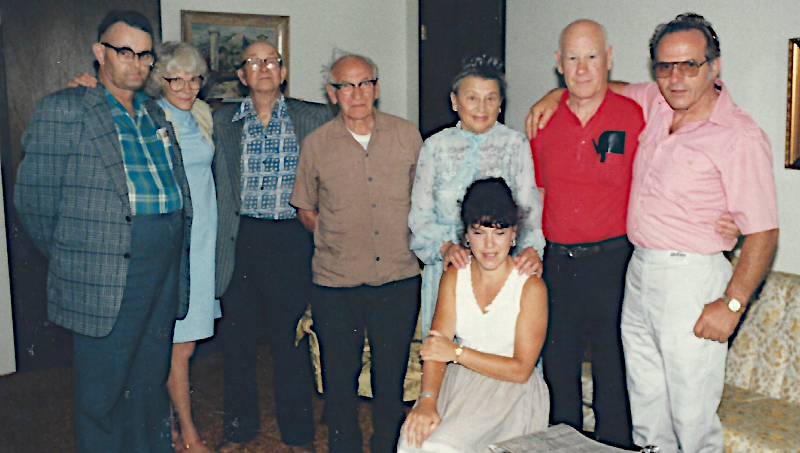
Marie had joined the Socialist Labor Party as a young idealistic woman because her great aunt, Genevieve Gunderson, was a prominent member. The Socialist Labor Party routinely ran candidates for US President and Vice President. In 1972, Genevieve was the party’s nominee for Vice President, and the slate received over 53,000 votes. The Seattle party members, including Marie, would meet at Stella’s apartment in Seattle to work on the campaign. Marie told me she admired and loved Genevieve and was very close to her, but that Stella and all the other party members were also family to her. Marie provided photos to me and Dana Fisher of the handful of Seattle members in Stella’s apartment. In both photos, Marie is clearly the youngest member of the bunch, and Stella sweetly has her arm around Marie’s shoulder, the elderly veteran and the neophyte.
Marie told me that most party members, especially the immigrant members, were complete auto-didacts, not just interested in socialism but also interested in learning about everything by reading everything. Their curiosity and self-education and level of intellect were amazing to her. When Stella passed away in 2004 at the age of 104, daughter Sonny gave Marie some of Stella’s books.
Years later, as Marie was looking at one of Stella’s books, a letter, almost one hundred years old, fell out of it. It was from Michel to Stella – and to infant Sonny – written shortly after Sonny’s birth in August of 1929. This was just two months before the October Stock Market Crash, the worst disaster of capitalism in US history, which triggered the Great Depression. Michel wrote the letter while he was a passenger in steerage, the cheapest class of accommodation, on a ship called the RMS Berengaria, the flagship of the Cunard Line which made transatlantic voyages between New York and Southampton.
The letter gives no hint which direction Michel was going nor what his business was in England or Europe. But there’s a good chance the trip was party related. The Socialist Labor Party had a strong affiliate of the same name in England at that time. One of the founders of the British group was the famous Irish republican, socialist, and trade union leader James Connolly who was executed for his leadership of the Easter 1916 uprising against British rule of Ireland. The headquarters of the British Socialist Labour Party was in Scotland, but there were branches in other cities, among them Oxford, Birmingham, London, and Southampton, where Michel would have embarked and disembarked. That’s why I suspect this was a trip on behalf of the party, but we’ll never know for sure.
What we do know for sure is that the letter that Marie accidentally inherited is a beautiful love letter from Michel to Stella and their infant child Sonny. But it is also much more than that.
On December 31st, 2023, Marie wrote a lovely New Year’s Eve letter to her friends in which she quoted Michel’s letter in its entirety, and commented, “How this man’s thoughts resonate with me! I look around and see a different crash heading our way.”
Michels’ thoughts resonate with me too, as well as with Dana Fisher who was surprised and happy to have a copy of this suddenly unearthed passionate treasure written by his grandfather to his grandmother almost a century ago. And I agree with Marie. These words are worth quoting here in their entirety for the inspiration they invoke in the dark times we are approaching when we need all the encouragement we can get.
More than a love letter, this is Michel’s advice and counsel to all of us alive today. So Michel, with his soul of a poet, gets the final word in this story:
On the Atlantic my dear ones (Sonia included). The shaking on the boat seems to shake out everything but my thoughts of you – they ever persist in easing my feelings. Stella dearest, that last statement uttered from your mouth, “I have always loved you” still rings in my ears in spite of the shaking, the vibrations, and this squall. In spite of everything, your words remain deep in my heart and will never leave me.
And as I will go through life’s way, I presume your statement will echo its way into all my avenues of thoughts and feelings, as well through all my creations. My dears, I have seen you so little and talked with you still less. Nevertheless, the distance has failed to alter my love for you. When I think of you dears, I can only wish us lots of good fortune and happiness – a life not exactly minus hardships and tasks, but one with opportunity in expressing and realizing our future plans.
The greatest disappointment in life is one minus the fulfillment of our finest dreams. Each of us has that problem to solve. Some do it sooner or later. Others fall short of it in their way – tired and worn out in its everlasting endeavors. So, keep your task clean – set your mark clear – weed out the trifles in life, so that the main fruit may grow finer and more beautiful. Let your task be your expression of love – your goals the utmost background to a perfect creation.
I believe in you both but do not lose belief in your own selves. Faith is the only factor to action and fulfillment of our sincerest expressions. I hope that faith which you have in each other shall bear the relative results and pay big dividends. My dears, I too need your faith. We all need faith in this disorganized world; every echo of another’s faith only fortifies our own faith in mankind. Hope leads to action, and action to progress. I miss you so much and hope to soon hear of your pleasant news. Love to you always.
Michel •