
Weapons Make the World More Dangerous: Stop the increase in military spending and the militarization of our societies
The genocide in Gaza, the war in Ukraine, the Congo, Sudan and all the many other armed conflicts put the international system under very strong pressure. War is a horror and the search for solutions is essential. The Belgian government is considering only one option: more weapons and more military spending. (See the analysis of the peace movement that accompanies this manifesto.) But history shows that this does not lead to peace, nor does it guarantee “security.”
International security issues are rooted in socio-economic and environmental upheavals, looting, and exploitation or are the consequences of a lack of diplomacy and multilateral collective security mechanisms.
Reducing security to a matter of armament and military confrontation presents enormous dangers. The ever-increasing militarization of the international scene prevents multilateral cooperation, which is essential if urgent global issues are to be addressed, including poverty, hunger, housing, climate change, genocide, armed conflict, or the nuclear threat. The continuous increase in military spending is organized to the detriment of the resources needed for the mechanisms that truly ensure the security of individuals and the planet.
An inclusive security architecture that places a central role in diplomacy, disarmament, social justice, and environmental sustainability must be at the heart of our approach to ensuring peace and security. We call on the government to thoroughly revise the coalition agreement in this direction.
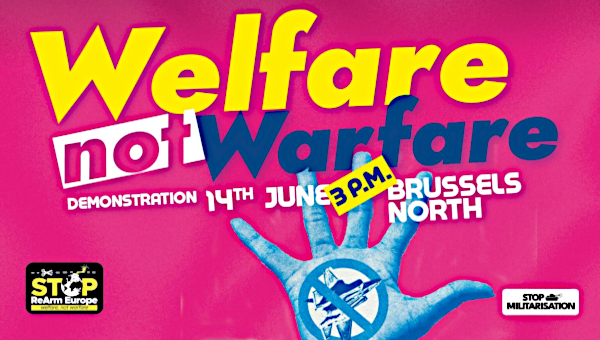
1. For a secure society, no increase in military spending
The Belgian military budget doubled between 2017 and 2024, from €3.9-billion to €7.9-billion. It benefited from two cycles of “recapitalization” with financial injections of €9.2-billion (government Michel, 2019) and €10.2-billion (government De Croo, 2022). Yet, despite the period of fiscal austerity announced for this legislature, the Arizona government still wants to increase Belgium’s military spending to 2% of GDP by 2029 and 2.5 percent by 2034. In the meantime, the government even seems to want to accelerate its ambitions to reach the target of 2% already in 2025. This corresponds to an increase of €4.5-billion in the annual budget of the Belgian army, the equivalent of what is advertised as an economy on social spending and public services during this legislature.
However, according to the NATO Secretary General, this remains insufficient. He called for expenditure on education, health, and pensions to be further reduced in favour of military budgets. In the run-up to its summit in June 2025, NATO plans to increase the “budgetary standard” to at least 3%. Officially, this new “necessity” is felt because of the “Russian threat.” However, already today, Russia’s military spending represents barely 10% of that of NATO member states, and barely one-third of what European countries spend on their armies, while Russia is entangled in the quagmire of the war in Ukraine. The possibility of Russia engaging in a military confrontation with a NATO member state is very largely questionable and does not legitimize this continued militarization.
We urge that the planned investments towards social security, public services, international solidarity, the fight against climate change, and the reception of refugees be realised. Legitimize all the mechanisms that actually and truly contribute to human security.
2. No sale of public assets for the benefit of the military industry
The government plans to draw a significant share of the resources to increase the army’s budget from a new “defence fund” to be created. This would be fuelled by the sale of public assets. In practice, this means that funds from public goods would be injected into the arms industry and into the purchase of war material, including additional fighter jets and a third frigate.
We oppose the privatization of collective resources for the benefit of the military-industrial complex and argue that it is illusory to believe that more weapons will guarantee more security.
3. Diplomacy, de-escalation, and mutual security guarantees
We reject a world order based on the rivalries between power blocs aimed at geostrategic domination.
The end of the war in Ukraine can pave the way for a new awareness of the need to invest in an inclusive security system, based on the principle that security cannot be sought to the detriment of others. Belgium can play a proactive role in establishing a peace agreement with Russia based on respect for international law, mutual security interests, and disarmament. Diplomacy and de-escalation are the bases of lasting peace.
It is imperative to pursue a proactive policy that aims to preserve and strengthen the multilateral system, international law, and human rights.
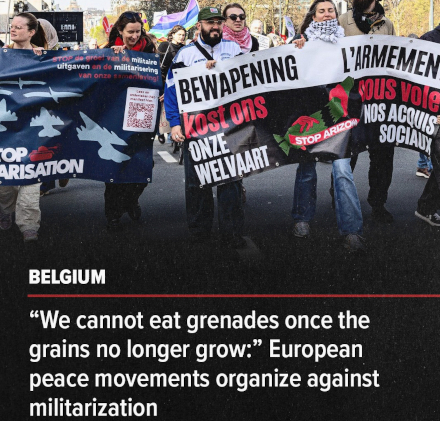
4. Nuclear weapons out of Belgium
The war in Ukraine has again made the danger of a nuclear confrontation a reality. It is unacceptable that the government refuses to officially confirm the presence of US nuclear weapons on Belgian territory and refuses to communicate about the recent deployment of new B61-12 nuclear bombs in our country. These nuclear weapons make our country a target and increase insecurity. To deploy them, our country has also ordered 34 F-35 fighter jets at an exorbitant cost. The government must end secrecy and allow for a transparent debate. We want these weapons of mass destruction to leave our territory. The government can take the initiative for a denuclearized Europe and a denuclearized world. Belgium should accede to the Treaty on the Prohibition of Nuclear Weapons.
5. A militarist culture is not a culture of security
To convince the population to accept the increase in military spending and militarization, the government intends to develop “a pan-societal approach”, to raise awareness “of society as a whole a new culture of security”, in other words, by trying to scare the community. However, the militarized culture of security does not allow a society to understand or meet the major challenges facing humanity. We call for the active promotion of human rights, democracy, and justice – in short, to promote a culture of peace in which education plays a central role. •