
Solving the Climate Crisis Requires Peace, and Peace a Stable Climate
The Agenda 2030 states a simple truth: There can be no sustainable development without peace and no peace without sustainable development. Therefore, it is not possible to treat sustainability – or the climate crisis, as an essential threat to sustainability – without also addressing the numerous wars raging at present, especially those that threaten to escalate, possibly to nuclear war.
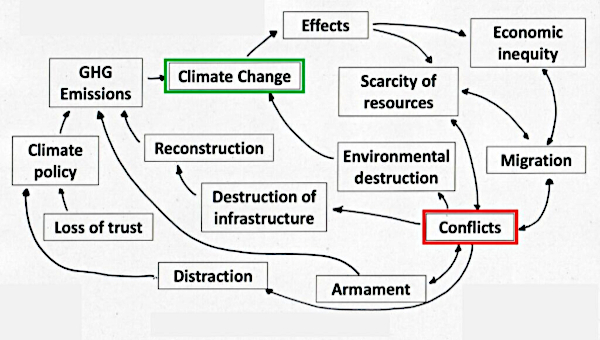
Additional greenhouse gas emissions occur due to the construction, operation, and destruction of military infrastructure and equipment, including protective measures, like tunnels or metal border fences.
Reliable numbers on additional greenhouse gas emissions of the military are not available, as it is exempt from the reporting obligations within the Paris climate agreement. Estimates put worldwide military emissions at 5.5 to 8% of global emissions, thus – were the military a nation – ranking third or fourth after China, the USA, and India (Braun et al., 2026; Parkinson & Cottrell, 2022).
Military Activities Enhance Greenhouse Gas Emissions
Very little is known yet about the climate costs of digitalisation in warfare. Satellite surveillance, medium- and long-range missiles, protective shields, drones, etc. – they all rely on sophisticated electronic devices and artificial intelligence that require power, batteries, rare earth, and other very limited resources, the extraction and processing of which is energy intensive.
Reconstruction of infrastructure is a major contributor and continues after wars end. Emissions through reconstruction in Gaza are expected to be considerably higher than those of the war itself (Neimark et al., 2024). Considerable emissions can result from burning oil and gas fields, fuel tanks, etc., as impressively documented for the war in Kuwait.1 Burning and destruction of woods, fields, etc., as unintended collateral damage or as a precautionary tactical measure as, e.g., the defoliation in the Vietnam war, cause additional emissions, and they also destroy carbon sinks.
War Impedes Solving the Climate Crisis
War redirects money, attention, resources, such as rare earths, means of production, workforce, and intellectual capacity, not only in the warring nations but also in those supporting either side, thereby constraining the means available for the transition to a sustainable future.
War also destroys trust between peoples and nations. Global problems like the climate issue, biodiversity loss, etc. cannot be solved by individual nations; shared efforts are needed. Without trust this becomes almost impossible. War thus counteracts the aims of the Paris Agreement and the efforts of the annual Conferences of the Parties (COPs).
The Climate Crisis Triggers Disputes
Climate change itself reinforces local and regional problems or disputes; it enhances economic inequalities, and increasingly intense and frequent extreme weather events – droughts, floods, tropical storms – as well as agricultural pests and diseases, which put food production at risk (Kemp et al., 2022). Migration has always been one way of adapting to climate change, but in the present densely populated world, this leads to disputes, e.g., over water and arable land. Sea-level rise aggravates the situation. Climate change is therefore not so much an environmental problem; it is a societal problem. Reinforcing loops triggered by displacements and increasing economic inequality lead to local or regional conflicts; destabilisation of states; and food, water and housing shortages that, in turn, lead to migration and conflicts.
But not only climate change itself can trigger unrest. The transition to fossil-energy use led to socio-political upheaval and revolutions in 2/3 of 60 studied countries (Fischer-Kowalski et al., 2023), as agriculturally dominated societies transformed to industrial societies, and dependent agricultural workers moved to cities and towns to become factory workers. The need to reduce per capita energy consumption in a transition toward a sustainable society is more painful, and it challenges dominant corporate interests, such as the military-industrial-nuclear complex.
The Path Forward – an Apocalypse?
When setting the doomsday clock at 90 seconds to midnight in 2024, the scientists stated, that “we are living in a time of unprecedented danger” due to nuclear risk, heightened by the war in Ukraine, the unabated climate crisis, and the collapse of global norms and institutions needed to mitigate risks associated with disruptive technologies and biological threats. Politicians are not acting fast enough and on a sufficient scale to secure a peaceful and livable planet. The scientific evidence is clear, but the political will is lacking.
In fact, the last decade has seen a systematic erosion of respect for international institutions and the rules-based world order, initially clandestine and abetted by the Western world.2 President Trump and his cabinet have recently made their disregard for a rules-based world order very explicit.
The European Union was conceived as a peace project: Joining historically warring European nations together economically was to ensure peace in the region and beyond. Europe was the mature culture calling for disarmament and diplomacy after two world wars originating in Europe. But over the last years, the European Union has reversed its course and now views confrontation and armament as inevitable. At the same time, it is engaging in cognitive warfare, calling it a peaceful tool of diplomacy, by e.g., permitting only one narrative and even sanctioning the proponents of deviating narratives. This is a dangerous course.
Peace as an Alternative
Yet, it is not too late to reverse course regarding sustainability, the climate crisis, or war. There appears to be a general understanding, stemming from different causes, that business-as-usual is not an option, that change is inevitable. The more systemic and holistic the problems are viewed, the more pathways toward solutions open up. Co-benefits abound and make solutions viable that would not be so if regarded in isolation.
In 1963 President John F. Kennedy, in a remarkable speech on peace stated:3
“First, examine our attitude toward peace itself. Too many of us think it is impossible. Too many think it is unreal. But that is a dangerous, defeatist belief. It leads to the conclusion that war is inevitable, that mankind is doomed, that we are gripped by forces we cannot control. We need not accept that view. Our problems are manmade. Therefore, they can be solved by man.”
And this is true not only for peace but also for a sustainable future. •
References:
- Braun, H., Hollweg, M., Walch, D. (2026). Globale Emissionen des Militärs 2025. In Attac (Ed.), pp. 7. Attac.
- Fischer-Kowalski, M., Krausmann, F., Pichler, P. P., Schaeffer, R. K., Stadler, S. (2023). Great transformations: Social revolutions erupted during energy transitions around the world, 1500–2013. Energy Research & Social Science, 105, 103280.
- Kemp, L., Xu, C., Depledge, J., Ebi, K. L., Gibbins, G., Kohler, T. A., Rockström, J., Scheffer, M., Schellnhuber, H. J., Steffen, W., Lenton, T. M. (2022). Climate Endgame: Exploring catastrophic climate change scenarios. Proceedings of the National Academy of Sciences, 119(34), e2108146119.
- Neimark, B., Bigger, P., Otu-Larbi, F., Larbi, R. (2024). A Multitemporal Snapshot of Greenhouse Gas Emissions from the Israel-Gaza Conflict.
- Parkinson, S., Cottrell, L. (2022). Estimating the Military’s Global Greenhouse Gas Emissions. Eds. Scientists for Global Responsibility and the Conflict and Environment Observatory.
This article first published on the Transform Europe website.
Endnotes
- Fires of Kuwait, IMAX film, 1992.
- “Davos 2026: Special address by Mark Carney, Prime Minister of Canada,” WEF, January 2026.
- Remarks at graduation ceremonies in the John M. Reeves Athletic Center on the campus of American University in Washington, DC, 10 June 1963.