
Rethinking Free Speech
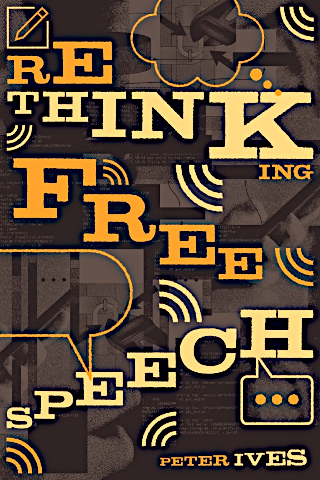
The following is an excerpt from Peter Ives’ book Rethinking Free Speech, Fernwood Publishing, 2024. Also check out this video interview with Peter Ives.
The analogy that free speech acts as a “marketplace of ideas” originated with Justice Holmes’s comparison to speech being valued like a consumer buys products, functioning as commodities for sale on the open market, as was expressed in his dissenting opinion in Abrams v. United States in 1919:
“But when men have realized that time has upset many fighting faiths, they may come to believe even more than they believe the very foundations of their own conduct that the ultimate good desired is better reached by free trade in ideas – that the best test of truth is the power of the thought to get itself accepted in the competition of the market, and that truth is the only ground upon which their wishes safely can be carried out.”
This “marketplace of ideas” analogy presents the First Amendment to be that which enables and allows for a space where the best ideas are able to emerge and thus fulfills the goals of enlightenment or social progress as argued for by Kant and Mill. However, despite its widespread influence, the analogy is rather counter-intuitive, as commodities traded in markets are usually material objects with unique physical existence. Ideas expressed in speech do not have such exclusivity: if you sell me an apple or a bottle of bourbon, you can no longer consume it; when you convince me of an idea, you do not relinquish it. The competition of ideas in a debate or discussion is not at all like the competition among commodities for the available dollars in a market.
The Marketplace of Ideas
Copyright, patent, and intellectual property law is an exception whereby, in a very limited manner, the exclusive ownership of specific ideas is granted to individuals. But this is not what Holmes was getting at, nor what is meant when the marketplace of ideas is invoked. Most of the ideas that circulate in public discussion are not inventions nor anything trademarked or copyrightable.
Moreover, history and experience have shown that the free market does not produce equality, justice, or particularly high-quality products. Markets place high value on some products, especially scarce ones in high demand, and do not on their own facilitate equitable distribution of wealth. Moreover, the marketplace of goods enables consumers to choose inferior products at lower prices instead of quality goods that cost more. Mill accepts this as a positive feature of real markets but does not think the competition of ideas should lead to lower-quality ideas.
Many have interrogated and challenged the analogy of a marketplace of ideas. English political philosophers Robert Sparrow and Robert Goodin expose its many weaknesses in detail. They argue that we should replace the market of ideas metaphor with a more accurate and productive “garden of ideas,” which better captures the active process of diversity and vibrancy of ideal public discussion. American legal scholar Vincent Blasi analyzes additional problems with the market metaphor: “One reason to doubt the efficacy of the market mechanism as a means of ordering beliefs derives from the concept, well recognized by economists, of market failure. Except in models, markets are imperfect. Differential access to information distorts markets. Collective behavior can distort markets.” Public discussion understood as a marketplace would be rife with such market failures, according to Blasi.
More profoundly, English post-colonial studies professor Anshuman Mondal argues that the “marketplace of ideas,” along with Mill’s depiction of an arena or zone of free speech, assumes a “planar” space that ignores the differences of power, circumstance, and experience that speakers and listeners bring to any dialogue. “Rather than visualizing freedom in terms of its scope and extent, across a flat and uniform social space that is emptied of context, I suggest we conceptualize liberty in terms of forces and flows channelled by and through an irregular and uneven terrain.” Media studies professor Gavan Titley draws on Mondal’s analysis of “the shape of free speech” to illustrate how the illusory homogenous marketplace of free speech “has been drawn into validating, amplifying and reanimating racist ideas and racializing claims.”
Similarly, in an article concerning free speech debates at American universities, “The Marketplace of Racist Ideas,” legal scholars Nancy Leong and Kevin Whitfield argue that the “anti-regulatory approach” (their term for the free marketplace of ideas) obscures structural inequality among students, faculty, and others at universities and that it also defies logic. First Amendment scholar Jared Schroeder offers a less critical reimagining in order to update the metaphor for the digital era, dubbing our social media environment as a “discursive marketplace of ideas.” Professor of public policy Philip Napoli presents a more critical analysis of what he calls the “algorithmic marketplace of ideas” of social media, showing how prone it is to “market failure” and other “red flags,” illustrating that “it seems increasingly dangerous and misguided to maintain confidence in the notion that the marketplace [of social media] is inherently oriented towards assuring that truth will effectively overcome falsity.”
These examples are just a sample of the host of diverse arguments, from various angles, questioning and rejecting the very influential marketplace analogy, especially in the current context of the twenty-first century. This analogy has been central for illustrating the negative freedom that merely prohibits regulation as a sufficient condition in securing the positive, productive requirements needed for critical and inclusive discussion. By falsely analogizing the interaction and diffusion of ideas with those of goods in a market, the idea of the marketplace obscures the different principles of government overreach restrictions and the search for truth and knowledge and eclipses any consideration of free speech as an effective and essential expression for individuals in a democracy.
In addition to questioning the analogy of free speech to that of a marketplace of ideas – especially for its evasion of inherent power dynamics amongst speakers and its potentiality for becoming an excuse for, or even fuel for, racism and other hurtful speech – I want to call attention to how the marketplace concept functions to confuse the differing goals of constitutional protection of the freedom of expression and the fostering of productive spheres for critical and inclusive discussion. Holmes mobilized the metaphor in 1919 to assert that anti-war propaganda ought to be protected expression. While he clearly disagreed with the defendants’ position, he argued that competition with better ideas would quash the propaganda’s impact.
However, had these ideas succeeded in the marketplace, Holmes’s test of a “clear and imminent danger” would kick in and allow Congress to stop their spread. In other words, Holmes’s famous invocation of a marketplace of ideas was an argument against government suppression of the competition of ideas, but with a backstop of the “clear and imminent danger” test to protect society from what might be called “market failure.” Behind Holmes’s seeming faith in reason and his confidence that dangerous ideas would be defeated by rational discussion was a safety check that could prohibit speech that was likely to cause “substantive evils,” as he noted in Schenck. And Holmes saw Congress’s job as preventing such evils.
The Canadian Charter Right to Free Expression
The Canadian Charter is much less overt textually about who it restricts than the American First Amendment which clearly limits the power of Congress – not of individuals or the public – to curtail people’s freedom of speech. Section 2(b) of the Charter grants the freedom of expression but is silent about who or what must allow such freedom. It is not until Section 32(1a) that it stipulates, “This Charter applies to the Parliament and government of Canada in respect of all matters within the authority of Parliament including all matters relating to the Yukon Territory and Northwest Territories.” The Supreme Court addressed this issue in RWDSU v. Dolphin Delivery (1986), shortly after the Charter became law. This case was about the freedom of association related to picketing, articulated in Section 2(d), but the precedent applies to the freedom of expression of Section 2(b). In its decision, the Court ruled that the Charter as a whole applies only to the government. McKinney v. University of Guelph (1990) clarified:
“The exclusion of private activity from Charter protection was deliberate. To open all private and public action to judicial review could strangle the operation of society and impose an impossible burden on the courts. Only government need be constitutionally shackled to preserve the rights of the individual. Private activity, while it might offend individual rights, can either be regulated by government or made subject to human rights commissions and other bodies created to protect these rights.”
This decision concerned mandatory retirement at the University of Guelph, however, it is important concerning the application of the Charter to universities.
The McKinney v. Guelph decision addressed whether organizations funded by the government – like universities – are considered within the “authority” of the government and thus subject to Charter restrictions. While the Court decided in this case that universities were not a part of the government, and thus the Charter did not apply, it did stipulate that neither the federal nor provincial governments could delegate their activities to private organizations which would then be free from Charter considerations. In Eldridge v. British Columbia (1997), the Court made it clear that the Charter applies to hospitals because they operate through the delegated authority of the provincial governments. Chapter Three’s discussion of academic freedom will look more closely at the relationship between universities and the Canadian Charter of Rights and Freedoms, but even where there are grey areas, the principle is that the Charter applies to governments and not organizations that are non-governmental.
The history of the Charter right to freedom of expression in Canada includes many cases where the Court ruled that expression had been infringed but determined that such infringement was “reasonable” and “demonstratively justified in a free and democratic society,” as set out in Section 1. Thus, unlike the US framework, the idea of balancing free expression with other values is built into the very wording of the Charter. For example, one of the early freedom of expression cases, Irwin Toy Ltd. v. Quebec (1989), decided that the Quebec statute against advertising to children under thirteen years of age did restrict the toy manufacturer’s freedom of expression. The decision did not overturn the law, however, because the court determined the limit was reasonable and justified to protect children’s well-being. Similarly, in Little Sisters Books and Art Emporium v. Canada (2000), the Court ruled that the government could confiscate “obscene” materials imported from the US, despite the infringement on the bookstore’s freedom of expression, because it deemed obscenity a social harm that could reasonably be restricted by government. On appeal, however, the Court ultimately sided with Little Sisters because the confiscation contravened the Charter’s equality rights of the LGBTQ+ customers of Little Sisters.
The classic case in Canadian free expression jurisprudence is R. v. Keegstra (1990), which ruled that laws against hate speech are constitutional. Part VIII of Canada’s Criminal Code, entitled, “Offences Against the Person and Reputation,” includes Sections 318–20 that focus on “Hate Propaganda.” Section 319 makes it an indictable offence to incite or promote “hatred against any identifiable group,” defined as “any section of the public distinguished by colour, race, religion, national or ethnic origin, age, sex, sexual orientation, gender identity or expression, or mental or physical disability.” R. v. Keegstra tested whether this part of the Criminal Code contravened the Charter right to free expression.
James Keegstra was a high-school teacher in Alberta, convicted of using antisemitic speech, including Holocaust denial, in his classes. The court ruled that the law that prohibits any communication that “Wilfully promotes hatred” against identifiable groups is constitutional as a reasonable limitation on freedom of expression. As Richard Moon has argued, the Keegstra decision, written by Chief Justice Brian Dickson, significantly questioned the capacity for free expression to determine the truth. It is worth quoting Dickson’s reasoning at length because it demonstrates a very different perspective than the American thought on freedom of speech:
“Since truth and the ideal form of political and social organization can rarely, if at all, be identified with absolute certainty, it is difficult to prohibit expression without impeding the free exchange of potentially valuable information. Nevertheless, the argument from truth does not provide convincing support for the protection of hate propaganda. Taken to its extreme, this argument would require us to permit the communication of all expression, it being impossible to know with absolute certainty which factual statements are true, or which ideas obtain the greatest good. The problem with this extreme position, however, is that the greater the degree of certainty that a statement is erroneous or mendacious, the less its value in the quest for truth. Indeed, expression can be used to the detriment of our search for truth; the state should not be the sole arbiter of truth, but neither should we overplay the view that rationality will overcome all falsehoods in the unregulated marketplace of ideas. There is very little chance that statements intended to promote hatred against an identifiable group are true, or that their vision of society will lead to a better world. To portray such statements as crucial to truth and the betterment of the political and social milieu is therefore misguided.”

Thus, the Canadian Court sees the invocation of the marketplace of ideas as a potentially extreme position that rationality will overcome falsehood and thus justifies any harm caused by them. As addressed in Chapter Four, the advent of social media reinforces this doubt in such an optimistic faith in unregulated free expression.
Keegstra was far from a unanimous decision; the court split 4–3, with a strong dissenting opinion written by Beverley McLachlin (who would become Chief Justice in 2000), joined by Justices La Forest and Sopinka. Justice McLachlin specifically argued that “the claims of gains to be achieved at the cost of the infringement of free speech represented by s. 319(2) are tenuous. Indeed, it is difficult to see how s. 319(2) fosters the goals of social harmony and individual dignity.” While critics of Canada’s hate speech legislation often raise questions about its efficacy, the Keegstra decision has held. Both R. v. Butler (1992) and R. v. Krymowski (2005) cited the Keegstra precedent to define hate speech and uphold legislation against it. Saskatchewan (Human Rights Commission) v. Whatcott (2013) also upheld Keegstra but added that “hatred” must be applied as an objective not subjective definition.
The Criminal Code provisions concerning hate speech are not the only venue through which Canada restricts hate speech. Section 13 of the 1977 Canadian Human Rights Act (CHRA) declares:
“It [to be] a discriminatory practice for a person or a group of persons … to communicate telephonically …, repeatedly, any matter that is likely to expose a person or persons to hatred or contempt by reason of the fact that that person or those persons are identifiable on the basis of a prohibited ground of discrimination.”
The Supreme Court ruled in Canada (Human Rights Commission) v. Taylor (1990) that this section of the CHRA did not contravene the Charter right to freedom of expression – though once again Justice McLachlin dissented, along with two other justices.47 Controversy persisted over such hate speech regulation being adjudicated by human rights commissions, including provincial bodies in BC, Alberta, Saskatchewan, and the Northwest Territories. Section 13 of the CHRA was repealed in 2013, following the recommendations of a commissioned report written by Richard Moon in 2008. Justin Trudeau’s Liberal government presented Bill C-36 in 2021, and re-introduced it as Bill C-63, the Online Harms Act, to address the gap left in terms of dealing with hate speech on the internet, as will be discussed in Chapter Four.
Summary
The main point of this chapter has been to explore the legal and constitutional principles of freedom of expression, explaining how they are distinct from the ideals of critical and inclusive discussion. This distinction can be broadly understood as that of the negative freedom definitions and debates concerning any important concept, most especially one such as this one. To the extent that the disagreements have been so great that they have obstructed further discussion and potential cooperation (in this case, in fighting antisemitism), the ideals have failed. To the extent that collaboration and the increase of knowledge were possible prior to such breakdowns, it is regrettable, yet predictable and common, especially concerning such controversial political issues as this one.
When the same issue of defining antisemitism enters the realm of the legal or constitutional principle of freedom of expression, however, things are very different. In this case, such problems are exacerbated both by the self-declared status of being a “non-legally binding working definition,” and by the adoption of it by governments, especially as it relates that adoption to legal and juridical procedures. In the latter case, it is difficult to see how its use is not an infringement on academic freedom.
Moving Forward: Opening Free Speech to Truly New Ideas
In addition to providing conceptual tools to foster understanding of free speech controversies, this book engages in a more thorough rethinking of free expression. The rise of social media is one immediate reason for the need for this work, but equally important is whether our current understanding of free expression is meeting the goals for effectively advancing new and better ideas. Free expression has come to mean the freedom to repeat endlessly the same old arguments – whether they are racist, sexist, colonialist, or homophobic – without thoughtfully considering new and challenging ideas that may lead to a substantial increase in our understanding. This has led many to accept P.E. Moskovitz’s assessment that free speech is an empty concept, only useful as a shield for regressive speech. My hope is to reinvigorate discussions of free speech at a deeper and more meaningful level.
This book has clung closely to the terrain of contemporary free speech debates with their historical roots in the modern “Western” tradition of Kant, Mill, and others. My rationale for this approach concerns the dominance and nature of free speech conceptions of this so-called Western tradition, and how they fit within structures of the Canadian Charter, academic freedom, and current social media. They have a powerful hold on how people think about free expression. My approach, what can be called “immanent critique,” has limits and disadvantages, as well as advantages. In focusing on the dominant ways free speech has been understood and discussed, this book can ironically obscure alternative perspectives. Indeed, I have not engaged with Indigenous, postcolonial, or any non-European traditions of critical and inclusive dialogue in this study. This is work that desperately needs doing.
To shake up and change the dominance of the European, American, and Canadian approaches to free speech, we need to work from both inside and outside of common-sense understandings of free speech. My hope is that this book constitutes the part of that project that acts from the inside of these debates – the immanent critique – by showing the cracks and fissures at the centre of the dominant tradition of free expression.
I see this book as a small part of the wider movements that are more open to a variety of truly new, diverse, and challenging ideas. I have tried to uncover the dysfunctions in our conversations about free speech, whether they occur on social media or in the university classroom. The next step, in my view, is to look outside of the well-worn path of free speech discourse. For example, I have a lot to learn from the insights of Indigenous studies professor David Newhouse (Onondaga) who uses the metaphor of Teiakwanahstahsontéhrha’ – “extending the rafters” – to discuss academic freedom. When the Haudenosaunee longhouses could no longer contain the growing families, Newhouse recounts, the houses remained intact but the new family members would be integrated within it by extending the rafters. “Academic freedom,” he explains, “is about the capacity of the system to welcome and create space for Indigenous speech and knowledge that has been excluded.” •