
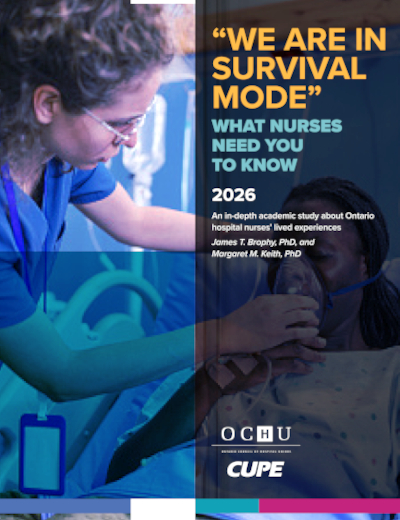
“We Are in Survival Mode”: What Nurses Need You to Know
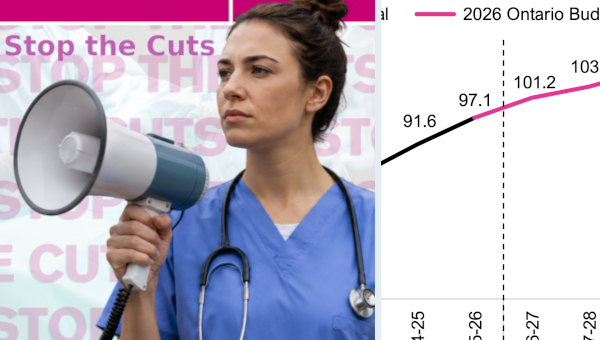
The healthcare system in Ontario faces a crisis of understaffing and inadequate resources, harming many overworked nurses and threatening the quality of care provided to patients. The harsh reality is that nurses are being negatively affected on a broad scale by their working conditions. They are being harmed physically and emotionally by exhausting workloads and stress.
The Human Costs
In a series of interviews, Ontario hospital nurses shared their personal experiences with staffing shortages, lack of funding, and poor support. They expressed fear for the future of healthcare, citing heartfelt concerns about reduced quality of patient care. Lena, a palliative care nurse, said she often feels guilt and sadness about the fact she cannot provide the comfort she, as a caring nurse, is personally compelled to provide. She said, “I have moral distress as a nurse and it goes on every day, every shift. All nurses are experiencing moral distress because we don’t have the time to help people.”
Sometimes nurses have to make impossible choices about who will receive immediate care. Jane, a medical-surgical nurse, described a shift in which the department was short-staffed, as is often the case. She simultaneously had responsibility for a palliative patient; an acute patient who was an IV drug user and was having chest pain; a patient who was awaiting long-term care that she was trying to help shower; and a very confused person on isolation in restraints with a catheter who had fallen out of bed. As call bells were ringing, she tried to get help from one of the other nurses on the floor, but they were each dealing with a similar number of patients needing urgent care. She said, “I’m the one who has to take the brunt of it. I’m the one who’s getting yelled at.”It also caused an existential crisis for her. “Then I’m the one who has to spend the next six hours of my shift constantly thinking about how I was a bad person because I couldn’t provide the appropriate care.” She was left wondering if she was really able to safely continue to work in such unmanageable conditions.
The majority of nurses experience violence and trauma, which is exacerbated by increased wait times and short staffing. Many suffer verbal and physical abuse, while others bear the emotional toll of witnessing such incidents. Karla, a mental health nurse, is particularly angry that very little is being done to protect her or her co-workers. She said, “It’s infuriating to know that a person can just repeatedly verbally or physically assault healthcare staff. There have been nurses I know who have been followed to the parking lot after work by patients who are harassing them. Nothing’s done about it.” She is angry about the way that hospital management minimizes such dangers: “… the language from management around it is described as, ‘Oh, the nurses are complaining.’ Like we’re not bringing forward a justified concern. They consider it to be basically whining. Anywhere else, if workers were being beaten up, that would just not be tolerated. But when it happens to a woman, we’re complaining or grumbling or whining. Actually, no, this is assault! It’s a physical assault! It’s illegal. It is notifying you that this violent act has taken place. I find the language around it to be very misogynistic.”
Public System Under Siege
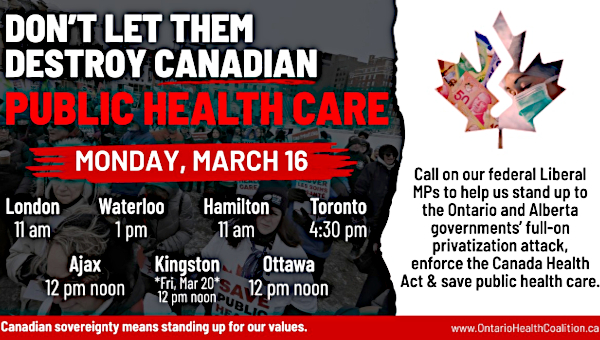
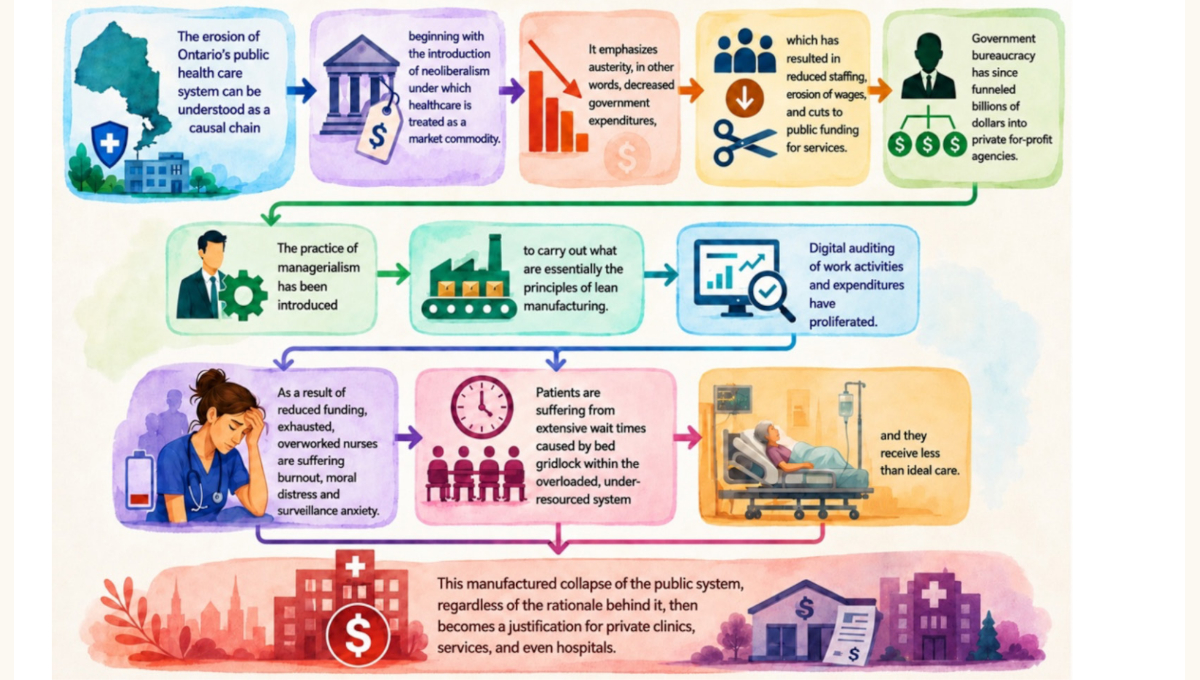
Ontario’s healthcare system is moving faster toward a two-tier model, where those who can afford it receive more timely care while those who cannot are left to navigate a broken and underfunded system. As Kim, a resource nurse, said, “It’s gotten really bad. I find a difference over the last 10 years… They are intentionally underfunding to push an agenda of privatization. They are not investing in public healthcare. And they are using tax dollars for private clinics.”
John Ralston Saul, one of Canada’s best-known public intellectuals, has said the answer to a struggling universal public system is to fix it, not abandon it.1
“… we have slipped into a two-tier healthcare system without any public debate over whether citizens wished to abandon the universal system. Worse still, our elites continue to talk as if we still have a universal system. They, and therefore we, condemn ourselves to live a lie… Medicare can only work if it is driven by ideas, by policy… our growing dependency on managers is killing Medicare…”
This shift toward privatization will intensify existing inequalities, leaving vulnerable or less affluent populations with even more limited access to quality care. It will also drain demoralized nurses from the already understaffed public system.
Misguided Priorities
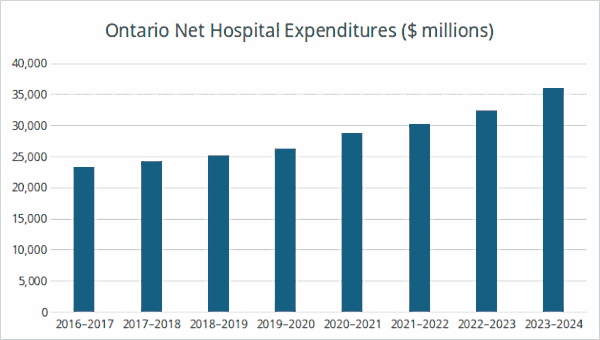
The root causes of this crisis are attributed to governments’ neoliberal austerity reforms and business-style managerial approaches, which prioritize economic efficiencies over human needs. The provincial government’s budget is far below the needed allocation, leading to ineffectiveness, reduced care, and limiting of access to services. Sumaia, a postpartum nurse, said she is saddened to see that relational patient care is often overlooked in favour of computer documenting measurable efficiencies that are more about the numbers than providing relational care. “The humanity has been taken out because they only see what the computer system says.”
Nurses Leaving Their Profession
The lack of recognition and support for nursing staff that is now contributing to burnout and decreased morale will only get worse, leading to an escalation of the problem of staff retention. Andy described working conditions that deeply impact nurses’ level of job satisfaction and explain why some people are voting with their feet. He said, “The culture has deteriorated. All my senior nursing colleagues have left and have found somewhere else to work that’s somewhat healthier… all we can do is watch the bus crash.”
Claudette also sees nurses leaving the profession and is fearful the deterioration of the system will get even worse. She said, “I’m worried about the future. I’m worried in terms of even me getting older and needing care. I’m wanting to leave nursing, and I know other people want to leave. There’s an exodus. I’m worried there will be an even bigger shortage of nurses. Who’s going to be there to take care of us in the future? What will happen? I already see more people getting less quality of care. It’s just not sustainable.”
What is Needed
To address these issues, nurse staffing within the public system must be prioritized. Minimum nurse-to-patient ratios (mNPRs), adjusted by department, have been enacted in many jurisdictions, including British Columbia. Where they have been long established, such as in California and Australia, they have proven to be very effective in protecting the well-being of nurses as well as improving patient outcomes and reducing mortality. As Laura indicated, “Nursing care directly impacts patient care, and the patients are the ones who are suffering right now. Staffing level to patient ratio would improve, which means patient care will improve, which means tasks are getting done on time, meds are being given on time, less med errors are happening, people’s dressings are getting changed.”
Patients Before Government Cost-cutting and Private Profits
A more empathetic and understanding approach to healthcare is needed – one that puts patients ahead of cost and recognizes the inherent value of compassion and kindness as an integral and essential aspect of quality care. Ellen said, “There’s not enough time in the day and a lot of the time we work short-staffed… Then you have to choose what you think you need to do for the patient’s safety. You know you could do a lot more for the patient, but you have to choose to do the things that keep that person alive until you get more help.” In many cases a patient’s dignity and comfort are sacrificed.
The managerial focus on doing more with less is dehumanizing healthcare. Mary, an emergency department nurse, said, “It’s not a car assembly line but it’s still an assembly line… they come in, they get seen, and by god I hope we can get them back out the door because that will save us some money.”
Next Steps
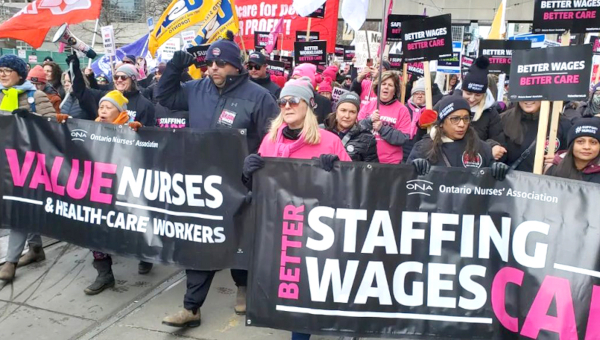
Immediate action is required. This includes increasing funding, legislating safe nurse-staffing levels, prioritizing patient care and dignity, and recognizing nurses’ right to a safe and healthy work environment. By prioritizing these essential components, we can ensure that our healthcare system provides high-quality care to patients and supports the well-being of nursing staff. As Katherine said, “The definition of healthcare is people helping people.” She urged those in charge of the healthcare system to “take care of the people who take care of the patients. It should be the number one priority.” •
The full report is posted here.
Margaret and Jim have collaborated with Michael Hurley and the Ontario Union of Hospital Unions (OCHU/CUPE) for over a decade to expose the dangerous conditions faced by nurses and other healthcare workers in Ontario’s hospitals.
Endnotes
- Saul, J. R. (1999). “Healthcare at the end of the twentieth century.” In M. A. Somerville (Ed.), Do we care? Renewing Canada’s commitment to health. McGill-Queen’s University Press.