
Pushed Over the Brink: The Escalating Assault on Ontario’s Hospitals
In previous submissions to the government, we noted that Ontario hospitals face a worsening capacity crisis due to stagnant bed growth, insufficient staffing, and inadequate funding. This has worsened as funding increases have failed to match cost pressures. We are now in the third year of funding plans that cannot maintain current service levels.
For the last two years, funding has fallen at least two percent per year behind costs. The current funding plans for this fiscal year fall almost 3% short of what is necessary to maintain services. Without intervention, hospital deficits, working capital shortages, job cuts and service declines will accelerate. Over the last year, this, unfortunately, has come to fruition with significant job cuts at hospitals.
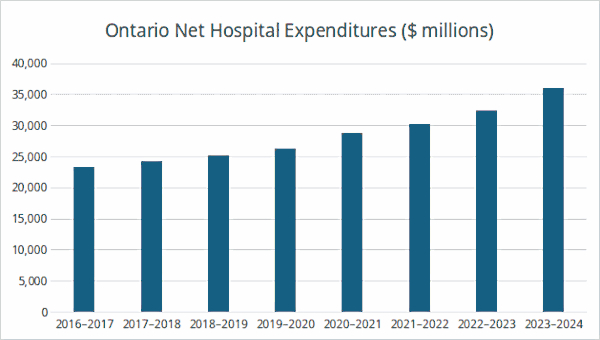
Net hospital expenses have increased on average by 6.5% per year over the last seven years as reported by the Canadian Institute for Health Information (CIHI). In the most recent four years, net expenses have increased even more rapidly: 8.2% annually on average.
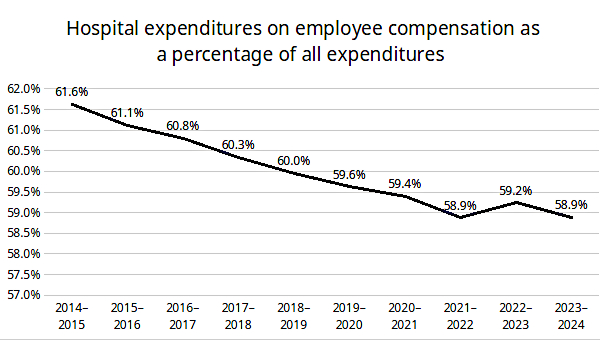
Employee compensation has had a moderating impact on hospital cost increases. For many years, compensation has fallen as a percentage as all expenditures from around 65% to less than 59%.
Hospital Costs Increasing Rapidly
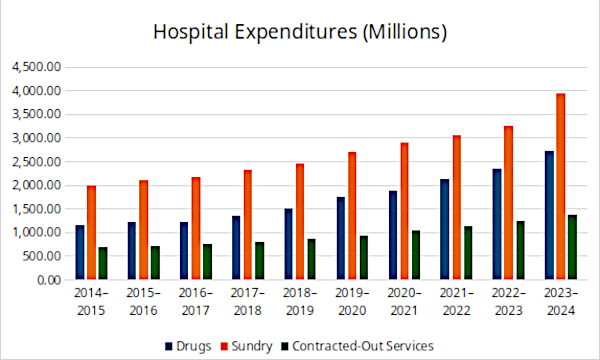
Expenditures on drugs, contracted-out services, and sundry have led the increase in expenditures – averaging 12.1%, 9%, and 8.9% annual increases respectively over the last 7 years.
Actual hospital cost increases have been somewhat higher than the 6% per year cost increases currently estimated by the Ontario Hospital Association.
This level of cost pressures accords with the realities that hospitals are experiencing; a growing and aging population, significant inflationary pressures, increasing utilization, and a population getting chronic illnesses at younger ages.1
Hospitalizations have increased 2.7% per year over last decade as reported by CIHI. Total inpatient days have increased 29% over the last decade (or by 2.6% per year on average). That is over two million extra hospital inpatient days. Average length of stay per patient has increased 15%, and the total number of hospital discharges has increased 13.2%.
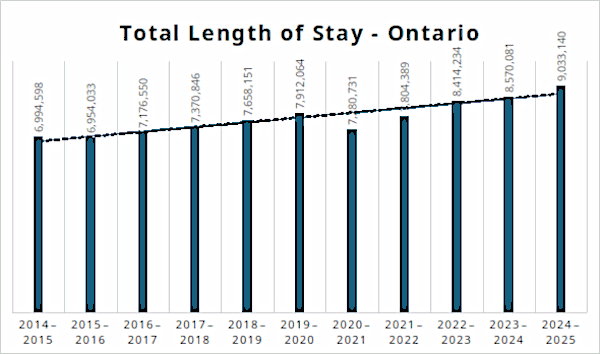
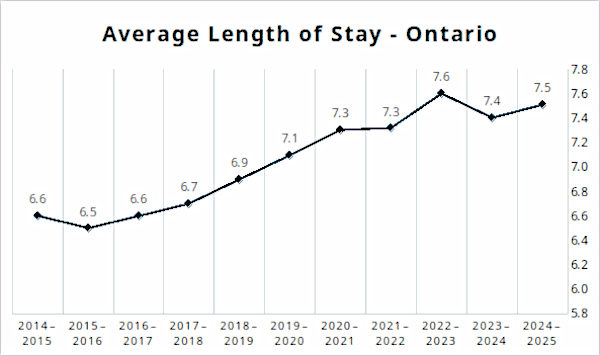
These increases in the average length of stay and the total length of stay have occurred despite a decline in the age-standardized length of stay.
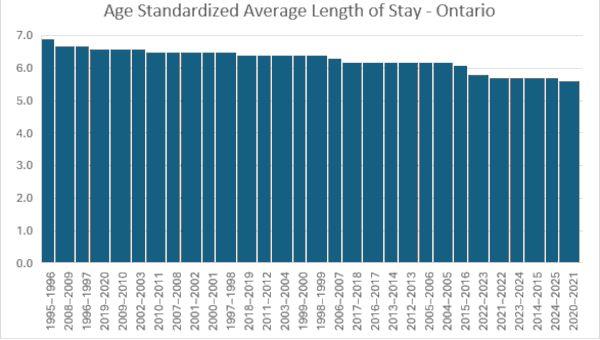
An aging population is driving longer hospitals stays, even while hospitals treat the same sorts of patients in less time.
So, even as hospitals are treating the same sort of patients in less and less time, the average length of hospital stays has increased.
Funding Falters
The Ford government ran on a promise of ending hallway healthcare in 2018. The COVID crisis also brought immense public pressure regarding the lack of capacity in the hospital system. These factors – along with campaigns by community and labour – helped ensure funding increases that were close to the hospital cost pressures noted above. Reluctantly, the Ford PC government accepted the consensus in the province that hospital services must improve – and that funding was needed to do this.
Funding for the operation of hospitals and psychiatric hospitals increased 37.6% between 2018/19 and 2023/24. That is an average of 6.6% per year.
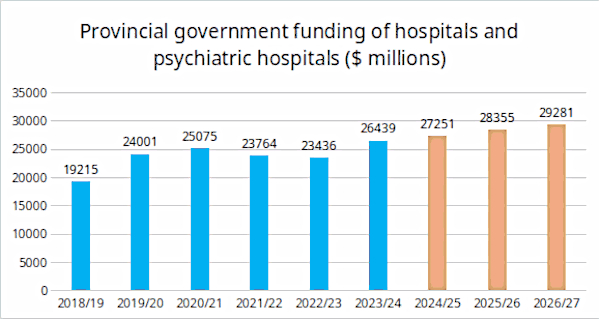
Notably, the increases won for hospitals were not in the government’s initial plan. Instead, community and labour campaigned and won better funding than originally budgeted during the fiscal year:
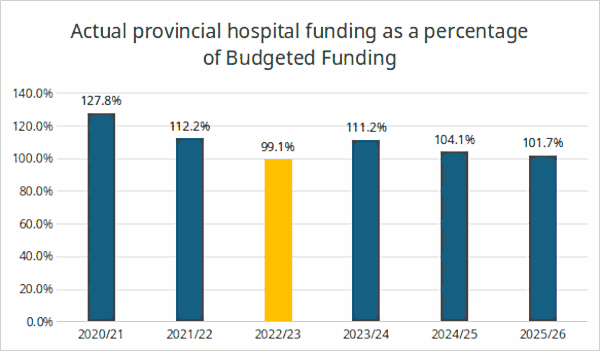
While this process is sub-optimal as it means hospitals cannot plan effectively, it does show that communities can win extra funding for their hospitals during the course of the year. This, unfortunately, is what must happen this year.
However, despite best efforts of community and labour, the government imposed much more modest funding increases starting in 2024/25. The increase that year was only 3.1%. In 2025/26, it was 4.05%.2 The current plan for 2026/27 is for a 3.3% increase. All of these increases are far below actual cost pressures. The Ford PC government has broken with the broad consensus in the province that hospitals must improve capacity and the quality of care. This change in policy has resulted in additional problems for our hospital system that will be discussed below. More problems will emerge unless the government revises its current policy of cuts.
The Consequences
Deficits: In the normal course of events hospitals are not permitted to run deficits. Regardless, that has become the norm – with hospitals required to seek waivers to run deficits. By the end of 2025,
hospital operating deficits across the province were over $400-million.
Do hospitals have sufficient funds to pay their day-to-day bills? Working Capital is the money hospitals have to pay day-to-day operating costs (which equals current assets minus current liabilities). In 2020, hospitals had over $2-billion in working capital.
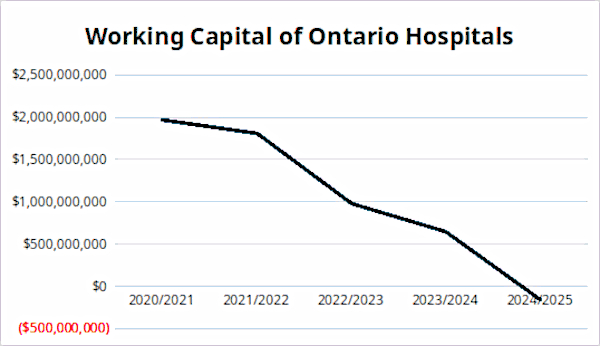
But as of the end of 2025, hospital working capital had fallen to negative $280-million. As a result, hospitals are required to spend public funds to pay for borrowed cash.
Job cuts and layoffs: The province required hospitals in deficit to submit in September 2025, three-year plans (Hospital Sector Stabilization Plans or HSSPs) to bring the hospital out of deficit. Since that time, over twelve hundred jobs have been eliminated at hospitals.3 Hospitals need to increase capacity to deal with an aging and growing population that contracts chronic illnesses at younger ages – but instead, we are seeing job cuts. While the public recognizes the need to improve hospital care, the Ford PC government is implementing cuts in hospital jobs.
Low staffing levels: Already, Ontario hospitals are dramatically understaffed compared to the rest of Canada. For core hospital services, even before these job cuts, Ontario needed 55,000 more full-time hospital staff to match the staffing capacity in other provinces.
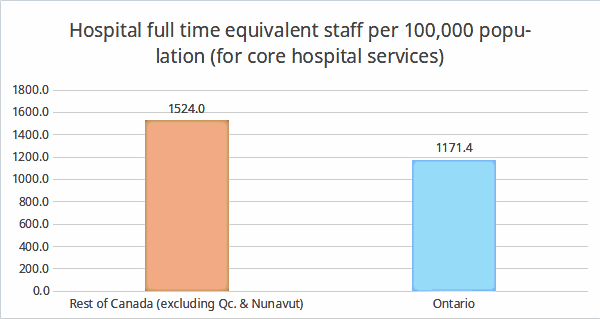
Underfunding: This is due to underfunding of hospitals in Ontario. According to CIHI data, Ontario hospitals receive the least funding from the provincial government of all provinces and territories in Canada. To match even the second lowest spending province, Ontario would have to add $2.17-billion in funding in 2025 to the total provincial hospital funding.
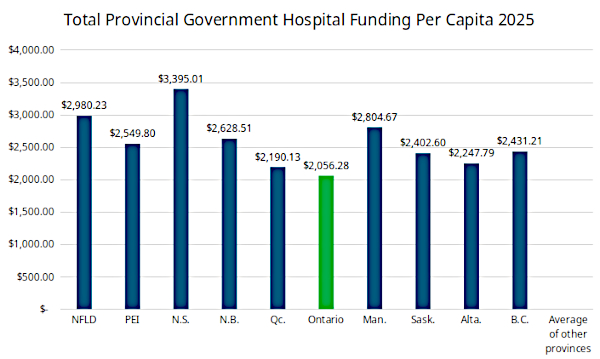
While Ontario in total underfunds hospitals compared to other provinces, Ontario funds certain hospital areas higher than other provinces: research, education, and community services. But for what might be considered the core of hospital services (inpatient care, outpatient clinics, surgeries, rehabilitation, complex continuing care, emergency departments, support services, etc.), Ontario is far behind. To match funding on a per capita basis (i.e., funding per person), Ontario would have to increase funding by $5-billion annually for core hospital services.
Assaults against staff: The number of incidents of violence against hospital staff resulting in injury has increased 23% since 2020. Violence against hospital staff leads to an average of 43 days lost per claim. This is far higher than any other sort of workplace injury.
Lost time injuries: The lost-time injury rate for hospital employees is higher (1.52 injuries
per 100 full-time equivalent employees in 2024 and 1.53 in 2025) than the rate for all covered employees (which was 1.18 in 2024). The hospital rate is about 29% higher than the rate of injury for all employees. For nursing and residential care (e.g., long-term care employees4), the lost time rate is much higher – an astounding 5.56 injuries per 100 full-time equivalent employees.
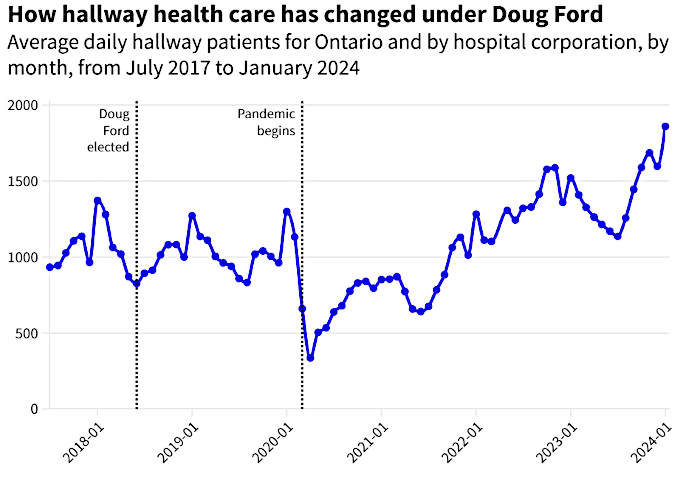
Very high bed occupancy: Due to a lack of hospital capacity, Ontario has very high acute care bed occupancy, regularly over the safe level of 80%, with many hospitals over 90%. The Ford government ran on a promise of ending “hallway healthcare”, a key manifestation of too high bed occupancy when beds simply are not available for patients who have come in through the Emergency Room. Instead, hallway healthcare doubled, and then the PC government decided not to publish that data.
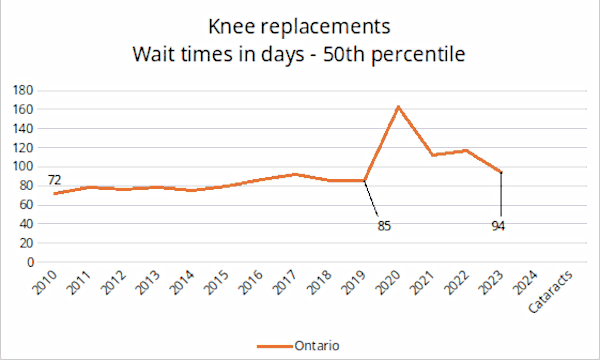
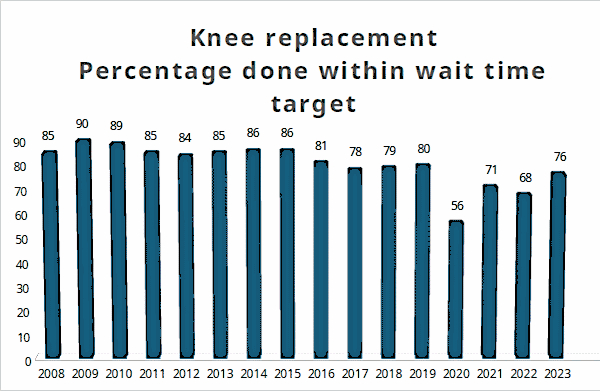
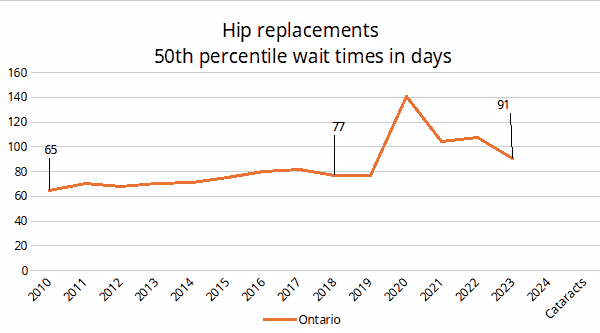
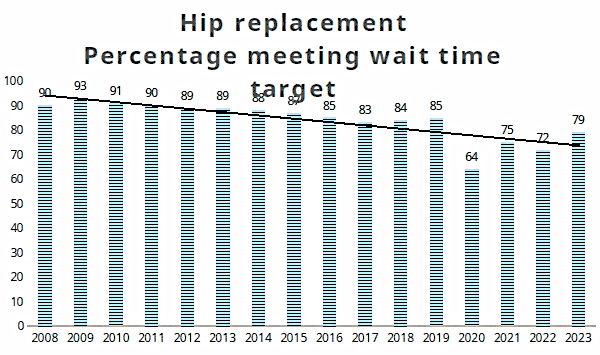
Lack of capacity: Recent staffing cuts have occurred despite longer waits for surgeries and declines in the ability of hospitals to provide care within the targeted wait times for common surgeries.
Knee Replacements
Hip Replacements
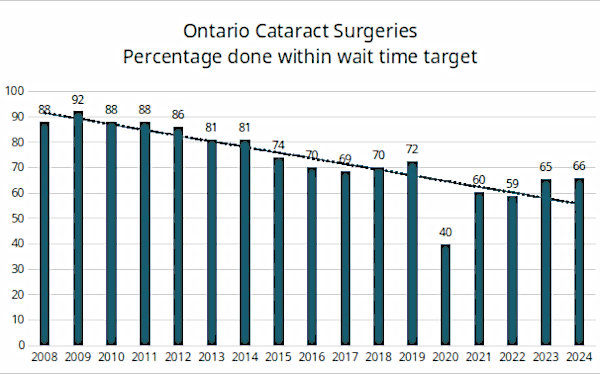
Fewer cataract surgeries are also being done within the targeted wait time. Indeed, the decline in this sort of surgery is most marked, falling from 92% of cataract surgeries being done within the targeted wait time in 2009 to only 66% in 2024, a decline of 26%. An extra quarter of the people getting cataract surgeries are getting them outside of the wait time target.
Privatization of surgeries is associated with lengthening wait times: Cataract surgeries are especially notable, as this area is connected with the Progressive Conservative government’s main new hospital policy, the privatization of surgeries, allegedly to deal with wait times.
However, since funding for private cataract surgery clinics was increased by the PC government in 2020, fewer patients are being treated within the targeted wait time – 72% were treated in the targeted wait time in 2019, but only 66% in 2024. Despite new funding for privatized clinics, cataract wait times have gotten worse.
Since the previous government’s budget in 2017/18, budgeted funding for the for-profit clinics has increased from $60-million per year to $294-million, or on average by 43% per year. In 2026/27, budgeted funding for the for-profit clinics increased $120-million or by 69% over last year’s budgeted funding.
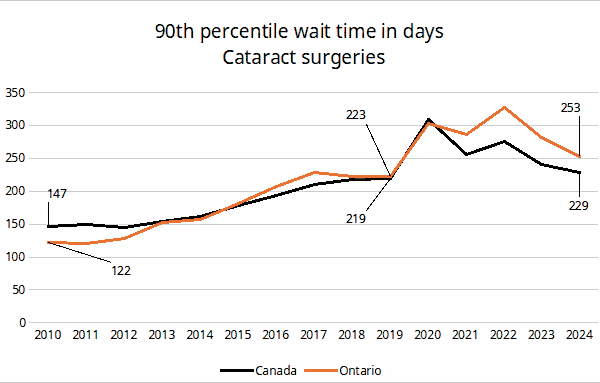
The wait at the 90th percentile increased from 122 in 2010, to 223 in 2019, to 253 in 2024 (more than double). After increased funding for privatization was introduced, the wait time increased 30 days, or by 13.5%.
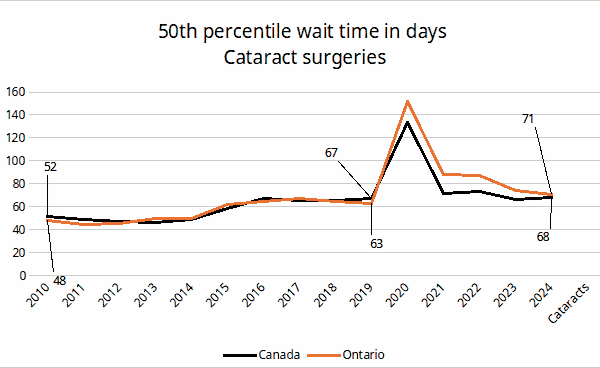
At the 50th percentile, cataract-surgery wait times increased from 48 days in 2010, to 63 days in 2019, to 71 days in 2024. That is an increase of 8 extra days after funding for privatization was increased – a 12.7% increase.
Ontario wait times are now longer for cataract surgeries than in the rest of Canada. The wait at the 90th percentile is 10.5% longer – 34 extra days. Wait times for cataract surgeries used to be shorter in Ontario than in the rest of Canada.
Hips and knees are currently done more quickly in Ontario than in the rest of Canada. At the 50th percentile, hip replacements were done in 91 days in Ontario and 131 days in the rest of Canada (2023). Knee replacements at the 50th percentile are done in 94 days in Ontario but 161 days in the rest of Canada.
This may change: hips and knees are now up for privatization by the current government.
Conclusion
Ontario hospitals are understaffed and underfunded. The funding policy over the last three years has heightened that problem. Hospital capacity issues have gotten worse and will deteriorate further unless the government changes its policy of service quality cuts. The “solution” it has offered to the capacity crisis – privatization – is no solution at all – it is associated with longer waits and more delays.
We believe these could be solutions to our current healthcare crisis:
- End private sector delivery of hospital services – it is exacerbating, not solving the capacity problem.
- Capacity must be increased significantly in acute care, complex continuing care, rehabilitation care, mental healthcare, palliative care, long-term care, and home care to meet the needs of an aging and growing population. Fund hospitals to deal with cost pressures and over time bring Ontario hospital funding in line with other provinces.
- All staff should work to their full scope of practice. This would alleviate some of the current pressures.
- Ban the use of nursing agency staff. These agencies charge double or triple what institutions pay their own staff, and they bleed away resources from round-the-clock and weekend staffing, worsen morale, and weaken the continuity of care.
- Improve nurse morale and retention and significantly improve patient satisfaction and outcomes by moving to nurse-to-patient ratios, as British Columbia has done.
- Address violence in healthcare. Adding staff, establishing a culture of zero tolerance, restricting working alone, providing whistle blower protection, prosecuting those who attack healthcare workers are all part of the solution to the problem of violence. •
Endnotes
- See OCHU’s previous brief on this issue, here.
- This is based upon the Financial Accountability Office’s recent assessment of hospital funding for 2025/26.
- This is almost certainly a very conservative estimate, as it is based upon notices of layoffs and eliminations of positions sent to CUPE and media reports. It therefore does not include notices received by the other large unions in the hospitals or job cuts that have not been reported in the media.
- A number of hospitals operate long term care beds and as a result LTC workers are part of OCHU/CUPE.