
National Exclusionism: A Global Problem and the Spanish Case
For Canadian readers, the names Frente Obrero (FO) and Reconstrucción Comunista (RC) probably evoke nothing. Organizations that wrap a reactionary program in the rhetoric of Marxism-Leninism tend to flourish in the relative obscurity that comes from operating outside large media circuits; that nobody knows them beyond their borders is part of their very reason for being.
But the form this phenomenon takes in Spain is sufficiently articulated, and sufficiently documented in the organization’s own texts, to deserve international attention. What RC and its Frente Obrero represent is not a local oddity. It is a textbook case of what we might see as the ‘imprint of fascism’ within the workers’ movement – a current that occupies the organizational forms and language of communism in order to introduce chauvinist, racist, and functionally pro-bourgeois content.
The difference from classical fascism lies not in the substantial political content but in the packaging: here ultranationalism is spoken in Leninist vocabulary, immigration deportation policies are justified by citing Soviet border regulations from 1927, and Islamophobia is presented as the defense of the “proletarian” national identity. The practical result – the division of the working class along ethnic and religious lines, the subordination of international solidarity to state chauvinism – is the same.
I. RC and Frente Obrero: One Structure, Two Faces
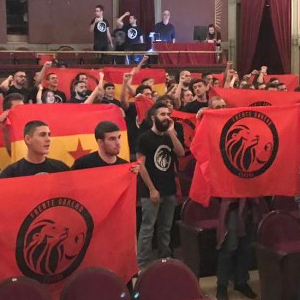
Before mapping the broader political landscape, a structural clarification is essential: Reconstrucción Comunista and the Frente Obrero are, to all practical effects, the same organization.
RC’s own internal documents describe this arrangement with total transparency. The Frente Obrero functions as the party’s main mass instrument, presenting itself publicly as a broad “patriotic and revolutionary” movement without explicitly identifying as communist, while the party operates behind it, setting political lines and directing cadres. As a recent RC congress document states, the objective is to work within the front without “renouncing who we are” as communists – but without flying the flag openly, given what the documents repeatedly call “the criminalization of communism.” This amounts to a total subordination of strategy to tactics, shying away from speaking of socialism out of fear of social rejection.
Former members corroborate this from the inside. In testimonies published by the Spanish revolutionary media outlet Bitácora ML, a former RC member from Valencia described the Frente Obrero as “a front created by and for the party – one more, and I’ve lost count – with the same deficiencies as the party, and no real external component.” Another put it more directly: the front and the party are “the same people” operating under different names depending on the audience. While in RC the communist references and Leninist citations flow more freely – albeit subjected to a thoroughgoing distortion of Marxism – in the Frente Obrero the reactionary political deviations are expressed without the Marxist wrapping: anti-immigration positions, transphobia, and national chauvinism with no ambiguity whatsoever.
II. A Brief Map of the Spanish Communist Left
For the reader unfamiliar with the terrain: Spain’s communist left is small and fragmented. The historic Partido Comunista de España (PCE), founded in 1921, transformed into Eurocommunism in the 1970s and is today a marginal force within the Izquierda Unida coalition. Alongside it exist various organizations claiming the Marxist tradition – the Partido Comunista de los Trabajadores de España (PCTE), the Partido Comunista de España (marxista-leninista), heir to the anti-Francoist resistance, and a handful of smaller formations.
Within this fragmented and weakened landscape, RC has for years been conducting a conscious work of penetration and influence-building, in parallel with its shift toward the far right. Founded in 2009, it has used the Frente Obrero since the late 2010s as its main public instrument: presenting itself as “patriotic and revolutionary” while the party operates behind it without identifying openly as communist. The two-tier strategy is described with total transparency in their own theoretical publications. We are not speculating about hidden intentions. We are reading what they themselves write for internal use.
III. Who They Are: Self-Presentation and the Tactics of Concealment
“Calling today, in present-day Spain, for the socialist revolution only serves to criminalize and ridicule our cause.” (De Acero, no. 16, 2020)
The journal De Acero is RC’s theoretical organ. In its inaugural issue of the third stage (January 2026), a series of articles oriented toward the party’s upcoming congress appear signed under the pseudonym “Julián de Soria” – who, by writing style, political positioning, and organizational trajectory, everything indicates is Roberto Vaquero himself, the organization’s historic secretary general, also known under the alias “Juan Mesana.” Until very recently, Vaquero publicly fronted the party as its maximum authority; no one else has stepped into that role since. These texts are a primary source for this article.
The self-presentation is grandiose to the point of messianism. A text by Denís Paredes closing the issue states: “If anything of communism remains in our beloved Spain, that something is found in the ranks of Reconstrucción Comunista. Where communism is not a memory, nor a label, nor a pose, but a living and conscious practice” (Paredes 2026, 40), and earlier: “All [communist organizations] have fallen, all have abandoned the path, save one” (Paredes 2026, 39). What makes RC analytically interesting is not its arrogance but the clarity with which it describes its own reactionary positions.
One central strategic datum: the organization is perfectly aware that its political content generates rejection if presented openly. “De Soria” writes: “The criminalization our movement suffers obliges us to be intelligent when presenting our ideology; we renounce nothing, but we must update our methods” (De Soria 2026, 4), and elsewhere: “[P]resenting yourself in elections under supposedly communist symbols and slogans is political suicide, at least in the short and medium term” (De Soria 2026, 20). This tactic of concealment is one of the most contemptible euphemisms for admitting that the banner of socialism has been quietly abandoned in favor of bourgeois ideology. In Lenin’s words [What Is To Be Done?]:
“the Bernsteinian and ‘critical’ trend, to which the majority of the legal Marxists turned, deprived the socialists of this opportunity and demoralised the socialist consciousness by vulgarising Marxism, by advocating the theory of the blunting of social contradictions, by declaring the idea of the social revolution and of the dictatorship of the proletariat to be absurd, by reducing the working-class movement and the class struggle to narrow trade-unionism and to a ‘realistic’ struggle for petty, gradual reforms.” (Lenin 1961, sec. C of chap. 1)
Under this pretext, RC-FO deploys a brazenly far-right politics dressed in red clothing, preferring to stoke the worst bourgeois prejudices among the proletariat rather than speak of socialism.
IV. The Real Positions, Document in Hand
Immigration, “Ethnic Replacement” and Deportation
The article by Vaquero titled “En respuesta al trotskismo: inmigración y fronteras abiertas” [“In Response to Trotskyism: Immigration and Open Borders”], published in the second stage of De Acero, develops the organization’s position on immigration with total explicitness. The document advocates for “border control, the integration of people already here, or the expulsion of those who obstruct that process” (Vaquero 2022). The key word is “expulsion.” This is a deportation policy articulated in Marxist vocabulary, backed by citations from Lenin and from the 1927 Soviet border regulations. This backing does not withstand the slightest scrutiny. The USSR’s border regulations in the 1920s responded to precise historical conditions: a workers’ state under construction, under imperialist blockade, managing population flows in the context of the New Economic Policy and an economy devastated by civil war. Extracting from that exceptional context a “Leninist authorization” to deport immigrants in 21st-century capitalist Spain is not an application of Marxism: it is an apologetic use of Soviet history to give a red veneer to a policy that any right-wing European government would endorse without hesitation.
The programmatic document for the upcoming congress goes further still. Among the “fundamental tasks” Spanish communists must assume, the text lists: “immigration, Islamization, the national question and the struggle for sovereignty” (De Soria 2026, 18), specifying that this must include “a defense of our borders against mass immigration, which only leads to the pauperization of workers and the enrichment of those businesspeople and sectors of society who promote this madness” (De Soria 2026, 18).
The most revealing indicator of the organization’s actual ideological framework, however, is its use of the term “ethnic replacement” (sustitución étnica) (De Soria 2026, 19) – a concept rooted in social Darwinism and the most anti-scientific sectors of today’s far right, coined by French ideologue Renaud Camus and adopted globally by neo-fascist movements, including the perpetrator of the 2019 Christchurch massacre. In RC’s documents it appears as a category of their own analysis, not as an object of critique but as a description of the phenomenon “to be combated.” That an organization defining itself as Marxist-Leninist uses the terminology of the Great Replacement without embarrassment is not a slip. It is a clear counterrevolutionary commitment.
Islamophobia as Political Program
The programmatic text includes as an explicit thesis: “We declare ourselves against any process of Islamization of the West and, in particular, of Spain. We are not Muslims nor should we be” (De Soria 2026, 27). This is not an anticlerical position, nor a materialist critique of religion as an institution but a definition of national identity based on religious exclusion – identical in its logical structure to the argument of Christian identity movements in the European far right. The document complements this with attacks on the left’s “Islamophilia,” proposing as the historical Soviet model – citing directly – “campaigns to burn veils in public squares” (De Soria 2026, 34).
This Islamophobia has its correlate in the rehabilitation of medieval Spanish historical figures as emblems of “revolutionary patriotism.” In his book ¿Cómo reconstruir la izquierda revolucionaria en España? [How to Reconstruct the Revolutionary Left in Spain?], Vaquero draws on Enver Hoxha’s rehabilitation of the Albanian hero Skanderbeg – presented as a figure of “resistance to Islam” – to justify the rehabilitation of El Cid Campeador and Alfonso VIII at the Battle of Las Navas de Tolosa with identical logic: both as combatants against “the expansion of Islam, of the Muslim world” (Vaquero 2020, 245). In the same volume, Vaquero defends the reclamation of “Hispanidad” as part of the historical heritage that the revolutionary left must not “surrender to the right” (Vaquero 2020, 227). Hispanidad, El Cid, Alfonso VIII: the same calendar shared by Vox and the Falange, now dressed in citations from Hoxha.
Negation of Trans Identity
The congress document classifies feminism, “transgenderism,” and “anti-racism” together as “bourgeois revolutionary fads” that “have nothing revolutionary about them in reality” (De Soria 2026, 15). On trans identity: “they no longer even know what it is to be a woman, which for them is no longer a material reality but a feeling” (De Soria 2026, 32–33). A French communist organization that began as a kind of RC affiliate in France and later broke critically with them characterized this transphobic position – rooted in vulgar materialism – as that of “communistes conservateurs” (“conservative communists”) (Reconstruction Communiste 2026), citing RC directly as an example of this political distortion. The practical result of denouncing every trans person as a victim of a “bourgeois fad” is not their liberation as proletarians: it is their abandonment to the violence and discrimination they face daily because of their identity.
The National Question: Undisguised Spanish Chauvinism
The “Theses for Revolutionary Change in Spain” (January 2026) are explicit in their centralism: “There exists no colonial or national oppression of any region of Spain, so the right to self-determination makes no sense in our country” (De Soria 2026, 27). In the context of the Spanish state – where Basque, Catalan, and Galician national realities exist with a long-documented history of oppression, including the Francoist repression of their languages, cultures, and identities for forty years – this objectively reproduces the discourse of classical Spanish nationalism (Partido Popular, Vox, España 2000). That it is done by citing Lenin does not change its real political function.
The analysis produced by Bitácora ML demonstrates this with precision. Their work shows that in 2014, the same organization published documents recognizing Spain as a plurinational state, explicitly opposing the chauvinist position it now defends. By 2019, its journal De Acero was speaking of Catalonia and the Basque Country as “dying nations.” By 2026, it has moved to outright denial of any national oppression whatsoever. The shift is not explained by any theoretical development. It is explained by the political orientation toward Spanish chauvinism that the leadership decided to impress on the organization. Bitácora ML traces this evolution precisely: RC’s adoption of the term “nation of nations” – a formula from Spain’s 1978 bourgeois constitutional debates, used by Carrillo’s Eurocommunist PCE to deny the right to self-determination – represents the direct adoption of the Spanish bourgeoisie’s conceptual arsenal, repackaged in Leninist citations.
V. The Objective Function: Whom Does This Serve?
RC practices what we might call a two-stage politics. In the first stage, it attempts to penetrate the communist movement by presenting itself as an “anti-revisionist” Marxist-Leninist force with credentials of combativity – its members sent a brigade to Syria, its secretary general was imprisoned following an operational security failure, the organization has faced bans. In the second, it introduces into that space a program that in its substantial points – immigration, national identity, trans rights – is functionally indistinguishable from that of the populist right and modern fascism.
The effect on Spain’s communist movement is threefold. It divides: any debate about immigration or identity in anti-capitalist left spaces becomes enormously complicated when an organization claiming the Marxist-Leninist label defends “ethnic replacement.” It discredits: Frente Obrero-RC allows the right and the media to present racist and chauvinist positions as if they were genuine communism, reinforcing the criminalization of the left that the organization itself claims to combat. And it fascistizes: it attracts young workers looking for class politics and introduces them into an ideological framework that progressively distances them from international solidarity. Once inside the framework, the organization’s internal logic does the rest.
Bitácora ML has documented this process of political capture in detail. Former members describe a pattern of political decontextualization in which new members are drawn in by the organization’s combative style, and only gradually – through “theoretical formation” sessions – absorb a worldview in which immigrants “pauperize Spanish workers,” trans identity is a bourgeois imposition, and the Catalan national movement is a dying residue of the past. Former members from Valencia describe specifically how RC used the Frente Obrero and its food bank initiative, the Banco Obrero Solidario de Alimentos, as recruitment instruments, instrumentalizing solidarity for social media publicity and membership capture.
There is a cruel irony the documents themselves reveal. The ninth of the “Theses for Revolutionary Change” expressly distances itself from the historical concept of “social-fascism,” dismissing it as a “childish tendency of the late twenties.” The need to make this defensive move reveals that the organization knows it is vulnerable to exactly that characterization. When someone insistently denies being what they are, it is worth paying attention.
VI. The Response of Spain’s Revolutionary Movement
The Spanish revolutionary media outlet Bitácora Marxista Leninista – a modest publication of critical Marxism-Leninism – has for years been the main space for rigorous, documented denunciation of the Frente Obrero-RC phenomenon. Their work, which includes an anthology of over 700 pages on the political trajectory of RC and Frente Obrero, has tracked the organization’s evolution with analytical precision. This is not sectarian polemic. In any politically healthy tradition, we would recognize it as line delimitation: the exercise of identifying which positions are compatible with the working-class emancipatory project and which are not. That the denounced organization responds with insults and accusations of “postmodernism” against its critics is the habitual response when arguments are lacking.
What this analytical work has achieved is to document the process with precision. There was a “PMLRC” that in 2014 published documents defending the right to self-determination. There exists an RC of 2026 that proclaims that right “makes no sense in Spain” and that the struggle against “Islamization” is a fundamental revolutionary task. That trajectory has a name: it is not theoretical development – it is deliberate political regression. The documentation assembled by Bitácora ML also shows that the organizational forms of RC/FO, frequently praised by sympathizers as evidence of seriousness and discipline, have a darker side. Former members describe a systematic manipulation of mass work – front organizations that are “fronts in name only, because behind them there is only the party itself” – alongside a culture of internal pressure and personal loyalty to the leadership that one former member compared to a religious sect.
VII. Why This Matters Internationally
Canadian readers might ask why they should care about a Spanish organization of limited size. The answer is that the phenomenon represented by FO-RC is not a Spanish anomaly. It is a symptom of a broader European process that has been accelerating since the 2008 financial crisis. The collapse of traditional left representation, the securitization of migration as a mainstream political issue, and the profound disorientation of sectors of the working class created fertile ground across Europe for political formations that channel proletarian discontent into nationalist and identitarian frameworks. RC/FO represents a specifically communist-inflected variant of this broader tendency: the occupation of radical-left organizational aesthetics and discursive repertoires by a politics converging with key themes of the populist and nativist right. Comparable dynamics can be observed, albeit in different ideological registers, in formations such as CasaPound in Italy, strands of the French national-révolutionnaire milieu, or various “third positionist” and national-bolshevik currents that combine anti-liberal and anti-capitalist rhetoric with anti-immigration, civilizational, or ethnonationalist politics. While the degree of theoretical sophistication and historical self-understanding varies considerably across these cases, they share a common political operation: the reframing of class antagonism through national, ethnic, or cultural exclusion. The ideological vocabulary may be articulated through references to Hoxha, Lenin, national syndicalism, or anti-globalist “social patriotism,” but the practical effect remains the fragmentation of working-class solidarity along ethnic and religious lines.
Internationalist solidarity cannot be blind. Supporting an organization because it calls itself communist or cites Lenin is as mistaken as rejecting it without analysis. What the case of Frente Obrero and Reconstrucción Comunista teaches is that verification of actual political content – not of self-presentation – is an unavoidable responsibility for any left that takes internationalism seriously. The level of theoretical articulation of this organization – which allows it to present immigration deportation or the negation of trans identity with an apparatus of Marxist citations – makes it a particularly valuable case study for the international left.
Spanish workers deserve an organization that represents them without dividing them by ethnic origin or religion, without presenting deportation as class politics, without treating recognition of trans people as a betrayal of the revolution. They deserve, in short, what RC/FO claims to be and is not. Critically examining and distancing from the organization’s own documents in hand, is not sectarianism – it is political struggle. •
References
- Bitácora Marxista Leninista (Equipo de Bitácora M-L). 2020. Antología sobre Reconstrucción Comunista y su podredumbre ideológica [Anthology on Reconstrucción Comunista and Its Ideological Rottenness].
- De Acero (theoretical journal of Reconstrucción Comunista). 2022. Second stage, no. 1. Includes: Vaquero, Roberto (Juan Mesana). “En respuesta al trotskismo: inmigración y fronteras abiertas” [“In Response to Trotskyism: Immigration and Open Borders”].
- De Acero (theoretical journal of Reconstrucción Comunista). 2026. Third stage, no. 1 (January 2026). Includes: De Soria, Julián (pseud.; strongly linked to Roberto Vaquero, secretary general). “Tesis para el cambio revolucionario en España” [“Theses for Revolutionary Change in Spain”]. Pages 4, 15, 18–20, 27, 32–34. Paredes, Denís. “Lo nuevo y lo viejo” [“The New and the Old”]. Pages 39–40.
- Lenin, Vladimir Ilich. 1961. “Chapter I: Dogmatism and ‘Freedom of Criticism,’ sec. C: ‘Criticism in Russia’.” In What Is to Be Done? Burning Questions of Our Movement. Moscow: Foreign Languages Publishing House. Accessed May 22, 2026.
- Reconstruction Communiste (France). 2026. “Libération Trans.” Accessed May 22, 2026.
- Vaquero, Roberto. 2020. ¿Cómo reconstruir la izquierda revolucionaria en España? Combatividad, principios, organización y cultura [How to Reconstruct the Revolutionary Left in Spain? Combativeness, Principles, Organization and Culture]. Almería: Editorial Círculo Rojo.