
Ontario Budgets are Highly Misleading
In the lead up to the Ontario provincial Budget, it’s useful to flag just how unreliable they have become as a guide to public spending and provincial deficits in recent years under the Ford government.
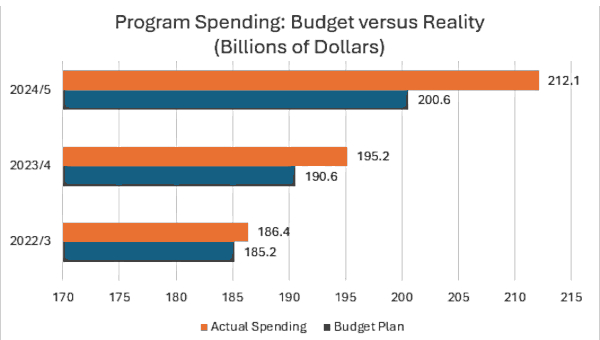
The government has shown a significant ability to increase funding for public programs and healthcare programs if the public demands it. The Public Accounts report that total provincial government program expenses for 2024-25 increased by $16.9-billion or 8.7 per cent over the previous fiscal year. That is an increase from $195.2-billion in the previous fiscal year to $212.1-billion in 2024/25.
Furthermore, the actual 2024/25 spend was $11.5-billion more than the 2024/25 Budget plan. The Budget was a very unreliable indicator of actual program spending.
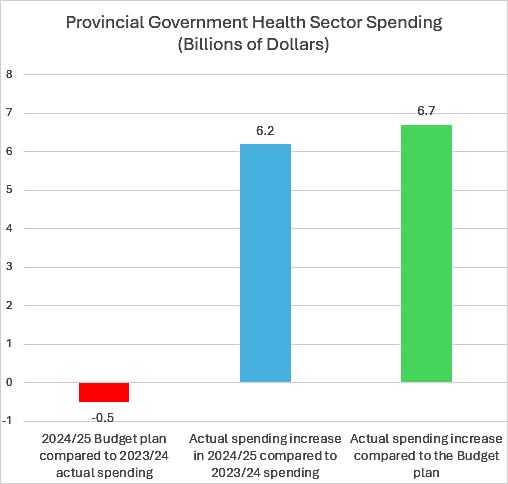
A similar scenario played out in health sector funding. It increased by $6.2-billion or 7.2 per cent over the previous fiscal year.
The total health sector spend was also $6.7-billion more than the Budget plan. In other words, the government planned to cut healthcare funding by half a billion dollars in 2024/25 but ended up increasing it by 7.2%. Again, the Budget plan was a very unreliable indicator of actual spending on healthcare as reported in the audited public accounts.
According to the Public Accounts, key health sector increases included:
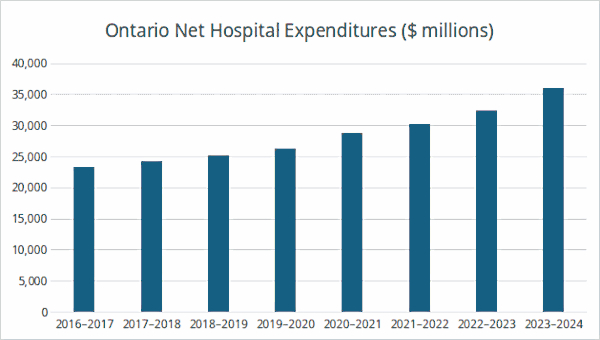
- $1-billion in higher spending by hospitals “driven by program growth, the expansion of service delivery capacity, and increased demand for services”
- $0.8-billion in additional funding for hospitals “to respond to Ontario’s aging and growing population”
Over the years, the current PC government has consistently altered Budget plans to increase hospital funding.
- So far in this fiscal year (2025/26), the province has added about another billion to the Ministry of Health budget plan – for home care and hospital care. It’s possible more may be added for 2025/26 in the 2026/27 Budget.
- The Financial Accountability Office (FAO) notes that in the 3rd and 4th quarters of 2024/25 there was a “$1,781-million increase for Health Services (Vote-Item 1416-1), including $1,009-million for the Operation of Hospitals, $257-million for Home Care, and $122-million for Community Support Services.”
- Similarly, the FAO notes that in 2023/24 fourth quarter there was a “$2,598-million increase for Health Services (Vote-Item 1416-1), largely for the Operation of Hospitals. The spending-plan increase is partially due to compensation for the impact of wage restraint under Bill 124, the Protecting a Sustainable Public Sector for Future Generations Act, 2019. A portion of the spending related to Bill 124 will not have a fiscal impact in 2023-24 because it was already recorded as a liability in 2022-23.”
- Similarly, in 2022/23, they increased hospital-operating funding plans by $258-million mid-year.
- In 2021/22, the hospital-operating funding plan increased by $3-billion in the fourth quarter.
Hospital funding plans can and do change, often late in the fiscal year.
According to the Public Accounts, health sector expense “increased from $69.5-billion in 2020–21 to $91.6-billion in 2024–25, or on average by 7.2 per cent per year” (our emphasis). Funding for the health sector has grown rapidly – but often the increases were achieved not via the Budget plan but by changes made during the fiscal year. The real budget is not set at the time of the provincial Budget but much later in the fiscal year. Unions, healthcare providers, and communities have to fight for the funding throughout the year.
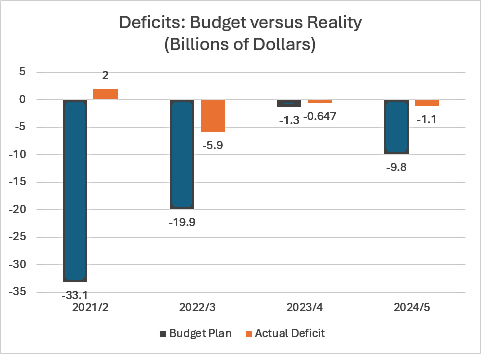
These in-year increases occurred, even while deficits consistently came in well under the Budget forecast: There is quite a contrast between forecasted budget deficits and actual deficits in recent years. The 2021/22 Budget forecast a $33.1-billion deficit. The Ontario government finished with a $2-billion surplus! The 2022/23 Budget forecast was a $19.9-billion deficit, but they finished with a $5.9-billion deficit. In the 2023/24 Budget, they forecast a $1.3-billion deficit but came in at a $647-million deficit. In 2024/25 they forecast a $9.8-billion deficit but finished with a $1.1-billion deficit.
In total, the government came in over $58-billion better than they forecast over those four years – in another words an average of $14.5-billion better than forecast.
This was usually achieved even with much higher spending than forecast, e.g., in 2024/25, the PC government forecast $200.6-billion in program spending but spent $212.1-billion; in 2023/24, they forecast $190.6-billion in program expenses but spent $195.2-billion; in 2022/3, they forecast $185.2-billion but spent $186.4-billion.
Things are not nearly as bad as the Budget usually claims. With fightbacks from unions, local communities, and by healthcare providers, there usually is significantly more spending than the Budget sets out, and this occurs simultaneously with much smaller deficits than projected in the Budget.
The fight for improved healthcare funding, before provincial Budgets and throughout the year, is vital. Ontario remains far behind other provinces in healthcare and hospital funding and so, for example, needs 48,000 more full-time staff just to meet the staffing levels of the other provinces. We need additional funding to offset healthcare inflation (which is considerable), population aging, population growth, increased utilization, people getting sick at a younger age, and people living longer with chronic conditions.
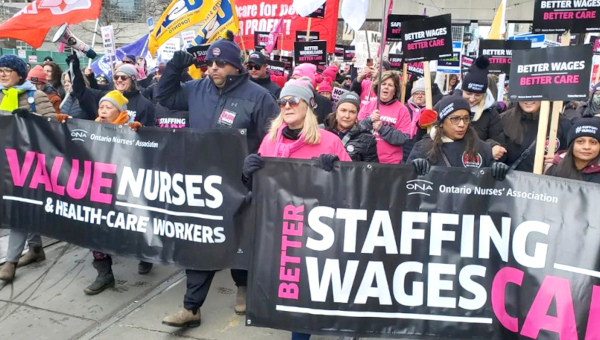
Campaigns have won additional healthcare funding in recent years, despite fierce resistance from the Ford government. But there is a lot more to do. •
This article first published on the Defend Public Healthcare website.