
Closing the Loophole on Canada’s Complicity in Genocide and War Crimes
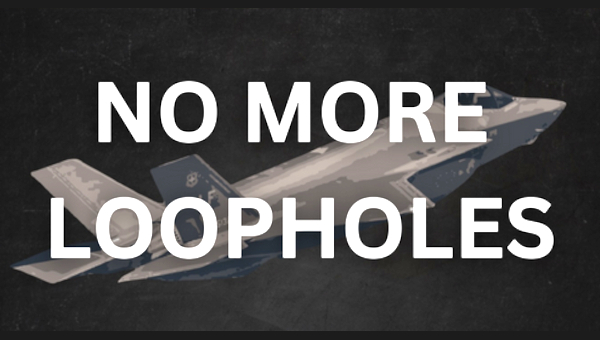
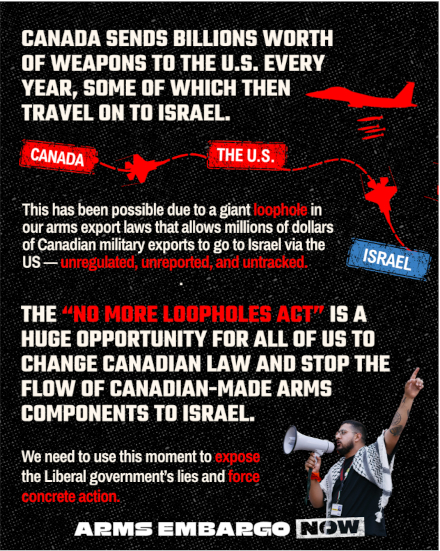
On Wednesday, March 11, MPs will vote on Bill C-233, the No More Loopholes Act. This bill, which is sponsored by NDP MP Jenny Kwan and jointly seconded by Liberal MPs Fares Al Soud and Nate Erskine-Smith, NDP MP Leah Gazan, and Green MP Elizabeth May, would prevent Canadian arms manufacturers from taking advantage of a ‘loophole’ that currently allows them to ship weapons and weapons parts to Israel, as well as numerous other countries, through the US.
The bill is currently scheduled for debate on March 9 with a vote on March 11. Bill C-233 would prevent Canada from supplying the US with weapons and weapons parts that would be shipped to countries committing war crimes.
What’s In the Bill?
The bill would amend the Export and Import Permits Act to more fully align it with the Arms Trade Treaty and to remove exemptions for specific countries by: (1) applying export controls to all arms, parts, and technology; (2) removing the US and other country-based exemptions from the Export Control List; (3) requiring end-use certificates to prevent diversion to human rights abusers; and (4) mandating annual reports to Parliament on Canada’s compliance with the Arms Trade Treaty.
Currently, most exports to the US do not require a permit.
“This bill closes the dangerous loopholes that undermine Canada’s international obligations and put civilian lives at risk,” Kwan said in a press release. “It’s about transparency, accountability, and making sure Canadian companies will not profit from war and repression.”
How Did We Get Here?
In July 2025, World Beyond War and the Palestinian Youth Movement (PYM) published a report, “Exposing Canadian Military Exports to Israel,” based on commercial shipping data tracing direct shipments from Canadian manufacturers to Israel through July 2025 and Israeli Tax Authority import data from October 2023 to May 2025. These findings garnered wide media coverage, as it definitively proves Canada’s complicity in the Gaza genocide,1 violating the one-way arms embargo implemented in March 2024.
“These exports are bypassing all of Canada’s export controls because of the way they’re routed through the US, and nonetheless, they’re still making it to Israel and directly supporting Israel’s capacity to carry out war crimes in Gaza,” said Rachel Small of World Beyond War following the release of the report.
Additional evidence released in November 2025, “Exposing The US Loophole: How Canadian F-35 Parts And Explosives Reach Israel,” provided further information describing how Canada continues to exploit the loophole by shipping Canadian-made fighter jet components and explosives to Israel via the US. Data from both reports directly refute the repeated denial of Prime Minister Mark Carney and Anita Anand, Minister of Foreign Affairs, and their continued insistence that no weapons or parts made in are being used in the Gaza genocide.
In May 2025, The Maple revealed that the Canadian Commercial Corporation (CCC) identified 99 cases of alleged Israeli crimes as detailed in a heavily redacted report. Despite these crimes, the CCC concluded that “indirect transfers” of Canadian-made weapons and weapons parts to Israel are “appropriately mitigated.” Global Affairs Canada (GAC) responded by saying they remained “in communication with the parties involved to ensure compliance with Canada’s rigorous export controls regime.” In addition, the CBC recently reported that the CCC alerted Dominic LeBlanc of the sale of ammunitions to the US, which were sent to Israel.
Currently, once shipments reach the US, Canada has no say on where weapons and their supplies will go – that is solely under the purview of the US government, a fact unbeknownst to most Canadians. And this goes beyond shipments to Israel.
As anecdotally reported, vehicles made in Canada were spotted in Sudan during the massacres that took place last year. The Independent also reported that the Canadian defence manufacturer Roshel has agreed to provide armoured vehicles to US Immigration and Customs Enforcement (ICE) as part of a 7+ billion-dollar contract. Regardless of whether the vehicles are made in the US or Canada, a Canadian company is directly contributing to the atrocities committed by ICE, who have killed several Americans and continue to illegally deport people or send them to detention centers that are riddled with human rights violations.
How Is the Vote Shaping Up in Parliament?
In ongoing discussions with MPs, Boutaïna Chafi, PYM organizer, noted that some legislators have two main concerns about the bill. They believe the bill would: (1) impact military support to allies like Ukraine; and (2) interfere with raw material exports. These are simply misconceptions.
Military assistance to Ukraine is sent primarily through an entirely separate process mediated directly by Canada’s Department of National Defence. What commercial trade we do have with Ukraine has received permits from GAC. The Bill also does not attempt to regulate steel, aluminum, or composite materials that have not been manufactured into parts or components for assembly into a full weapons system.
Bill C-233 removes country-specific exceptions from the Arms Trade Treaty that allow for indirect shipments from Canada through the US to countries committing war crimes and human rights violations. And will have no effect on the majority of exports.
In the weeks leading up to the vote, the bill has garnered some support in Parliament. It is likely that 15-20 Liberal, Green, and NDP MPs will vote in favour of the bill.
“Hundreds from coast to coast have organized actions at MP offices in the hopes of bringing these talking points to their elected officials. The closer we get to the vote, the more the grassroots pressure will become untenable for MPs,” says Chafi.
Will Canada Continue to Choose Profits Over People?
Alex Paterson, Senior Director, Strategy and Parliamentary Affairs, Canadians for Justice and Peace in the Middle East (CJPME), points out that Canada is at a crucial point in time while facing economic challenges posed by a now rocky relationship with the US, Canada’s largest trading partner. The Carney government is “sacrificing morality and Canadian values for economic growth” while ignoring Canada’s longstanding commitment to human rights abroad, although it should be noted that Canada continues to ignore human rights violations faced daily by indigenous people in this country. Fewer than 20 of the 94 Truth and Reconciliation Commission’s calls to action have been fulfilled in the last 10 years.
The Liberal government’s repeated denials about indirect shipments simply reflect their “feigned ignorance” since they currently are not performing human rights risk assessments on 60% of Canada’s military exports and therefore are not required to change our foreign policy.
Regardless of whether the bill passes, Chafi notes that the growing pressure from grassroots mobilization and the ongoing debates in Parliament are likely “further the rift within the Liberal Party, pushing GAC to take action.”
“The hope is that even in defeat we can facilitate further discussions about how Canada can honour its commitment to human rights,” said Paterson. •
(Special thanks to Boutaïna Chafi and Alex Paterson for their contributions to the article.)
Endnotes
- Projections posit that Israel’s actions will kill roughly 480,800 or 20% of the pre-October 2023 population of Gaza. Higher ratio scenarios suggest the possibility of over 682,000-961,600, or 28-40%, of Palestinians in Gaza eventually being killed as a result of Israel’s operations. However, the true death toll is unknown. Since the “ceasefire” was announced in October 2025, hundreds of people in Gaza have been killed. Israel, with the support of the US and other Western countries, continues to bomb Lebanon, in violation of their ceasefire, and accelerate the annexation of the occupied West Bank.