
Ensuring that the Unions’ Bark will be Worse than their Bite
The United States had a Tricky Dick. Canada has a Sneaky Mark.
Contextualizing Part III of Bill C-39—Labour Relations
A collective bargaining regime which does not permit a workers’ union to conduct a strike is not collective bargaining at all. It amounts to collective begging. Employers are in favour of such a regime. They can be kind to beggars or not. It is their choice. They like that. The Mark Carney government wants to make investors and employers happy. It says so all the time and now is acting on these declarations. Bill C-39 is a series of wide-ranging proposals declaring that Canada is more open to business than it ever has been. A central component is proposed legislation which will enfeeble trade unions. This weakening of workers’ power is found in an omnibus bill entitled The Building Canada Strong Act. It might be funny if it was not so duplicitous and draconian. How has this come about?
1944: From Collective Begging to Legal Privilege
Modernizing liberalism had to acknowledge the legitimate role of unions in the setting of terms and conditions of employment. In 1944, the federal government of Canada accepted a version of the United States’ New Deal legislation known as the Wagner Act. The skyrocketing unemployment and misery, the plunge in consumer demand, the threat to capitalism by rebelling workers, had combined to bring about a revolutionary change. From then on, employers lost their legal right to refuse to bargain with any union chosen by their workers. If a union, following some rather stringent rules, was certified by an administrative agency, a Labour Relations Board, the employer and the union were compelled to bargain with each other in good faith. If, after abiding by some more bureaucratic and dilatory processes, they could not reach an agreement, they were entitled to wage economic war fare against each other, but only against each other. The employer was entitled to lock out its own employees, and the union was permitted to organize those same employees to withhold their labour in concert.
The idea was, and is, that the economic pain the parties could inflict on one another might lead to more agreements without work stoppages. If that failed, the ensuing work stoppages would affect a minimum of third parties. The parties determined the terms and conditions by themselves, and they were enforceable at law. The duration of the agreement was specified by the parties and, during the life of that collective agreement, the parties were forced to settle any disputes about the interpretation or application of its terms and conditions by reference to a sophisticated privately-run grievance process. They were not allowed to resort to lock-outs or strikes.
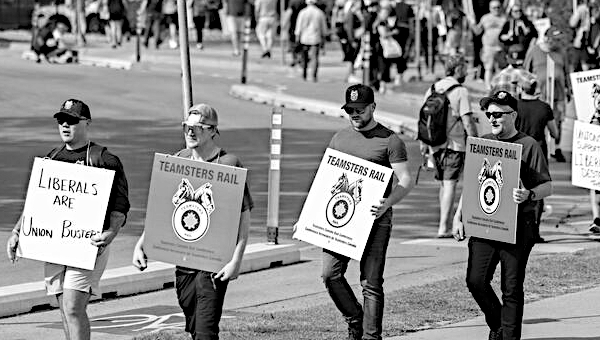
In Canada, this scheme was concretized after the 1948 Ford strike’s settlement, which added important features. A certified union was to have its dues collected for it by the employer (the Rand Formula). In return, the union took on the responsibility to ensure that workers did not engage in any collective economic action that was not permitted under the scheme. Most importantly, strikes could only be entertained to get a new agreement after following the processes the statutory scheme provided. There were to be no wildcats.
Canada’s collective bargaining statutes did not change in any fundamental way until 2015. Since 1948, there has been an entente that a modicum of countervailing power had to be granted to the working class and that this counterweight was limited by the statutes based on the 1935 Wagner Act model.
This is reflected in the way we talk about strikes. We call them legal or illegal, depending on whether all the labour relations statutory requirements have been met or not. So-called legal strikes, then, are best characterized as an exemption to the normal legal repression of concerted actions by workers. To say that a strike is a legal one is another way of saying that, in some very specific and rather narrow circumstances where all sorts of requirements to confine the impact of the strike have been met, the union and its members are to enjoy the privilege of not having the centuries’ old legal restraints apply to them.
Limiting the Privilege
Collective bargaining with its most potent weapon, the strike, was seen as a privilege, as an exception to the usual rules. It could be taken away if governments felt that a union was abusing its privilege. One abuse, of course, was the pooling of unions’ ability to get workers to strike to achieve social or political causes they favoured. This was behaviour which inevitably violated the enterprise-by-enterprise, narrow economic bargaining which undergirded the spirit of the private market Wagner Act model. It is a model which insists on keeping the attainment of economic and political goals separated from one another. While, in general, unions are politically more progressive in their beliefs than other institutions, our collective bargaining model dissuades them from using the might of the strike weapon to push working class politics. This is not to say they never do so, but they do so rarely and repeatedly try to re-assure the dominant class that they are not intent on turning their daily struggles with them into a war on employers as a class. Most of the time, when unions do support social or political issues, they do so more as if they were a strong and well-resourced advocacy group rather than as if they were principal militants engaged in class struggle. Educated to understand that their exceptional standing depends on adherence to the model, they find it hard to marshal their funds and organizational advantages to use the inherently coercive collective powers of workers to advance social or political causes.
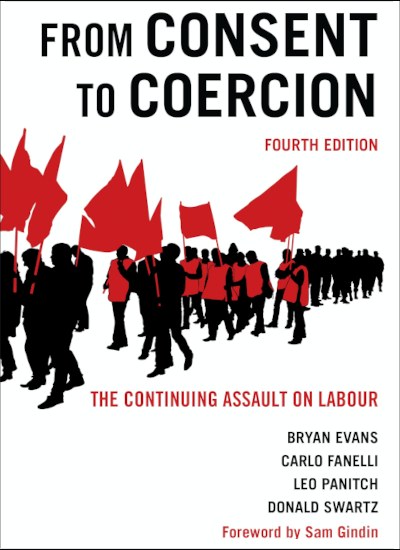
More pertinent here is the other side of this coin. The perception of the strike weapon as a limited privilege has meant that governments have felt free to use their default power to inhibit and prohibit the use of strikes. As capital, having had to make concessions after the end of World War II, began to claw back what it had lost, collective bargaining and strikes came under concentrated attack. Governments of all political stripes have limited permissible strikes or suspended them altogether. It became an epidemic in Canada from the late 1970’s/early 1980’s onwards. This was detailed and documented by Leo Panitch and Donald Swartz in 1988. To underscore the tenacious focus of all governments on the confinement and cribbing of union powers, the fourth edition of that book reported that, by 2023, some 35 years later, the assault on union powers was still in full swing.
It turns out that it was easy for governments to argue that they were not illiberal, that they were not abandoning their support for the need for a countervailing power, for unionism. They claimed that they had no real choice, that, on occasions, if they were going to fulfill their mandate to advance the greater good, they just had to force legal strikers back to work. After all, as properly elected governments they have a duty to make sure that necessary services not be imperilled by a union whose only permitted use of militant action is to pursue the narrow economic interests of its members. The union does not have any responsibility to protect the wider public as it discharges this duty. The government does. This justification for intervention with otherwise ‘legal’ strikes is most plausible when the employer confronted by a strike is an agency of the government tasked with delivering specific public goods and services, say, in public education, public transport, or the like. In those kinds of circumstances, governments will look benign even as they act coercively. Additionally, they are also supported by the logic of a rarely articulated concept.
That concept is that collective bargaining, Wagner Act model style, is a market-based scheme. It is a legislated piece of machinery which changes the bargaining climate for some workers and, having reconstructed the market, leaves it to the parties to come to terms. Some measure of coercion by workers is to be allowed, but this weaponry must not be used for wider political actions. For this reason, Franklin Delano Roosevelt wrote to say that the collective bargaining/strike regime which he had guided through the legislature should never be used in the public sectors. There the confrontations would necessarily be both economic and political, as demands for better work conditions would affect political choices and allocations of funds by governments. In the US, this caution has been heeded in many jurisdictions where public sector workers may not unionize or use the strike. Not so in Canada, which followed the unusual policies of Sweden and France that permitted government servants to strike. Since 1967, Canadian public sector workers – with notable exceptions such as police, firefighters, health workers, the military, farm workers – have been allowed to bargain and strike just as their comrades in the private sector have been doing since 1948.
The underlying model, then, is stretched beyond its raison d’etre. Distortions are inevitable.
In Canada, not only have we forced the Wagner Act model into the public sectors but, as manufacturing, mining, forestry, and fishing employ fewer and fewer workers, the most unionized sectors of the workforce are now to be found in the public sectors. Public sector workers are five times as likely to be covered by collective agreements than are those in the private sectors. Mainstream political parties, having taken on board the mantra propagated by capitalists that governments should step aside as much as possible and leave the creation of wealth to the owners of the means of production, have become focussed on privatization and deregulation of the public services they once delivered directly. To state the obvious, these are central features of Mark Carney’s vision as he embarks on the re-engineering of Canada.
This approach impacts harshly on public sector workers, including those in privatized services (rail, air, ports, post office…) where, even though governments have established private profit-maximizing entities to deliver services they once guaranteed, governments hold themselves responsible when a disruptive strike is undertaken. After muttering about their respect for collective bargaining, they frequently order workers to abandon their strike. “For the good of the general public,” they will say.
This repeated, persistent evisceration of the entente that some workers could enjoy the privilege of immunization from the sanctions enshrined in law was dictated and framed by the changes wrought in our political economy. As the nature of the economy changed, new technologies evolved, leading to different modes of production; capitalists became more mobile, giving them a stronger hand against workers; the dominant class and its think-tanks and intellectual gatekeepers became ever more effective as their entitlement to use their ample finances to influence political parties and politicians was legitimated. Public and para-public sector workers came to be identified by right-wing pundits and mainstream politicians as a major brake on the capitalist project. Governments increasingly led the fight on behalf of the dominant class. The working class increasingly saw government as a hypocritical force, one which favoured unions in word but not in deed. They saw governments deploy cunning tools to inhibit unions’ militance. Governments, instead of being potential allies, were increasingly perceived as enemies.
The embedded nature of this toxic approach to unions is what Panitch’s and Swartz’s book documented in 1988. In 2023, the fourth edition of that book reported that the governments’ assault on workers remained fierce, indeed appeared to be intensifying. In 2026, as if to prove the accuracy of that observation, the federal government’s anti-union stance is being given new oomph by Mark Carney. He is intent on strengthening the toxic brew by adding new poisons to it in order to dilute union powers and thereby build a “stronger Canada.”
2015: From Legal Privilege to an Enforceable Right
Unsurprisingly, as the governments’ attacks mounted, unions had sought to fight back. They went to a different forum for relief. In 1982, Canada embedded the Charter of Right and Freedoms in its re-patriated Constitution. It states that a freedom to associate with whomsoever they choose is available all individuals, including all workers. To a normal person this would signify that, should workers decide to form a union, an association, to protect and advance their causes, they would be permitted to have their union bargain and use a strike if necessary. Why else would they form this association, this union? But the people who occupy judicial benches and who interpret and apply the Charter are not normal people. So that, when public service unions went to the courts to complain that a provincial government or the federal entity had violated the freedom to associate by enacting legislation which provided that a union could not continue an otherwise ‘legal’ strike, they failed. Again and again. The judges agreed that their freedom to associate allowed them to form unions, but nothing else flowed from that. The 250-year record of anti-working-class judicial decisions was not to be jettisoned merely because the logical, the commonsense, interpretation of a clearly worded phrase in the Charter suggested that it should be thrown into the dustbin of history.
Unions under intensifying assaults by governments kept pleading their case in courts, and finally, in 2007, the Supreme Court of Canada agreed that freedom to associate guaranteed a protected freedom to bargain collectively, but not to use the strike. Workers continued to be ordered back to work after having initiated a ‘legal’ strike or having workers designated as essential workers diluting the impact of that ‘legal’ strike. Unions returned to the courts, asking them to rein in the governments’ interventions. Those intervening governments always proclaimed their continued devotion to collective bargaining even as they marginalized its efficacy.
It became an embarrassing situation: the highest courts in the land and elected politicians, the most ardent proponents of the liberal political philosophy embedded in the Constitution, denied that philosophy when workers fought for their welfare as collectives.
The pressure generated by this contradiction forced a major change on the elites. In 2015, the Supreme Court of Canada finally agreed that its interpretation of the freedom to associate had been wrong all the time. They acknowledged the truth of what disdained legally ignorant people – workers, their unions, and any person possessed of commonsense – had said all along. Our highest court of law simply declared that, after all, the right to bargain collectively required that the bargaining workers had a Charter-protected right to strike when the time was right. This statement of what should always have been the obvious was hailed as a breakthrough. Surely, from here on in, governments would be prohibited from smashing unions on behalf of the capitalist project. Now the previously limited immunity for strikes and strikers (so easily removed) seemed to have been transliterated into an inviolable right.
2015-2026: From the Right to Strike on the way back Toward Collective Begging
While the judges, perhaps to re-enforce the legitimacy of the judiciary, may have felt the need to change their minds, this consciousness is not shared by the dominant class or our governments. They are fighting back. Both governments and the courts retained discretionary powers enabling them to adulterate and to dilute the Charter protection given to striking workers.
First, even if a court decides that a governmental edict or policy violates the new and heralded right to strike, that court may then decide that, even though there has been such a violation, it is not one which attracts a judicial remedy. The Charter itself (section 1) demands that courts defer to elected governments when there is evidence that the Charter-violating intervention by the government is a proportionate response to a problem that needed attention. There is no certainty about how unelected judges will deal with this requirement to balance the right to strike against the need to defer to an elected government. Given the judiciary’s historic aversion to collectivized action by workers, it is not, however, too long a bow to draw to suggest that it will often be the case that the suspension of a strike may be seen as a reasonable response by Charter-violating governments. Manifestly, the right to strike bestowed by the judges is not absolute, not even in the judges’ minds.
Second, the Charter provides, in section 33, if a clause is inserted into a statute, such as a back-to-work statute, which explicitly says that, notwithstanding that the law may violate a freedom protected by that same Charter, it may not be invalidated by a court. This is a serious limitation on the Charter’s efficacy. There are, inevitably, a lot of protests about what are said to be abuses of the notwithstanding clause. There is a political cost for governments which use it. Nonetheless, it has been used by several governments to protect their suspensions of strikes by workers in a legal position to use that weapon. Once again: the recently minted right to strike is not an absolute right. People merely think it is. This does trouble some governments and some political parties.
Not all governments want to reach out for the notwithstanding clause to save their legislation from the provisions of the Charter. For instance, the current NDP government in Manitoba says it will not deploy it unless a court has given its views on impugned legislation. More directly relevant to this paper, the federal Liberal Party has given a public undertaking that it will never use the notwithstanding clause to shield any of its legislation from Charter challenges. This brings us to the third weapon in the hands of the anti-right-to-strike brigades. Governments can, and do, resort to legal chicanery. Apparently, this appeals to Prime Minister Carney.
Much of his current popularity rests on his claim that, as a man of finance and high-level wheeling and dealing, he knows what is best for us. He is the new broom who will zealously sweep away the bumbling and unknowing L(l)iberalism Justin Trudeau had foisted on us. He has cancelled Trudeau’s timid effort to levy a capital gains tax on the super wealthy and a digital services tax; he drove a wrecking ball through Trudeau’s stuttering efforts to protect the environment – the carbon tax, cap and trading, the promotion of electric vehicle building – and in contrast, is pursuing environmentally destructive pipelines, mining, etc. He has reversed Trudeau’s rather expansive and tolerant immigration policies; he is committed to sack 42,000 federal public servants from Trudeau’s supposedly bloated Public Services; he has disparaged and then dramatically changed the low level of military spending the Trudeau government had favoured. All in a very short time. Carney has repeatedly shown his disdain for the kind of Liberal government presided over by Trudeau. Except for one thing Trudeau got right.
He loves Trudeau’s innovative way of attacking the working class. It may well be that Carney admires it because it echoes his profoundly-held belief that investors of capital, of money, are more important to wealth creation than the actual producers of that wealth. And/or it may be that the adaptation of Trudeau’s methodology when assaulting unions will allow him to continue to present himself as a real liberal while doing illiberal things, like curtailing the right to strike.
The Trudeau government was confronted by a series of strikes, all initiated after extremely lengthy negotiations which included attempts at conciliation and mediation. Railways, ports, air transport, and the post office were brought to a standstill. Because the federal Liberals had committed themselves to be the ultimate cheerleaders for the Charter, they could no longer do what they had done for about two decades or more. They could not enact special legislation ordering the workers back to work. The government would be seen as deliberately violating the new right to strike. But it still wanted the same outcome: to beat those uppity unions down. The government found a way.
They revived some provisions in the Canada Labour Code which had been dormant for decade: sections 107, 108 and 108.1. Section 107 gives the responsible Minister the right to refer a matter to the Labour Relations Board overseeing the operation of the Act. The minister may do so if there is a crisis. The minister can ask the Board to determine what should be done – suspend the strike, order arbitration – or could direct the Board to make such a decision. The conceit is that any apparent interference with the right to strike is not the result of a government acting politically against workers but rather the working of the Canada Labour Code as it is meant to work. The processes are presented as being a-political. There are no public debates in the legislature. There is no clear attack on any Charter right, even though one of its guaranteed freedoms may be violated.
The legitimacy of this line of argument hinges on how wide the discretion of the minister is when setting out to suspend the right to strike by invoking section 107 (or sections 108, 108.1). This is not the place to unravel the different ways a legislature drafts the scope of the minister’s discretion. But it is useful to note that its technique is inspiring anti-working-class fellow travellers. The Coalition Avenir Québec (CAQ), having been faced by massive para-public and public workers’ strikes in 2023-24 in Quebec, has enacted a statute which the Minister, Jean Boulet, specifically said is channelling the federal government’s section 107 and refining it. The statute provides that a whole series of procedures must be followed ere a minister can suspend a strike or direct a labour relations board to do so or to order arbitration. The procedures are an attempt to show that the minister has come to a well-based decision that a crisis requiring intervention with strike rights exists.1 The procedures are guardrails. Do they make it difficult for a minister to suspend strikes? Not at all. The Quebec statute has given a sweeping range of circumstances which will allow the minister and labour relations board to spring into anti-strike action. They may do so when the strike is viewed as imperilling health and safety; social, economic, or political welfare; or national security. The language is vague, plastic, malleable. The scope of discretion left to ministers is breathtaking.2
This kind of perfection of the gambits engineered by the Trudeau government in 2024 invites employers to play hardball in negotiations, pushing unions to strike knowing that there will be relief soon. To ensure that there will be government intervention, they often will lock-out the striking workers. This permits a government to say there is an irreconcilable conflict. Governments are enabled to claim that they have been forced to make an a-political decision to stop the strike from wreaking serious damage to the welfare of one and all.
It is trickery: everyone understands that this machination is undertaken to neuter the impact of the Charter-protected right to strike, that the government is malevolent in intent.
The trick, and it is a trick, appeals to Carney. It is easy to see why it might. He has spent his life amongst bankers, large corporations. and financial investors. The technique is familiar to him. It is one used by major corporations when they set up schemes to avoid tax. Like tax avoiders, governments find a provision in a statute which, if applied imaginatively, will render one of the statute’s main goals unattainable. By relying on the formality of law, that is, by pretending that they are acting legally, the governments undermine the spirit of the law to which they repeatedly proclaim their undying loyalty. When tax avoiders were found to be using legally permissible shell corporations to hide their profits from tax laws, Obama bitterly said, “It may not be illegal but it is immoral.”
And yet, Carney, the man who stands for the Rule of Law and liberal values (as he indicated in his book Value(s): Building a Better World for All), is embracing this trickery, this chicanery. In the Background Paper for Bill C-39, it is proposed that section 107 is to be given new guardrails, requiring a special mediator to be appointed who will report to Ministers who will consider the report (they are not to be bound by it) as they determine whether the strike or lock-out will have a “significant adverse national impact.” Talk about vague, plastic, malleable! Of course, the proposal will be debated before it becomes law, so there may be changes. Hopefully, they might make the use of section 107 more difficult. Or, it may be that Jean Boulet, having channelled and improved the trickster Trudeau’s ploys, will be Carney’s mentor as he strengthens his assault on workers, a frightening thought. We will have to wait and see. In the meanwhile, we have been given a clear indication that Carney’s government is in the business of dampening workers’ power on behalf of Big Business.
Summation
- Carney is draped in the flag as he holds his elbows up to ward-off the ogre Trump who does not share our liberal values. But that does not signify he is abandoning the capitalist project. Far from it. Carney believes that the rich must be allowed to get richer. This is good for Canada and Canada’s sovereignty. As the very wealthy chase more wealth, there will be growth as measured by Gross Domestic Product. Eventually, so goes the sweet talk, this will lead to a better opportunity to save our now more ravaged environment and to halt the now deepened erosion of the working class’s well-being. After all, to get to the promised land, sacrifices have to be made. Not by the wealth class. Because capitalists must be seduced to invest some of their wealth in Canadian projects, they are to be given tax breaks, less annoying environmental regulations, and an assurance that unions will have no serious power. The self-proclaimed liberal Carney has no difficulty sweetening the pot for the owners of the means of production while demanding that workers and their unions must give up some of the gains they had made after centuries of struggle. His life as a successful functionary on behalf of capitalism has required him to develop intellectual elasticity. He is ready to re-shape, to dilute his liberal values, if they interfere with the private accumulation of socially produced wealth. Carney is a dangerous man because his elbows-up and faux-folksy posturing as the reasonable and sage adult in the room has been sold very well to the public, while all the time he is actively pursuing the agenda of the ultra-wealthy, Canadians or not. Our physical environment is under greater threat than ever it was. Unions are under the same threat as endangered species are.
- For the longest time unions had enjoyed a privilege that gave them some immunities from repressive laws when they bargained collectively and struck, provided they abided by a set of restrictive monitoring rules. As capitalists set out to roll back the concessions they had made, the assault on the expanding para-public and public sectors intensified. They were the target because one of capitalists’ objectives was to reduce State interventions and control of spheres of activities where profits could be made. As the assaulted sectors reached out for help, they went to the courts that were to administer the Charter of Rights and Freedoms. The judiciary, an institution whose anti-working-class sentiments are deeply etched in its DNA, took 33 years to declare that collective bargaining rights must include the right to strike. This has elicited responses from the dominant class and its compliant governments. It has given rise to innovative avoidance measures by governments that say they respect the judicial notion that there is a right to strike but that, regrettably, it has to be taken away from time to time. Under Trudeau first, then other provincial functionaries and now Carney, these new processes can be used not only to reduce the judicial right to strike to rubble but also to dilute the standing that the long-lived zone of privilege for unions and their members had enjoyed. There is an overall push that is bringing our mechanisms of adjustment to resolve capital-labour dispute closer and closer to a collective begging regime. Inexorably, this will drag down the conditions of all other sectors of the working class. This is a clear and present danger to our notional liberal polity. Even liberals know that “necessitous men are not free men.”
- It is clear that a class war is being fought by capitalists and the governments that serve them. They want liberty for themselves, not others. They twist and turn, leaving old liberal-based laws formally on the books but, functionally, in tatters. It is legal and immoral. There needs to be a “gloves-off, over the board” response, to use the imagery Carney likes to deploy. These refined and sophisticated brutal attacks by governments eager to do the bidding of Big Business, that is, eager to wage class war from on top, must be met with a vigorous, class-based response. While it is easier to say than do, a practical response would be for the unions of this nation to issue one simple statement to which they all subscribe. It should be something like this:
“If the federal government enacts Part 3 of Bill C-39 as currently proposed, we, the unions of Canada, will not obey that law. Never. We will not be reduced to being beggars on behalf of workers. Beggars are not free. Workers want to be free. That is what sovereignty means.”
It would amount to organized disobedience of laws that have been corrupted. There would be dangers, for both individuals and unions. However, unionists and unions would have the moral high ground and considerable political heft. As Arundathi Roy wrote, “We are the many, they are the few.” •
Endnotes
- The Quebec statute also allows the Minister and the Board to name essential services in respect of which the parries should negotiate which employees are to be designated to maintain a level of services during a strike or lock-out. The parties’ agreement is subject to oversight by the Board which may amend it. The purpose is clear: restrain the unions’ capacity to conduct effective strikes.
- For an elaboration on sections 107, 108, 108.1 , see my “The Air Canada/CUPE Fight and the Bias of Law: and why it is righteous and effective to breach the law,” The Bullet, 25 Aug., 2025. For the Quebec legislation see An Act to give greater consideration to the needs of the population in the event of a strike or lock-out. The title of the statute tells the story of how a government pretends that it abides by the right to strike but that, sometimes, it must give way to other social and economic goals. In Quebec, the title of another statute also speaks to that government’s vicious anti-worker mentality: An Act to improve the transparency, governance and democratic process of various associations in the workplace, April, 2026. Its purpose is to deny the right of workers to use their dues for social and political causes, that is, its purpose to reduce unionism to a narrow privilege. Hopefully the Carney government will not follow this lead. But who knows?