
Opposing Western Intervention and the Iranian Regime
As the United States and Israel escalate their military campaign against Iran, the war is being justified through a familiar vocabulary: security, deterrence, and the elimination of existential threats. Yet beyond official rhetoric, the conflict is also unfolding as a battle over narratives – one shaped by media framing, digital propaganda, and deeply divided political communities.
Among the most striking features of this moment is the fragmentation of the Iranian diaspora. While some voices have openly supported military intervention in the name of “liberation,” others warn that such positions risk legitimizing a destructive external project with long-term consequences for Iranian society. At the same time, attempts to oppose both the Iranian regime and Western intervention are often marginalized, reduced to simplistic binaries that leave little room for nuance.
In this interview, award-winning Iranian-Canadian journalist and producer Samira Mohyeddin offers a critical perspective on the narratives surrounding the war, the role of social media and organized messaging, and the internal contradictions shaping diaspora politics. Drawing on historical context and contemporary developments, she challenges dominant assumptions about Iran, questions the logic of external intervention, and reflects on the political and ethical difficulties of sustaining a principled anti-war position in an increasingly polarized environment.
Baris Karaagac (BK): In his televised address on April 1, Donald Trump defended the war against Iran primarily in terms of security and stability – particularly the need to prevent nuclear escalation and eliminate perceived threats. Similar justifications have appeared across official statements and much of the media coverage. How do you interpret this narrative, and what does it obscure or leave out?
Samira Mohyeddin (SM): I think the primetime address that Donald Trump gave to the American public was primarily an attempt to sell this war. As you noted, he framed Iran as an imminent threat and emphasized the need to eliminate its nuclear capabilities. But what is consistently missing from media coverage is crucial context.
Back in June, during the 12-day war launched by the United States and Israel against Iran, the US used a weapon it had never deployed before in this context – a 30,000-pound bomb. Following those strikes, Trump himself stated that Iran’s nuclear capabilities had been “obliterated.”
So, the question is: are we really expected to believe that within just a few months, Iran was able to fully recover from that supposed “obliteration” and reconstitute its nuclear program? That claim simply does not hold up.
We know this in part because Rafael Grossi, the head of the International Atomic Energy Agency, stated just days after the latest escalation that Iran posed no imminent threat and was not developing a nuclear weapon. According to the IAEA, Iran was not even close to having that capability. Yet this context is largely absent from mainstream coverage.
Instead, what we are seeing is a process of manufacturing consent. The United States and Israel need to justify this war to their domestic audiences – to convince Americans why they should be paying $4 a gallon for gas. When Trump tells Americans that this war is “a great investment” for them, their children, and their grandchildren, it reveals the extent of that effort. Quite frankly, the statements he was making were laughable.
There is also a broader historical dimension that is often overlooked. Iran fought an eight-year war with Iraq – a conflict in which Iraq was backed by major Western powers, including France and Germany. Despite that, Iran did not concede even a small portion of its territory.
What people don’t understand about Iranians is that they will fight to the end. They don’t care how much infrastructure is ruined or anything. They will not give up this war to America and Israel.
BK: Now, this next question is a little bit personal. You have also been the target of online attacks, including from pro-Israel and Zionist voices. More broadly, how do you assess the role of Zionist and pro-Israel advocacy networks and institutions in shaping media narratives about Iran in Canada and other Western contexts?
SM: I think it would be a mistake – and a dangerous one – to dismiss the role that social media has played, both in this specific conflict and over the past decade.
Let me break your question into two parts, because the impact of propaganda directed at Iranians inside the country is crucial to understanding what is happening.
First, Israel operates a significant number of Persian-language social media accounts that are explicitly targeted at Iranians. What kind of messaging are people hearing? They are hearing messages from Benjamin Netanyahu and other officials claiming, “We are coming to rescue you. We are the only country that cares about you.” At times, Netanyahu has even delivered these messages in Persian, including through AI-assisted translation.
Alongside this, there are satellite television channels such as Iran International and Manoto TV, which for decades have pushed and promulgated a certain ideology into the country. So, there is a long-standing ecosystem of messaging that predates the current war.
And then, on the other hand, we know – from outlets like The Times of Israel and Haaretz, Israeli media outlets – that Israel has spent, this year alone, up to $250-million on social media campaigns, including paying influencers $7,000 per post. Netanyahu met with them in New York – we have the photos. These are not conspiracies; these are facts.
And they have really pushed an agenda to try and get Iranians to agree with the dropping of bombs on their heads.
You mentioned the threats I have received. When I look at many of these accounts, they are not real people. They may have two posts, ten followers – clearly inauthentic profiles. But there are so many of these accounts pushing the same messages that people stop asking basic questions: Is this a real person? Or is this a bot?
Instead, a narrative takes hold – that Iranians support the war, that they welcome these attacks. But the reality is far more complex. These campaigns rely precisely on the assumption that most people will not investigate the sources of what they are seeing.
BK: How do you interpret the fact that parts of the Iranian diaspora, including in Canada, frame external military intervention as “liberation”? What does this reveal about diaspora politics, and what consequences might it have for struggles inside Iran?
SM: These are great questions – really excellent questions – because I think, first of all, we are dealing with a very dangerous diaspora.
And I use the word dangerous on purpose, because they are wholly delusional. And they don’t quite understand the impact, which brings me back to the propaganda we were talking about – the effectiveness of the messaging that Israel has directed at Iranians, both inside and outside the country.
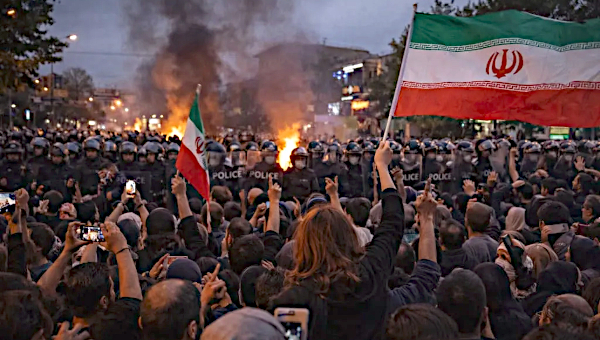
Right now, we are seeing members of the diaspora waving Israeli flags, gathering outside embassies, and thanking Donald Trump for what he is doing. Many people excuse this behavior as desperation. I disagree. I don’t think it is desperation.
I think that within parts of the community, there is a mode of thinking that is deeply authoritarian, even fascistic. And there is also a latent form of racism that is rarely acknowledged. What has emerged, in some cases, is a kind of homo-nationalism that is very fascistic at its core.
There is also a recurring idea among some Iranians that they are the exception. You hear statements like: “We are not Syria. We are not Afghanistan. We are not Iraq. We are much more sophisticated.” But what does that imply? It reflects a hierarchy – it reflects racism.
It suggests that, regardless of what external powers such as the United States or Israel want, Iranians somehow stand apart from the rest of the region. We are much more sophisticated than these people.
You also hear figures like Mark Levin saying that people in Iran are “Persian,” that they are “Western,” and that they are not like the rest of the Middle East. And some Iranians internalize and reproduce this message because it offers a sense of distinction or superiority.
A lot of Iranians get angry at me for pointing this out because there’s this idea of airing our dirty laundry in public. But I think it’s really important to call this stuff out because we’re going down a very dangerous road – very, very dangerous.
BK: In your view, why has it become so difficult in public debate – particularly in Canadian and Western public debate – to sustain a position that both opposes Western military/imperalist intervention and critically engages with the Iranian regime? How should such a position be articulated?
SM: It’s hard to maintain this position because it is, quite simply, a messy one.
In the media and in public discourse, there is a tendency to reduce everything to black and white. We operate in binaries. If you are against the Iranian government, then you are expected to support the war. And if you support the war, then you are aligned with Israel and the United States. There is very little room for people who reject both positions – for people like me, and what I believe is actually a silent majority.
People are afraid to speak out. It is not just about holding a principled position – it is about the consequences of doing so. People are attacked, threatened. I receive death threats and racist abuse on a daily basis. I mean, these aren’t imaginary things, right?
To take a principled stance against the decimation of your country’s infrastructure, while also recognizing that the Iranian government is authoritarian and repressive, is a very difficult balance to maintain right now. But it is one I refuse to abandon.
This is not a new phenomenon. For decades, anyone who has opposed war against Iran has been labelled “pro-regime,” accused of being paid or acting on behalf of the state. I myself have been accused of taking money from the Iranian government. It is absurd – it is almost a parody – but it remains a persistent tactic, especially within parts of the diaspora, to discredit dissenting voices.
Even when someone has consistently criticized the authoritarian nature of the Iranian government – as I have, including in publications like The Globe and Mail – it makes little difference. If you are operating within any space that has nuance or exists in shades of grey, you will be labelled as such. And the people who do this are, I’m sorry to say, very ignorant, and I don’t trust them.
There is a Persian expression – hezb-e baad, the “party of the wind” – which describes those who simply follow whichever direction the wind is blowing.
And the wind has shifted. Just a few months ago, it was strongly pro-war. But in recent days, some of those same voices have reversed their positions, as the consequences of the war become more visible.
A lot of people who were pro-war have now completely done a 180 because they’re starting to realize that with every bridge that gets bombed, with every pharmaceutical company that gets bombed, the United States, and Israel are only concerned with decimating the country of Iran.
Decimating its domestic capabilities and creating a servile client state, like they have in Syria – one that Israel can come and bomb from time to time, and that has no ability or capability to protect itself or its citizens.
BK: You have emphasized that meaningful political change in Iran must come from within. Why do external interventions – despite being framed as supportive – tend to undermine that possibility?
SM: There are historical precedents for this – and it has never worked. If you take a long view of Iran’s socio-political history, going back even to the Constitutional Revolution of 1905–1906, you can see that change has often emerged through internal dynamics and transnational connections within the region. People were learning from each other.
For example, in the early 1900s, Iranian women were in contact with women in India who were organizing boycotts of British cotton. Iranian women learned from that and organized boycotts of British sugar and tea. These kinds of regional exchanges were taking place, but they were never welcomed by external powers such as Britain, Russia, or later the United States.
We have also seen the consequences of external intervention elsewhere. Iraq is a clear example. The country has still not recovered from the US invasion and occupation. Do I think Saddam Hussein was a good person? Of course not. But change should have come from within Iraqi society, not through foreign intervention. It is delusional to think that meaningful change in Iran can come from the outside.
If the United States believes it can engineer transformation, we should already have seen evidence of that. We have repeatedly heard figures like Donald Trump and Benjamin Netanyahu call on Iranians to take to the streets. But how do you expect a civilian population to mobilize when 1000kg bombs are falling on them? It is simply not realistic.
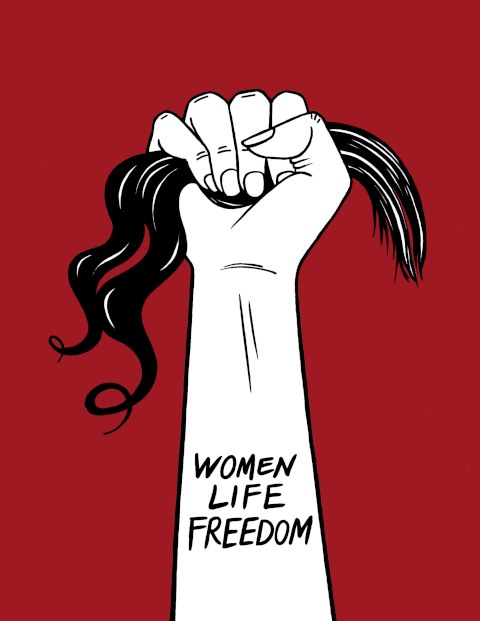
What is often forgotten is that internal change has been happening. During the “Woman, Life, Freedom” movement in 2022–23, significant social transformations were taking place. These social changes – made by women – were incremental – step by step – but they were real.
More broadly, Iran today is not the same country it was in the 1980s. Despite the constraints of the political system, there have been important advances, particularly driven by society itself. Iranian women, for example, have made substantial gains. Iran ranks among the leading countries in terms of women graduating in STEM fields. And figures like Maryam Mirzakhani – the only woman to have won the Fields Medal – reflect these developments.
These changes have often occurred in spite of the state, not because of it. Yet there is a tendency in public discourse to erase them, to present Iran as a static, unchanging society. That is simply not accurate.
Look, we also need to have a long view of what democracy is. Europe had four or five hundred years to get to where it is today. How many revolutions did France go through before developing the system it has now?
And we expect Iranians to catch up in 50 years? How is that possible? It’s impossible.
Iran was never left alone to do what it needed to do in order to make these advances – especially in the last few years. And now, we are going to see everything that Iranians were able to build over the past 50 years start to disappear because of this war.
BK: At this moment – given the intensity of the war, the media environment, and the divisions within the diaspora, including in Canada – what do you see as the most dangerous misconception shaping public understanding of Iran today?
SM: I think one of the most dangerous misconceptions is the idea that all Iranians are in favour of this war. One of the most troubling framings – especially in Western media – is the suggestion that Iranians welcome this war, that it is somehow necessary, or that people are simply helpless and waiting for external forces to intervene.
There is also this implication that Iranians themselves wanted this outcome. This is a very dangerous narrative. It’s very dangerous to say that, and it’s because, you know, as I said, we have this diaspora that, unfortunately, is going through this collective psychosis and delusion that somehow Israel and the United States are coming to help it when all they really want to do is destroy the country.
BK: We thank Samira Mohyeddin for this insightful and thought-provoking conversation. •
This article first published in Turkish on the BirGün website.