Healing Iran’s Wounds
Tehran, Nowruz (New year) Days, March 2026
It is the first days of Farvardin.1 I have come to Tehran to buy a book. It feels apocalyptic: dark lifeless streets; an overcast sky thick with smoke; passersby troubled and sorrowful. A few bookstores around Enghelab Square2 are open. There is a sharp smell of sulfur in the air. Someone points southward and says they have bombed somewhere in the southern part of the city. It seems a thick black column of smoke has risen into the sky from Shahr-e Rey.3
On Keshavarz Boulevard,4 I see several men in black carrying Kalashnikovs,5 and a few people handcuffed to the railings in front of a building. They are shining flashlights into the detainees’ eyes and interrogating them.
The atmosphere is heavy and terrifying. One of the men in black comes up behind me and says that if I do not walk faster, I too will be arrested.
There is none of the usual liveliness of Laleh Park.6 The food stalls along the boulevard are gone; neither the park market nor the kiosks are open; and in the darkness, there is no sign of Tehran’s famous cats.
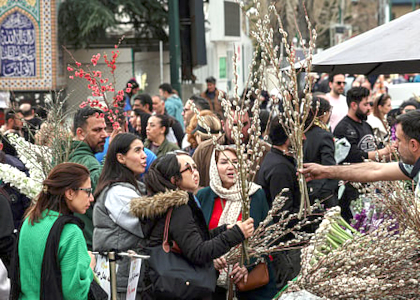
In Valiasr Square,7 around a thousand people have gathered carrying Iranian flags. A giant television screen stands on one side of the square, and Mohsen Chavoshi’s8 song Hasbi Allah9 is playing. A Maddah10 chants in praise of the valor of the first and third Imams of Shi‘ism11 and the resistance of Iran’s fighters, and the crowd chants along with him.
A man climbs onto the platform and speaks of one of his friends who had been stationed behind a missile launcher and whose two hands were amputated in the hospital. He speaks of another friend: “He was martyred last night. The son of that martyr was born just a few hours ago.”
Most of those gathered in Valiasr Square are women. I see at least two women who are not wearing hijab.
For twenty-seven days now, Iran has been under bombardment by the wicked forces of the world. For more than forty years, Netanyahu had wanted to bomb Iran. In his resignation letter last week, the head of the US National Counterterrorism Center wrote that the Israel lobby had dragged Trump into this war.
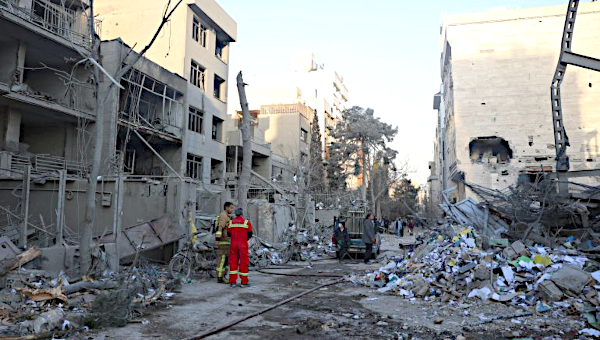
As of today, one hundred thousand residential and commercial units across Iran have been damaged. Three hundred medical and emergency facilities have been destroyed or rendered inoperative. Five thousand Iranians have lost their lives. Millions in Iran [and Gaza and Lebanon] have been driven from their homes. And the environmental, psychological, and economic wounds of war remain to be fully felt.
Netanyahu and Trump are the embodiment of human wickedness in the contemporary world: racist, deceitful, greedy, and complicit in the slaughter and suffering of children. Their ultimate aim is to weaken Iran under the banner of “fighting the regime.”
Israel was opposed to a strong Iran even before the Revolution. For fifty years, regardless of which government has been in power in Iran, America’s inhumane sanctions have been imposed on the Iranian people. It was the US president that tore up the JCPOA12 before the cameras, not Iran.
Isfahan, the Days Before the War, Winter 2026
It is the days before the war. I am in Isfahan,13 speaking with a friend I had met through cycling around the city. He had been arrested on the 18th of Dey14 and had spent a month in Dastgerd Prison in Isfahan.15
He says that two of his cellmates were brothers in their twenties. The younger brother had asthma. Their mother had gone to the judge several times, saying her son needed medication. The judge refused her request to deliver the medicine. The younger brother grew weaker by the day in prison, but the authorities paid no attention. Until, in the final week of his detention, in the crowded and stressful environment of the prison, he fell unconscious. The officials took him to the hospital. The next night, news came that the boy had died in the hospital. My friend spoke of the grief that settled over Dastgerd Prison with that news.
I go to a hospital in Isfahan for my father’s surgery. There I see another acquaintance who has come for his wife’s treatment. He tells me about his sister and brother-in-law, who, on the 19th of Dey, were crossing the street when the brother-in-law was shot and killed before his sister’s eyes.
The acquaintance says that for nine days the authorities refused to hand over the brother-in-law’s body to the family. They gave the family two choices: either pay a substantial sum to retrieve the body, or sign a document stating that the deceased had been a supporter of the government and was a martyr. In the end, under psychological pressure, the boy’s mother agreed to sign the document. The acquaintance says that his sister still has a speech impairment.
Beyond the Binaries
The media – from Iran International16 to state television – generally construct binary narratives; that is, they portray two groups of Iranians in opposition to one another so that a story of good versus evil can take shape, and each side comes to see the other as its enemy: pro-/anti-regime, pro-/anti-war, religious/non-religious, and so on.
These binaries, however, are simplifications of a complex social reality. Most of Iran’s population likely belongs to neither end of these spectrums.
A free Iranian stands against oppression. It makes no difference whether the oppressor is foreign or domestic, whether oppression is carried out in the name of religion or in the name of human rights. A free Iranian stands against discrimination. It makes no difference whether discrimination comes from a racist European or a prison officer, whether it is the result of colonialism or despotism.
A mother whose soldier son has been killed behind a missile launcher, and a mother whose son was killed on the 19th of Dey, experience a similar suffering in their humanity. A soldier who has lost both hands behind an air defense system, and a protesting farmer in Isfahan who lost his eyes to pellet shots are equally deserving of empathy and care.
Families who spent the moment of the New Year17 at the martyrs’ cemetery share common experiences with the families of those killed in the Ukrainian plane crash18; Kian Pirfalak19 and the schoolgirls of Minab20 are equally worthy of attention and mourning.
Our collective well-being depends on bringing these ordinary people closer together. The Iranian phoenix rises from their coming together.
To come closer together, we need to become familiar with each other’s lived experiences. This requires listening. Listening is an act of selflessness. And selflessness does not emerge from anger and resentment.
If Iranian society is to pass through this crisis without falling victim to endless violence between people, there is no path but connection with those other ordinary people; that is, stepping out of one’s own epistemic cave, leaving behind self-made tribes, and walking toward those who hold a different worldview, yet share with us in being human, being Iranian (and being Muslim).
The truth is that the beginning of this path lies not outside us but within us.
Hope Amid the War
In these days of war, when Red Crescent workers pull someone from beneath the rubble, they do not ask about that person’s political or religious beliefs. Their service is universal, without favor, without discrimination, effective, and directed toward the preservation of all Iranian lives. They are among the best practical examples of how to break the prevailing binaries, serving people not as supporters of one side or another but simply as human beings in need. •
Original Persian text on Ali’s Telegram channel, and here.
Endnotes
- The first month of the Iranian calendar.
- A cultural hub in Tehran, named after the 1979 revolution.
- A historical district in the south of Tehran.
- A boulevard near Enghelab Square in central Tehran.
- A rifle commonly used by the IRGC.
- A major park in central Tehran, bordering Keshavarz Boulevard.
- A major square at the intersection of Keshavarz Boulevard and Valiasr Street in central Tehran.
- A popular Iranian singer and songwriter.
- An Arabic phrase meaning “God is sufficient for me.”
- Religious vocal performers who sing at Shi‘i ceremonies.
- Imam Ali and Imam Hossein: Ali, who was assassinated while serving as caliph, and Hossein, whose martyrdom at Karbala lies at the heart of Shi‘i tradition.
- The Joint Comprehensive Plan of Action (JCPOA) was a 2015 international agreement, in which Iran agreed to limit aspects of its nuclear program in exchange for relief from international sanctions. The United States withdrew from the deal in 2018.
- A major historical city in central Iran.
- The tenth month of the Iranian calendar, corresponding roughly to December–January. Just before the war, popular protests were brutally suppressed in the days around the 18th and 19th of Dey.
- A major prison in Isfahan, known for severe overcrowding.
- A London-based news outlet with disputed sources of funding.
- Refers to the equinox moment (tahvil-e sal), which marks the
beginning of the Persian calendar and is celebrated by Iranians as Nowruz. - Refers to Ukraine International Airlines Flight 752, departing from Tehran, which was shot down by Iranian forces shortly after takeoff in January 2020, killing all 176 on board, most of them Iranian.
- A nine-year-old boy killed during the 2022 “Woman, Life, Freedom” protests in Iran, whose death became a widely recognized symbol.
- Refers to more than 100 schoolgirls in Minab, a city in southern Iran, who were killed on 28 February, the first day of the ongoing war, in US airstrikes.