
Trolling the Law Books to Find New Ways to Shut Down Critics of Israel
Outrage and resistance are growing against a vicious campaign to muzzle political speech and action. That campaign aims to silence and punish public criticism of Israel’s actions, especially the genocide in Gaza and the ethnic cleansing in the West Bank. Desperate at their inability any longer to defend Israel’s indefensible activities through traditional propaganda techniques (Hebrew word “Hasbara”), Canadian pro-Israel organizations and the lawyers who work with them have turned to attempting outright silencing (Hebrew word “Hashtakah”). We might call the instigators of Hashtakah Mashtikim.
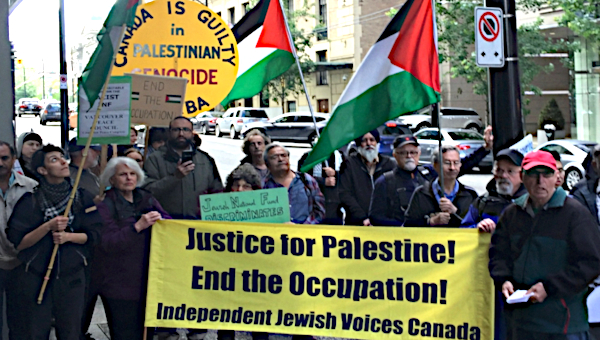
One aspect of the Hashtakah campaign is the attempt to prohibit demonstrations, rallies, protests, and meetings about Palestine at venues in cities across the country. I have written about bubble zones in the past. Winnipeggers recently rallied to halt bubble zones in that city.
A second and equally ominous aspect of the silencing campaign is abusing the law in novel (and totally inappropriate) ways to charge, bring to court, enjoin, and ultimately incarcerate those who speak out. And so far, especially in Montréal, it is having an effect. That is possibly due to the presence in that city of a group of especially aggressive pro-Israel lawyers who troll the lawbooks for new ways to punish and intimidate their opponents. The name of the game is legal overkill.
One of the latest legal manoeuvres involves using strong criminal law remedies originally designed for serious crimes involving the possibility of violence. The mashtikim have now weaponized that law against an entirely different target – non-violent political protest.
The Use of Criminal Harassment
One such law is called “criminal harassment” originally designed to protect women against violent male perpetrators.
In the early 1990s in Canada, there were a number of high profile killings by men of their female spouses. Several of these murders were preceded by harassing actions by the male spouse. Seeing that other means of deterrence, like peace bonds, were often less than effective, the Federal government in 1993 introduced Section 264 (and later additional amendments) to the Criminal Code that provided, when the victim reasonably fears for her safety, strong measures to deter the offender.
The offence of criminal harassment is ‘muscular law’, meant for a particular purpose. In the opinion of those involved in women’s rights advocacy, it is an essential tool in the kit of preventing intimate partner violence. A study of the law after ten years by legal researchers concluded:
“Criminal harassment, like sexual assault, is a gendered crime, and section 264 was enacted specifically to deal with the problem of men harassing women, usually their former intimate partners.”
It is clear that Section 264 was intended to prevent violence against intimate partners. It is meant to give possible offenders the narrowest berth to carry on spousal abuse.
But Section 264 was not meant to curtail an entirely different venture, political expression, an activity protected by Canada’s Charter of Rights and Freedoms. Nobody has the right to abuse and harass their intimate partner. On the other hand, we do have the right to engage in political expression. Free expression is such a crucial part of our democracy that we give it the widest berth possible. Expression cannot be curtailed except in exceptional circumstances.
Political expression, by its nature, can even sometimes be aggressive, rude, and discomfiting. Says lawyer Barbara Bedont of the Quebec organization Defend the Movement, which provides political activists with pro bono legal assistance:
“Freedom of expression is not meant to protect pleasant ‘chit-chat’. We have it in our constitution in black-and-white, and it’s to protect speech that is unpleasant, uncomfortable. It’s meant to allow people, citizens, to hold the politicians’ feet to the fire.”
Frédéric Bérard, a lawyer who teaches constitutional law at the Université de Montréal, told the CBC that harsh words alone aren’t enough to warrant an arrest, and that freedom of expression must be protected.
“We need to protect that sort of speech, that sort of protest, if we want to protect the democracy and protect the rule of law.”
While Section 264 involves a reasonable fear for safety, there are other laws against harassment. For example, Section 372 prohibits repeated or indecent communications via technology intended to harass, alarm, or annoy, and prescribes lighter penalties. Peace bonds and court orders also exist to impede persistent annoyance. And, of course, the Charter right to free expression involves us all tolerating a certain level of annoyance from people we disagree with. To paraphrase Oliver Wendell Holmes, allowing political speech one doesn’t like is the price we pay for civilized society.
Thus, the use of criminal and other forms of harassment law against political expression amounts to a blatant abuse of process.
The use of criminal harassment as a blunt force instrument does present some difficulties to the authorities: at trial it may be unsuccessful or the charges could be dropped if the Crown finds no reasonable chance of conviction. Or the use of the law could be overturned by the courts if and when it is subjected to a Charter challenge.
But, as activists often say, the problem is not just conviction, “the process is the punishment.” Getting dragged through jail and the courts is painful. A Charter challenge could take many years to wend its way through the courts, costing the plaintiffs a lot of money and a lot of time and disquiet. Meanwhile, cost, time, and irritation will have the intended chilling effect on protest and political expression. This is not to mention that those charged sometimes lose their jobs.
Below are three recent cases involving the misuse of Section 264.
Case 1: “The Indigo 11,” Toronto
In November 2023, police staged highly disruptive middle-of-the-night raids on the houses of ten protesters (an eleventh had been arrested earlier) who had several days before thrown washable red paint and pasted posters on the doors of Indigo Books’ Toronto main store . A month after Israeli forces began what would soon be labeled a “genocide,” the protesters had targeted proprietor Heather Reisman for her aid to the Israel Defence Force (IDF) through a charity supporting non-Israeli soldiers.
Police laid some hefty charges against the group, including criminal mischief, conspiracy to commit an indictable offence, and (the above-mentioned) criminal harassment. Claiming that Reisman had been targeted merely for being Jewish, police also added that the crimes were hate-motivated, rendering the accused susceptible to greater penalties totalling up to ten years in jail.
But the accused and their supporters vigorously denied hate motivation, insisting that Reisman was targeted not for who she is but for what she does and that the vandalism was a political act. Politics was certainly at play, as court documents revealed that Reisman had spoken to Toronto’s police chief shortly after the defacing.
This was possibly the first use in Canada of the offence of criminal harassment for political activity.
Civil liberties advocates like Naomi Klein called the arrests and the police modus operandi “an attack on political speech the likes of which I have not seen in Canada in my lifetime.”
Eventually, fifteen months later, there was not one conviction on the charges. The Crown dropped most of them. The few accused who pleaded guilty and received discharges may well have regretted that decision in light of the subsequent lack of convictions for the others. Yet, despite the failure of the charges, all of the accused suffered the punishment of the process. A message was sent and received.
Case 2: Alkhdour, Montreal
This case involves a Palestinian-Canadian woman originally from Gaza who suffered a heartbreaking loss. Due to foot-dragging by our Federal Department of Immigration, Refugees and Citizenship, Samar Alkhdour’s 13-year-old daughter, with permission to immigrate to Canada, died in January 2024 in Gaza before that could happen. The Canadian government’s failure to expedite the entry of Gazans after 7 October, 2023 is a national scandal, especially when compared to its earlier open arms to Ukrainians after the Russian invasion, where 81 percent of immigration applications were accepted, but only 16 per cent for Palestinian bids. The Ukrainian refugees were helped with their airfares, employment, and access to health care; the Palestinians got no such consideration.
Alkhdour was shattered when her daughter died so close to coming to Canada. As the mother told the media:
“I’ve had to live with that experience of losing a dear child. I don’t want that to happen again for my sister, for other family members of mine.”
She turned her heartbreak into action:
“She said that after her daughter’s death, she felt “helpless and useless,” so she decided to mobilize and staged sit-ins outside [at the time Immigration Minister Marc] Miller’s Montreal riding office in protest of the Canadian government’s policies on Palestinian refugees.”
For several months in 2024, Ms. Alkhadour and supporters picketed there daily. An altercation in September of that year is described by her lawyer, Barbara Bedont as reported by the CBC:
“Bedont said Alkhdour was packing her belongings after the protest, when Miller showed up in a vehicle. She said Alkhdour approached the vehicle and ‘expressed her feelings about his policies.’
“‘They said ‘shame on you’ and ‘you’re a child killer.’ Things like that — political speech,’ the lawyer said, adding that Miller was in the vehicle the whole time before it drove off.
“She said the interaction lasted about five seconds, with Alkhdour standing about a metre away from the vehicle, and the other two people who were charged standing further back.
“‘At no time was he ever threatened,’ Bedont said. ‘There was no violence. It was a purely peaceful expression of her political view.’”
Based upon a complaint by two of Miller’s assistants, police in Montreal charged Alkhdour, Wendy Ing, and Mohanned Mansour with criminal harassment. Miller’s people contended that protesters had surrounded the minister’s car, banged on and damaged it, and shouted obscenities.
Police across the country have informal protocols, or steps, by which they proceed in cases of criminal harassment. According to the informal legal protocol in Montreal police arrested the three. As with intimate-partner offenders, the accused were forced to surrender themselves into custody, and be subject to conditions to permit release. The criminal harassment charge carries a penalty of maximum of two years in prison or a $5,000 fine.
The conditions of release were severe. To avoid custody, the defendants effectively were enjoined from protest: they had to promise to stay away from the Minister’s riding office, refrain from posting about him on social media, and stay at least 50 metres away from the minister and two employees. They were forced to stay in detention overnight in order to contest the conditions before a judge.
Their lawyer, Bedont, got to the heart of the matter, criticising these conditions as effectively “criminalizing” the protest.
Before the judge, the three presented videos of the incident showing the accusations to be untrue, and the charges were dropped.
Nonetheless, the accused had to endure the humiliation of arrest, the expense of legal counsel and the torment of the legal system, and a night in jail. Moreover, others involved in the protest movement got the chilling warning that this could happen to them simply for organized dissent.
But the Montreal authorities weren’t done using criminal harassment against political activity.
Case 3: Engler, Montreal
A third case in point involves political activist Yves Engler. The case is convoluted, involving two separate legal battles, so I will refer to them as “Engler-Kurtz” and “Engler-police.”
Engler-Kurtz: During 2024, Engler, a well-known author and persistent critic of Israel, engaged in a social-media war of words with Dahlia Kurtz, a fervent supporter of Israel. Engler says he never directly messaged or threatened Kurtz, but harshly criticized her political positions on social media. Rather than using the blocking function on social media to shut Engler out, Kurtz responded with the accusation well-worn in the Israel-defending universe, that she felt “unsafe.” However, police did not respond to her urgings that they take action. At first.
According to Engler’s counsel, John Philpot, late in 2024, lawyer Neil Oberman got involved on Kurtz’s behalf ,and it became clearer that Engler was being set up.
In the pro-Israel ecosystem, Oberman has distinguished himself as an especially aggressive deployer of legal techniques (aka “lawfare”) to punish and silence pro-Palestine activists. For example, he was at the epicentre of the failed injunction against the pro Palestine student encampment on McGill University’s public field and later injunctions establishing judicial “bubble zones” forbidding protest at Jewish institutions across Montreal (described in more detail HERE.) In the April 2025 federal election, Oberman ran for the Conservative Party against Liberal incumbent Anthony Housefather in the Mount Royal, where Jews make up over a quarter of the population, a contest to see which of them was more in favour of Israel. Housefather won that round.
According to Philpot, subsequent to Oberman’s taking Kurtz on in December 2024, Kurtz lodged a complaint of criminal harassment against Engler with the police.
As in the Alkhdour case mentioned above, the police followed the informal protocol they use for criminal harassment in s. 264 and demanded that Engler present himself for arrest. Remember that this started as an online political dispute between two people.
To be released from custody, he was assigned several conditions by a judge, including not to talk, not to discuss the case on social media, and not to discuss the name of the person on social media. Engler refused to agree to some of these terms, calling them excessive, and the judge ordered him to jail, where he spent five days.
In the Engler-Kurtz case, the Crown eventually decided to drop the charges from the Kurtz complaint, an indication of just how flimsy it was. But this was not the end of Engler’s woes.
Engler-police: Back in February 2025, when police were responding to Kurtz’s complaint, the Montreal police hate-crimes division investigator Francesca Crivello contacted Engler’s lawyer to announce that Engler was going to be arrested for criminal harassment (of Kurtz) and go through the protocol.
On February 18, 2025, Engler wrote on social media about the pending arrest. He provided an Action Network petition form suggesting that supporters email Crivello. A pre-composed message stated: “The arrest of author Yves Engler for social media posts opposing Israel’s genocide is an abuse of state power. The charges against the father of two young children should be immediately withdrawn.”
Crivello received over 1600 emails. Rather than simply blocking the email petitions, Crivello claims to have been intimidated and prevented from doing her work. In response, police laid a bevy of charges against Engler: obstructing a peace officer (section 129(a)), attempting to obstruct justice (section 139(2)), and harassment (section 372(2)). Section 372 prohibits anyone from intentionally alarming or annoying someone else via “indecent communication.”
At Engler’s trial in January 2026, Judge Karine Giguère found him guilty on all three counts. Engler is appealing the conviction.

The Consequences of Criminal Harassment in Political Activity
A legal newsletter The Jurist summarizes the overkill threat presented by these convictions:
“The verdict could significantly restrict the public’s ability to petition law enforcement officials and challenge police charging decisions. This case is unusual in Canada, as it involves criminal convictions stemming from a coordinated email campaign to a police officer, prompting discussion about the limits of advocacy and free expression under the Canadian Charter of Rights and Freedoms.”
Among the concerns is this: organizing supporters to rally against or petition authorities is a fundamental tactic in the toolbox of political expression. Far beyond any temporary inconvenience to the authority, it is a way for the public to notify the authority that many people feel deeply about a cause, and perhaps get the authority to change its approach.
Were the convictions to stick, and a stiff penalty ensue, all political campaigns that involve petitioning public authorities would possibly become hors la loi (outlaws). Whatever the outcome, peaceful protesters are treated as criminals and must endure the punishment of the process. And that is precisely what the mashtikim desire.
As for Engler, he is a controversial figure not only for those on the right but also to some on the left. He marches very much to the beat of his own drum. Some refuse to come to his assistance for fear of appearing to endorse his whole political project.
But that is shortsighted. Often, in the realm of political expression and its preservation, civil libertarians are called upon to defend those with whom they don’t 100 percent share politics and methods.
Indeed, that is the real test of commitment to constitutional rights, especially freedom of expression.
Let it not be said, to paraphrase Pastor Martin Niemoller: “First they came for Engler, but some of us didn’t like him, so we said nothing.”
The victims of legal sledgehammers may be called unique cases. But they are not. If those instruments of Hashtakah can be used against the Indigo protesters, Ms. Alkhdour and her co-accused, or against Mr. Engler and we do not fight back, then these measures can be used against anyone protesting injustice, and our legal system becomes the tool of the tricksters who wish to change the channel away from genocide and ethnic cleansing. •