
A Socialist Political Earthquake Strikes Seattle
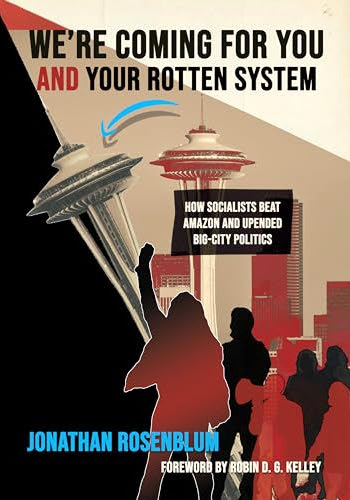
In recent years, municipal politics has emerged as an essential and viable arena for building socialist leadership and movements. In 2013, a group of socialists built an electoral strategy and a working-class-led movement to take on the corporate structure in Seattle, which is home to some of America’s largest corporations, including Amazon, Boeing, Microsoft, and Starbucks. Jonathan Rosenblum’s book, We’re Coming for You and Your Rotten System: How Socialists Beat Amazon and Upended Big-City Politics (OR Books 2025) examines how this movement disrupted the political terrain in Seattle and raised the bar for what the Left can achieve, even under the most seemingly difficult times.
The book centers on the coalition of activists and organizations of this movement, led by Kshama Sawant. Sawant, a software engineer with a PhD in Economics, became active during the 2011 Occupy Seattle movement. She was recruited by the Socialist Alternative (SA), an international socialist organization that emerged out of the New Communist Movement in the 1970s. Sawant ran for city council in 2013 against a top Democratic Party member on council at the time, on a platform to raise the minimum wage in Seattle to $15 an hour. Rosenblum, who was former director of the SeaTac Airport workers’ Fight for $15 campaign, describes how the momentum between Sawant’s campaign for city council and the fight for $15 was synergistic. But even though workers were excited about their win, most of their paycheques went to their landlords.
Like many major cities around the world, the fight for affordable housing in Seattle took center stage in the mid-2010s. As Rosenblum writes, an average of 1,000 people were moving to Seattle every week during the city’s tech boom, and developers and big landlords took advantage of this boom by raising rents and gentrifying previously affordable neighborhoods. Between 2012 and 2016, Seattle area rents increased by 29 percent, and homelessness grew by 21 percent to over 10,000 people on the streets. In the Central District, the Black population went from 70 to 15 percent.
Insurgent Politics
Reflecting back on his time as a staff organizer in Sawant’s office, Rosenblum argues that the Tax Amazon movement in Seattle embodied a new kind of left politics, which he calls Marxist insurgent politics. It is neither a recipe for organizing nor a policy framework but rather a set of methods and principles for advancing socialist struggles in the twenty-first century that center around three key pillars: 1) a class struggle approach; 2) making bold demands; and 3) building popular movement democracy. When Sawant became councilmember, she immediately refused to participate in back-handed deals between labour union leaders, the Democrats, and corporate executives to undermine the fight for $15. Taking a class-structure approach, Sawant exposed the rifts between labour leaders and their members, as well as elected officials and their working-class constituents. She launched an alternative grassroots campaign for the fight for $15, led by rank-and-file members. The second pillar centers on developing bold demands that signal the need for systemic change, such as the fight for $15 and Tax Amazon, and seeing them through to victory. To be clear, the tax was aimed at large firms, but Amazon was the largest revenue source of the tax given the size of the company. Third, the movement emphasized hard-hitting tactics with grassroots organizing and participatory democracy. Organizing neighborhood and citywide meetings to build consensus, alliances, and demands, and mobilizing for the city’s annual budget review were ways in which the movement built democratic participation. For Sawant and the SA, it is not only important what a movement can win for the working class but also how it wins.
Rosenblum claims that Marxist insurgent politics represents a radical departure from the road of incremental reformist politics that has come to dominate much of the Left, particularly among European Social Democrats and in the US, within organizations such as the Democratic Socialists of America (DSA) and the Justice Democrats. To back this claim, Rosenblum covers a lot of ground. From revolutionary parliamentarism in Europe in the 1900s to the beginnings of the international Socialist Alternative in the 1960s, Rosenblum reconstructs nearly 175 years of Marxist political struggles, showing how reformist-minded socialists have retreated from class struggle by making compromises with the capitalist class and demobilizing the working class. The seeds of the Tax Amazon movement were also planted during key moments of Seattle’s history of mobilizations against corporate power, from the anti-globalization protests in 1999, to the anti-war movement in the early 2000s, and Occupy Seattle in 2011. This history informed how Sawant and the SA approached struggles over policy and secured important wins, including the expansion of tenant and workplace rights, taxing big business to fund social housing, with the explicit goal of building a working-class coalition that could challenge the ruling class. The book itself is largely told through the voices and stories of key activists in the movement, positioning readers within some of the key debates and conversations at the time.
A New Coalitional Politics for the Left
While Rosenblum’s three pillars of class struggle, bold demands, and democracy provide a useful starting point for understanding the general theory and strategy of the movement, as a housing activist in Vancouver during the same time period, I was drawn to the distinct approach that Sawant and the activists around her took toward movement building: 1) building a broad-based coalition; 2) organizing rank-and-file members outside of the labour unions; 3) developing principled socialist leadership; 4) advancing socialist politics at the municipal level.
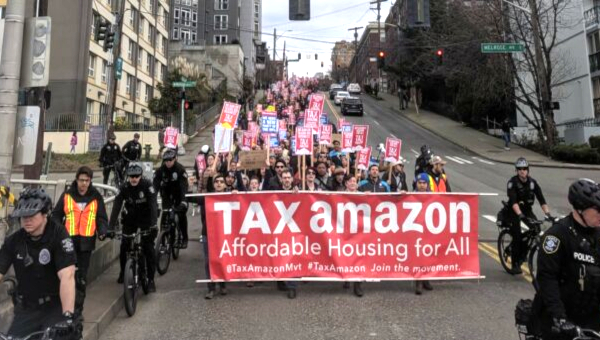
First, the movement achieved what most housing struggles have not – it merged struggles for labour, housing, and racial justice (which are often treated as separate primary class struggles in the realm of production and secondary struggles in the realm of consumption). Years of groundwork culminated in a cross-sectoral coalition of activists from labour unions, housing organizations, and Black Lives Matter. The tax was passed at the height of the Black Lives Matter protests in 2021, when BLM activists forced the Democrats on city council to raise the tax rates to $214-million a year to fund at least 750 of new union-built social housing units per year, as well as $20-million for Green New Deal funding, and Sawant’s amendment that an additional $18-million be dedicated toward new affordable housing for Blacks. In 2024, the tax’s revenue generated an actual revenue of $360-million because of Amazon’s payroll income. The victory of the Amazon Tax, as Rosenblum underscores, is thus a victory of the BLM movement.
Second, both the fight for $15 and the Tax Amazon movement organized rank-and-file members outside of the unions. The movement had a clear strategy to reject business unionism – the practice of unions that solely focus on improving wages, hours, and working conditions within the framework of capitalism rather than toward the achievement of extensive social changes or reforms for the working class. Sawant revealed how labour leaders and Democrats were willing to compromise with corporate CEOs on the fight for $15 as well as the tax on Amazon, with some even defending Amazon as a responsible developer that also pays living wages. But organizing rank-and-file members also comes with significant challenges for the workers themselves. Rosenblum gives examples of how members of the Carpenters’ union who joined the Tax Amazon movement found themselves in hostile situations where they faced the wrath of their fellow members and union leaders. This means that it is crucial to identify what Jane McAlevey calls ‘organic leaders’ – workers that can influence and persuade other workers – as well as activists, and for the movement to support and back rank-and-file members.
The third lesson is about building principled socialist leadership – how to lead as individuals and as a movement – without compromising on core values. In the US, Sawant’s electoral victory in 2013 was part of a wave of high-profile democratic socialists who were elected to office, from Bernie Sanders to AOC to the Squad members, and most recently, Zohran Mamdani. Rosenblum argues that while all of these candidates channeled working-class outrage toward the ruling class, Sawant’s leadership differs sharply from progressive Democrats because she is uncompromising and actively builds democratic participation throughout her campaigns.
Rosenblum also highlights what leadership looks like in different phases of a movement – leadership in the face of defeat as well as victories, and while navigating splits and debates within coalitions and organizations. The key lesson here is about developing a perspective that political disagreements and setbacks are often neither permanent nor necessarily destructive to a movement. The first version of Amazon tax was repealed in 2018 before it was brought back in 2020 and passed at a higher rate. During a crucial wildcat strike that was organized by construction workers, activists also engaged with pro-Trump supporters who were initially hostile toward Sawant, but they were won over by her support of their strike. These events are a reminder that circumstances always change, and contradictions can shift. Socialist leadership has to be attuned to new contradictions as they emerge.
The fourth crucial lesson is that municipal politics is indispensable to advancing a transformative socialist agenda. The Seattle experience was part of a global wave of housing struggles in major cities worldwide, including in Barcelona, Berlin, and Vancouver. These struggles all took up housing in various ways, including housing activists that ran for city council, as in the case with Barcelona, to build municipal socialism. But even without control over the mayoralty or majority over city council, Sawant and the SA shows how labour and housing rights could be expanded at the local level. During her ten years in office, Sawant introduced policies to support workers, including mandating employers to pay for workers’ parking, restoring the right to strike and a ban on no-strike clauses in city construction projects, as well as penalties for wage theft.
However, the book also raises additional questions. A demand to tax Amazon is certainly bold, but what is the transformational vision that accompanies this insurgent approach against Amazon? A paradox often accompanies such victories, where workers’ livelihoods are improved, but the capitalist firms can continue to operate, and in the case of Amazon, they are expanding exponentially into various sectors of the economy and our lives through healthcare, courier services, groceries, online data management, and media content. Further, while Rosenblum insists on organizing new activists to take on insurgent politics, what is the political vehicle that they can join, especially after the campaign or movement? The book also raises a key issue that plagues the Left, which is how to build and sustain alternative working-class organizations, outside of mainstream unions and political parties, which can then control the state from outside as opposed to trying to change it from within.
Rosenblum provides a crucial starting point to reflect on these questions and has written this book to encourage – even insisting – activists to take up creative and confrontational approaches to class struggle. Activists will find this book to be an important read, particularly those who are organizing against Amazon, as well as social housing activists. But those who are supporting electoral campaigns and running for city council as progressives will also find many insights. •