
Organizing Amazon: An Interview with Amazon Worker Solidarity
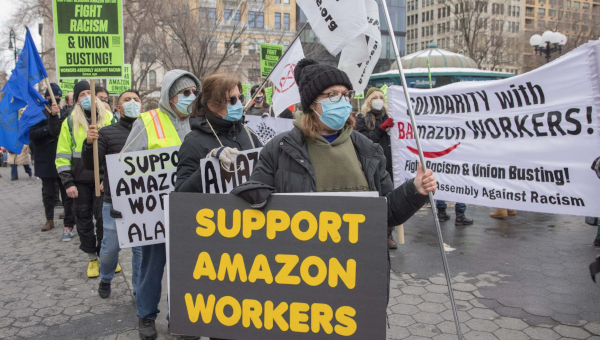
Milla Vodello is the pseudonym of an organizer with the Amazon Worker Solidarity (AWS) group in Toronto.1 Amazon Worker Solidarity is an independent grassroots organization of trade unionists, community activists, researchers, and workers at Amazon who recognize the fight against Amazon must be led by Amazon workers. It serves as a research and communications hub that disseminates analysis, research, and knowledge to support organizing happening on the ground at Amazon facilities in Ontario. Amazon is at the forefront of the current technological assault against workers, and since the mid-2010s, has been a core target for labour politics throughout Europe and North America.
Milla became politicized during university, where she started organizing with her campus union. Soon after graduating, she began working at an Amazon fulfillment center in the Greater Toronto Area. Milla recognizes Amazon as a key workplace for radical politics not only because of Amazon’s scale and power but because organizing Amazon workers will lead to significant changes in Canada’s labour movement. She has been a labour organizer at Amazon for several years, and it is through this activity that she met Victoria Fleming. A media and labour studies scholar from Toronto, Victoria has also been involved with Amazon workers’ struggles in Canada, including through research that supported AWS’ efforts to understand the company and its chokepoints.
Victoria Fleming: How did you get involved with Amazon? Why do you focus on Amazon?
Milla Vodello: The Postal Workers Union in Canada had a “salting program” for Amazon. Salting programs find people who are willing to get hired to organize a workplace. When I learned it was Amazon, I became very interested. The scope and scale of Amazon in an industry like logistics, which is important in the West and North America in particular, could lead to a meaningful breakthrough in the labour movement. But it also requires the transformation of the labour movement to seriously take Amazon on. The story of the Amazon movement in general is that, before big unions were involved, a few socialists in different places got jobs there to organize. It’s grown past that now in good and complicated ways.
VF: How do you approach organizing at Amazon as a socialist? What makes that different from other approaches?
MV: In some ways, how a socialist would approach organizing, especially at a place like Amazon, would be considered good organizing by labour movement or unionist standards. The reasons why you are doing it and what your intentions are would inform certain decisions in a different way. This approach to organizing is considered good because you’re trying to develop leadership among the working class instead of focusing on mobilizing people around a specific issue who then become activated around campaigns. We’re organizing to say we’re contesting management for power all the time. Even though a union, in the end, is a defensive organization, the point is to develop a parallel structure to management. Unions have their management and their interests, and we should be able to have that on our side. To do that you need to be able to build up leadership in the union. You have to be systematic and specific when you’re organizing so that you have the whole place organized, not just interested people who come out to things. You’re constantly trying to build an organization that covers the whole of the work and the workplace. That’s a very difficult task, but I think it’s especially necessary for Amazon.
At Amazon, we’ve learned – partially through our relationship with research – that the kind of strike where everyone knows about it in advance, since it happens after bargaining breaks down, won’t be very effective. Stopping production is something Amazon can get around. You need to have a deep enough and wide enough organization where you can switch on and off disruption and use different disruption tactics. That will mess with them.
As an example, imagine in one facility or at a couple facilities, people slowing down work one day and working normally the next day. That would make Amazon go crazy and they wouldn’t know how to deal with it. If it’s a known walk out or strike, they have redundancy built into their systems so efficiently that it’s easy for them to get around it. But disruption, that can be unpredictable. It needs a very high level of coordination and organization to pull off.
For organizing, people think about where the least redundant places with the smallest number of people are. They’ll go there to organize because it seems to make the most sense. If you were to follow this logic, last-mile facilities would be ideal sites to organize. They’re smaller, and once the package is there, if you stop it from getting somewhere, you’ve disrupted something. They can’t reroute that same package. But we focus on the big places, what’s referred to as the “first-pile facilities” [fulfillment centers, in e-commerce slang], where all the inventory first comes in that are massive and replaceable. They can reroute the work quite easily in those places. There are a few reasons why we focus on them that we think are necessary in the long term of organizing. One is for political reasons. We’re in this work not only because we want to mess with Amazon. The point is to build working-class organizations. We want to go to the places where there are massive amounts of people and think about how to organize them. We need to learn how to do this in this new context. The other reason is, if we consider the disruptive approach instead of striking, fulfillment centers are good places to be. They’re not easy for Amazon to move or shut down. A lot of capital is injected into these facilities as opposed to the smaller delivery facilities that can be easily shut down or moved around.
To build political power at Amazon, you have to organize the masses of workers. These masses of workers are in fulfillment centers (also known as “first-pile facilities”). If you’re organizing in one of these facilities it’s easy to be isolated, but if you’re organizing in at least two or a few, it will be difficult for Amazon to isolate you. They’ll feel like there’s disruptive activity happening in more than one facility, and it’s spreading. We refer to this as a “regional strategy.”
VF: What role did research play in your organizing strategies when deciding to focus on fulfillment centers rather than delivery stations?
MV: First, we had our political conclusions and knew these needed to be tested or corroborated. Research on Amazon’s facilities and how Amazon functions, where they tend to put their money, what importance they place on different facilities and for what reasons, showed us that this was a good strategy beyond it being a politically relevant focus. These fulfillment centers make up a big percentage of major industrial projects in the United States.
Additionally, Steve Maher and Scott Aquanno’s recent report, “A Prime Competitor: Understanding Amazon’s Market Power,” analyzes how Amazon makes their money.2 This report challenges three common arguments about Amazon that people cling to and use to assess their organizing assumptions. First, people argue that warehouses are not profitable and that Amazon Web Services makes all of Amazon’s money. The second assumption is that Amazon’s monopoly in the logistics sector is continuously gaining concentrated amounts of power. The third assumption is that Amazon’s greatest logistical strength is that it can deliver something within a day of you ordering it, which is true and important. With these three assumptions, people focus on last-mile delivery as the site of organizing. Amazon will care the most if you stop the package from being delivered to a customer within a day. Amazon does care about this, and we’re not going to pretend this doesn’t matter. It does. Steve and Scott’s report showed that Amazon’s logistics empire is at the heart of how Amazon functions and funds its other businesses and initiatives. Amazon has a certain amount of power and capacity to deliver things that no one else does, but there’s still a lot of competition happening, which drives them forward. They don’t just have this maniacal thirst for greed; they have to consistently outpace their competition. Because of the infrastructure they’ve built, they’re able to delay paying their suppliers right away. Their suppliers will come and sell their product on the Amazon marketplace, and Amazon uses that money as interest-free loans to continue expanding their empire by putting it into other projects through research and development.
Amazon is the industry leader in terms of spending money on research and development, and they’re able to do that because of their logistics capacity. They’re taking the money from third-party sellers and other vendors, expanding their operations with it, and by the time they make returns on it, they’re sending it back to the supplier. It’s still a high turnaround time in terms of the supplier getting their money. Importantly, Amazon’s first interactions with suppliers happen at the first-pile facilities. This doesn’t mean that the last mile isn’t important; it means that the first pile is also important in terms of Amazon fulfilling their promises. We wouldn’t know this without research.
This report is a great example of how organizers and researchers feed off each other. The researchers knew where to look and what to look at. The questions and orientations that we had gave us pertinent and important information on how to tackle Amazon but also make workers feel empowered by knowing things about their employer. Having some understanding of the complex ways Amazon works and functions is important for organizing and empowering workers.
VF: Could you talk more about this dynamic between organizers and researchers? How did this orientation toward research develop?
MV: The way people think about research, when it comes to organizing, is in a corporate campaign way. The mentality is that we need researchers to find us things for propaganda purposes or to understand who the stakeholders are. That’s sometimes necessary, but there’s this general idea that the organizers come up with a plan and then tell the researchers what to do. Yes, organizing can give you a particular kind of view on things, and we approach research differently. Researchers also have a particular kind of skill set and view into things that organizers won’t have. It’s through debate and discussion as equals that we come to what is the most correct or interesting strategy. For us, our research objectives are not narrow where we’re trying to figure out a handful of things. We’re trying to understand Amazon in its complexity by having guided questions that we come up with together so we can analyze the company and the initiatives surrounding it as a whole. Steve and Scott’s report about how Amazon makes their money, what they care about, why and where they’re expanding, and what their competitive pressures are is an example of working like this. Researchers need conversations with organizers to develop their approach, but the organizers will develop analysis and strategy through talking to researchers. It’s a collaborative process of trying to come up with a shared strategy.
I think there are also two different ways people usually talk about academics in general and what their usefulness toward organizing is. There’s either this tokenization of workers, where workers lived experiences are considered the only important part of the conversation, or there’s this separation between worker and researcher where academics will pontificate about random things that don’t seem useful. What seems helpful is expecting academics to come out because they want to contribute to something important, and to challenge organizers and be challenged right back. In our case, we don’t have this inside-outside approach; we’re political equals doing different work but trying to come to conclusions together.
VF: How did you come to this idea of research?
MV: There are many experiences in the organization that led us to this, but I’ll speak of my own inclination toward this approach. After witnessing dynamics with other organizing projects, where researchers and others who wanted to do real work were relegated to being a part of a solidarity committee of ‘supporters’ who sat outside of organizing. This causes real tensions. Ideally, you want people to come and participate because they feel like it’s their own project, and they want to contribute to it. They’re compelled in some kind of personal way to participate and help in the ways they can. If they’re considered supporters who must seek direction from people, there will be tensions and questions about autonomy over work and who’s directing it and why. These could be productive tensions but not if there’s an inherent inequality between someone who’s doing the organizing and someone who isn’t.
Here, we believe that organizing is the primary thing but so do the researchers. No one has any illusions about that. When we debate, I’m not going to tell someone to shut up because they’re a researcher and I’m an organizer. I think seeing that dynamic play out made me realize it’s not a productive tension. It ends up wasting people’s time, energy, and efforts. Our approach is that we are all a part of the organizing, making decisions together, while still understanding what is a primary and what is secondary problem and struggling over that. We want to engage in the process of struggling over our unities. If you’re an external, then – whether it’s a researcher, a fundraiser, a communications person – as long as you’re in this thing, we’re all going to have to struggle over these ideas together.
VF: You started a health and safety campaign in some warehouses. What role did research play in developing that campaign?
MV: People often think that Amazon is better on certain organizing issues, like wages or benefits, than other workplaces. Wages are not necessarily industry standard. In fact, because we’re lumped in with retail and not warehousing, they’re quite low. The biggest problems at Amazon, however, concern working conditions related to health and safety. If you’re working too fast, that means you’re injuring yourself or you have repetitive strain injuries. The machinery is not necessarily properly maintained, or maybe you’re asked to check things improperly before you use them. Understaffing, which always happens at Amazon, ends up being a health and safety issue. Because one person is supposed to be doing at least two people’s jobs, the worker ends up getting injured.
The campaigns developed around health and safety have been rooted in general research to provide a full picture of what’s happening. You can do some surveying of the people you’re working with to get a sense of how people’s bodies are impacted by the work. There are specific methods used and developed by researchers and organizers to survey people about health and safety in a way that becomes an organizing tool. For example, there’s a method where workers come together and talk about their injuries using a body map to illustrate where it hurts. People put dots on the body map, and you can see that everyone’s upper backs hurt. That quickly becomes a way to talk about pain and work where you can politicize it and use it for organizing. It’s also a research tool where researchers are engaged and involved in surveying people.
Getting the full health and safety picture at Amazon requires us to look at the rates of injury at warehouses in comparison to other warehouses. There’s a massive discrepancy. There are many more injuries in Amazon’s warehouses, despite Amazon saying they’re the safest workplace to be. Amazon emphasizes health and safety quite often, but they do it for liability reasons. They want to avoid liability like the plague. Health and safety issues end up happening not only because Amazon is being negligent; it’s the nature of the work itself and how fast and relentless it is. I’ve worked in other warehouses and can attest that working at Amazon is different. It’s inherently unsafe, which is why you have so many more people on accommodations and who are injured. Research helps fill out that picture.
VF: What are some of the difficulties you’ve faced with research? How do you translate research materials into materials for workers?
MV: I always say to researchers who approach us, let’s try to find a way to make this mutually beneficial. If it’s going to help your research, that’s cool, but it should contribute something for us too because otherwise there is no point in us setting up a meeting with them. I don’t see this situation as necessarily being malicious or anyone trying to be extractive, but I do think there needs to be reciprocity in these relationships.
The other challenge is having researchers who have useful skills that would be very helpful for us, but either they’re too worried about overstepping or don’t fully care about contributing to this project. It’s difficult for research to be self-directed. Independent research takes time to develop.
You need time and effort to come up with proposals, plans, and ideas.
In terms of translating research materials, we have people thinking about communications and how to translate research into different forms for popular consumption. That’s where our public organization, Amazon Workers Solidarity (AWS), comes in. The analysis, research, and knowledge we produce is in support of the organizing that’s happening on the ground and the union building that’s occurring. It’s content that we put out for workers and use in our campaigns that combines communications, helping frame the campaigns, but it’s also where organizers and researchers come together and talk through what’s most pertinent and how to translate that to workers. Translation is a question of contextualizing more than anything else. Asking, for example, why is this information interesting?
VF: What do you see the future of labour organizing looking like? Especially at Amazon.
MV: I think there’s more interest in labour organizing today. At the 2022 Labour Notes, the opening panels were about Amazon, and some of the most attended panels were Amazon related.3 With the Teamsters – the largest private sector union in North America – joining the fight against Amazon, we will see dynamic and interesting changes and challenges that I think, or at least hope, we’ll learn a lot from. I do worry about the Teamsters’ capacity to scale up in a good way and build the kind of working-class power that is necessary. What seems to happen is that these waves emerge which are hopeful, positive, and interesting, but they don’t last. For example, with Bernie Sanders, people were very excited, but then the momentum was lost, and they had to go somewhere else and build something. There’s this peak energy happening around Palestine organizing right now too, and hopefully, it will politicize a lot of people.
The question comes down to whether you’re building something out of these moments or not. Building something that lasts over time is always a question and a problem. I see that potentially happening with this new uptick with labour organizing at Amazon. At the very least, with labour organizing, there’s a tendency toward institutionalization there because that’s what unionization is. But taking on Amazon is a very broad and adventurous thing to do, and I think the future of that organizing is uncertain. I hope as it gets more complicated and more people get involved, there are some lessons learned through time that continuous generations of people who are taking this on try and understand and think through. These lessons can help people after us learn and build in different ways. I hope people continue doing the groundwork and continue building in a good sustainable way, which takes longer. •
This interview was published in Notes Toward a Digital Workers Inquiry, Common Notions, 2025. Creator: The Capacitor Collective. This work is licensed under the Creative Commons Attribution NonCommercial 4.0 International.
Endnotes
- AWS is also the acronym of Amazon Web Services, the cloud computing platform owned and operated by Amazon.
- Stephen Maher and Scott Aquanno, “A Prime Competitor: Understanding Amazon’s Market Power,” Amazon Worker Solidarity, October 9, 2024.
- Labor Notes is a conference by and for rank-and-file unionists and labour activists from US, Canada, and Mexico. It takes place in Chicago every two years.