
Two Statements from South Africa on the Challenges for Socialists
Another World Is Not Only Possible — It Is Necessary and Urgent
We enter a new year in a time of deep crisis and danger. In South Africa, the state under the Government Of National Unity dominated by the African National Congress (ANC) continues to fail and collapse. Basic services are crumbling, corruption and patronage flourish, unemployment and hunger get worse, and the everyday violence of poverty is normalised. The governing elite has shown, again and again, that it is neither willing nor able to meet the needs of the people and especially the poor and working class majority.
Instead, the government increasingly caters to investors, speculators, and an emerging layer of ambitious wannabe capitalists — those who see the suffering of working people as an opportunity for enrichment. Behind the language of ‘growth’, ‘investment confidence’ and ‘stability’ lies the reality of austerity, privatisation, wage repression and the assault on hard-won rights. Those in power ask the poor and working class to endure sacrifice, while the rich are insulated, protected, and rewarded.
This Crisis is Global
Across the world we are witnessing the nightmare of a rising extreme right — reactionary forces, especially the US, use state power to reassert imperial dominance over resources, particularly in the Global South. We see the grip of militarism, border violence, repression, racism, patriarchy, and xenophobia tighten. We see the powerful act with impunity, trampling international law and enabling mass murder and genocide. The machinery of empire once again seeks to discipline those who resist, and to punish those who demand freedom.
The ruling classes everywhere offer humanity nothing but deepening inequality, ecological devastation, war, repression, and despair. And they repeat a sickening message to the working class and poor, that we must all make sacrifices, and that we must all be patient!
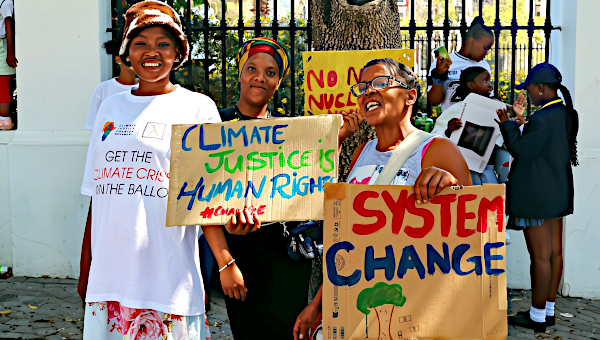
The ecological destruction we see every day is not an accident. It is the direct outcome of a system built on extraction, plunder and profit; a system that treats nature as a commodity to be bought and sold, and communities as disposable as the plastic they poison us with. Climate change is no longer a distant threat: it is already reshaping daily life with drought, floods, extreme heat, hunger, rising food prices, and the destruction of homes and livelihoods. It is the poor, the working class, rural communities and women who are hit first and hardest. The wealthy remain secure with their private water, private electricity, and private protection.
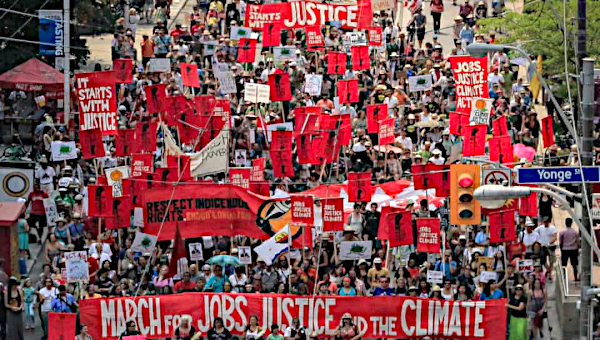
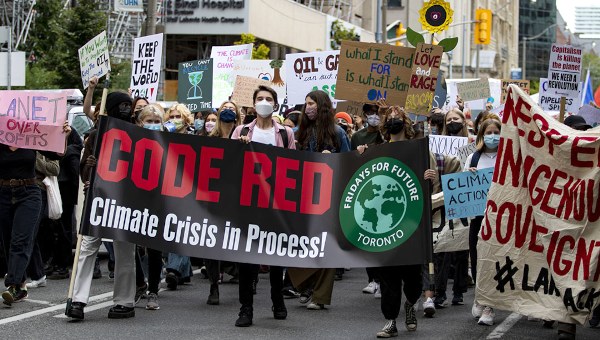
Capitalism is driving the planet toward catastrophe. The elites offer us ‘solutions’ with carbon markets, greenwashing, and privatised transitions. But these are designed to protect profits, not people. We cannot allow the climate crisis to be used as another excuse to impose austerity, to deepen inequality, and to expand corporate control and greed over energy, land and resources. The fight against climate change is inseparable from the fight for socialism.
The Future Is Not Theirs
Even in the midst of collapse, we find reasons for real hope. It doesn’t come from the empty promises of politicians, or the illusion that the system can be ‘fixed’ for our benefit. It comes from the only force capable of transforming society: the organised power of poor and working people — the working classes.
Hope lives on:
- In workers organising on the shopfloor and in communities, building unions and worker committees that defend dignity and fight exploitation.
- In women organising against violence and patriarchal domination, and in the feminist struggles that insist that liberation must be total.
- In movements that defend land, housing, public services and the right to life itself.
- In struggles for climate justice and against ecological destruction: communities resisting pollution, land grabs, water theft, destructive mining, and the privatisation of energy.
- In the demand for a publicly owned, socially controlled energy system that provides affordable clean power, decent work, and a just transition that leaves no worker and no community behind.
- In international solidarity, especially with the Palestinian and Sudanese people facing genocide, and all those facing occupation, racial oppression and dispossession.
The Role of Youth
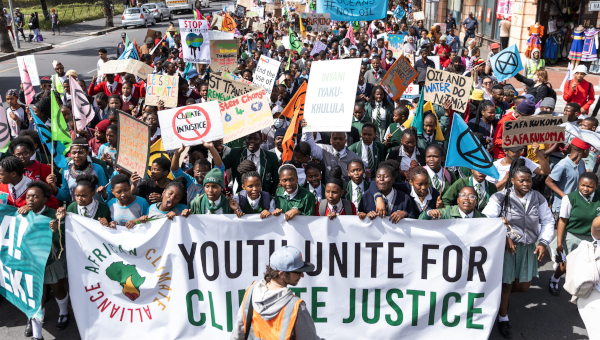
The youth are not simply ‘the future’. They are the decisive force of the present. They are the generation living on the sharpest edge of the capitalist crisis, with mass unemployment, the collapse of education, permanent insecurity, police violence, and the rising threat of climate breakdown. Youth are also among the most militant and imaginative fighters for justice in our society. Their leadership is indispensable if we are to break out of the mess we are in.
As we move toward the 50th anniversary of the June 1976 youth uprising, we honour the courage of the students who rose up against apartheid’s brutality and humiliation, who confronted the armed state with determination, and who inspired a new wave of struggle across the country. June 1976 was a declaration that the youth will not accept oppression as their destiny. In 2026, that spirit must be renewed, not as memory alone, but as a living commitment to organisation and struggle.
Today’s youth may face a different regime, but the same system of exploitation and ruthless dispossession. We call on young people everywhere to build the organisations, study groups, youth formations and movements that can sustain struggle; to reject the poison of xenophobia and division; to defend democracy from below; and to forge alliances with workers and communities in a common fight against capitalism, patriarchy, racism, and ecological destruction. As Marx and Engels wrote in 1848 in the Communist Manifesto “The proletarians have nothing to lose but their chains. They have a world to win.”
Local Government Elections
The coming year will also be especially challenging because it will be shaped by the build-up to the local government elections. Already, and increasingly in the months ahead, we will see hundreds of parties, both old and new, flooding communities with promises, slogans and lies. They will claim that a change of faces, a reshuffling of councils, or a different coalition will end the suffering endured by the majority. Yet most of these parties accept the same system that produces this suffering: a system based on profit, privatisation, corruption, exploitation and the abandonment of the working class. Elections will be used to divert anger into empty competition, to divide communities, and to weaken organised resistance.
We must be clear: no ballot paper will substitute for mass organisation and struggle from below. Real power is built not every few years at the polls, but every day in the workplaces, streets, schools and communities where people fight collectively for their lives.
The system will not change into something better by itself. It can degenerate into barbarism: rule by force, hate, scapegoating, and authoritarianism. The extreme right grows precisely where working-class organisation is weakened, where communities are isolated, and where people are convinced that nothing can change. When people lose hope!
Our Tasks in 2026
This is why our task in the coming year is urgent. We must collectively resist the forces of exploitation, corruption, repression and imperial domination.
But we must do more than resist: we must organise. We must:
- Forge solidarity across colour, language, gender, and sector.
- Build movements that are democratic, rooted, militant, and able to sustain struggle.
- Fight for a socialist future, based not on profit, but on human need; not on extraction, but on care for people and the planet; not on competition, but on cooperation; not on borders and exclusion, but on internationalism and freedom.
This new year must be a year to rebuild working-class power from below: in workplaces, farms, schools, universities, townships and informal settlements. It must be a year to:
- Deepen political education and clarity.
- Challenge the lies of capitalism and the poison of xenophobia and homophobia.
- Strengthen the structures that can defend people now and prepare us for the struggle for systemic change.
- Organise for climate justice, and insist that the fight for a liveable planet is a fight against capitalism itself.
This is what we stand for as ZASO (Zabalaza for Socialism). We want to build working class confidence so that those who have made the wealth of this country and this world, start to take control of it. To take control of the needs of our communities, of our workplaces, our schools and universities. To demand the services and resources that build a future for everyone, and not a small privileged elite. That is why we say another world is not just possible, but essential!
History is not written only by presidents and generals. It is written by ordinary people who organise, resist, and refuse to accept oppression as destiny. •
Zabalaza for Socialism Statement on COP 30
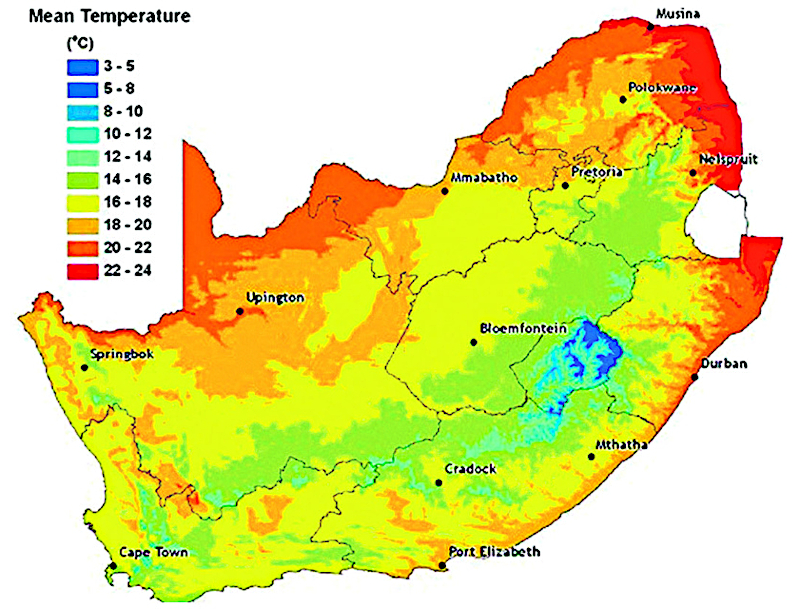
As COP 30 approaches, one truth is undeniable: capitalism has driven the planet to the edge of ecological collapse. The United Nations Environment Programme warns we are heading toward 2.8°C of warming by the end of the century – a catastrophe that will devastate working-class and rural communities across the Global South.
The Paris Agreement has failed because it is built on the same neoliberal logic that caused the crisis. Instead of confronting fossil capital, corporate power, and global inequality, it entrenched market-based mechanisms – carbon trading, offsets, and voluntary pledges – that commodify the atmosphere and let polluters continue business as usual. These schemes transform the climate emergency into a playground for financial speculation while diverting attention from the need for planned, state-led decarbonisation and redistribution. Emissions rise, temperatures climb, and the poorest pay the price through floods, droughts, and ecological collapse. The failure is not one of ambition – it is the failure of capitalism itself.
For most South Africans – already facing unemployment, hunger, and inequality – the climate crisis is not a distant threat but a daily reality. It exposes the structural violence of capitalism: a system that exploits both nature and human life for profit.
The Climate Struggle Is a Struggle for Life
Outside of a global mass movement rooted in national realities, the necessary steps to confront the climate crisis will not occur. Yet such a movement cannot be built if it fails to address the immediate needs of the working class and the poor. The fight for climate protection and ecological justice must therefore begin with the fight for life itself – for clean water, decent housing, jobs, food, and security against the elements.
If we are to build a mass movement capable of forcing systemic change, we must speak to the basic needs of billions who have been denied the essentials of existence. Right-wing climate denialists exploit this desperation to drive a wedge between ordinary people and climate action, presenting environmentalism as a threat to livelihoods rather than the path to survival. To win the majority, our movement must link ecological transformation with social justice – demanding the redistribution of wealth and power away from the billionaire class, big tech, and ruling elites who plunder the planet for profit.
The obscene concentration of wealth in the hands of a tiny minority is not incidental to the crisis – it is its engine. The same system that extracts surplus from labour also extracts life from the earth. Once the vast resources hoarded by the few are redirected toward meeting human needs, emissions will fall sharply, and genuine sustainability will become possible. This is why it is urgent to end privatisation, austerity, and tax breaks for the rich. The connection between neoliberal policy, rising inequality, and ecological breakdown is no coincidence – it is causation.
South Africa’s Neoliberal Climate Policy: Green Structural Adjustment
Rather than breaking from neoliberalism, the South African government has deepened it through the Just Energy Transition Partnership (JETP) – a new form of green structural adjustment. Sold as “climate finance,” it reproduces the same debt-driven, market-centred logic imposed on the Global South by the IMF, World Bank, and international capital.
Under the JETP, South Africa is being locked into foreign-controlled, debt-laden transition plans that transfer the costs of “green growth” to workers and the poor through tariff hikes, job losses, and cuts to public spending. Instead of democratising Eskom and investing in public renewables, the state is “derisking” private capital – guaranteeing profits for corporations while socialising the risks. The same logic drives the dismantling of public rail, the privatisation of transport, and the creation of “green corridors” for investors.
This is green neoliberalism: the continuation of apartheid-era inequality under a climate-friendly banner. It sacrifices people and planet to preserve profits and appease global finance.
Building a Socialist Path for a Just Transition
Zabalaza for Socialism rejects the corporate capture of the climate agenda. A genuine just transition cannot be built on markets, private profit, or debt dependency. It must rest on public ownership, democratic planning, and popular power – rooted in the struggles of workers and communities.
We call for:
- Democratic public control of energy, through a transformed, worker- and community-accountable Eskom,
- Massive public investment in housing, water, and climate-resilient infrastructure to protect working-class and informal communities,
- Rebuilding public transport – trains, buses, and non-motorised mobility – to cut emissions and costs,
- Food sovereignty, through land redistribution and cooperative small-scale farming independent of agribusiness,
- South–South cooperation to build shared industrial capacity and technological sovereignty free from Northern domination.
This is not utopian – it is the only realistic response to a crisis born of capitalism’s failure.
From Derisking to People’s Investment
The logic of “derisking” must be overturned. Public investment must serve the people, not private financiers. Every rand spent must expand collective wealth, not subsidise capital accumulation. ZASO calls for:
- Cancellation of illegitimate “just transition” debt,
- An end to austerity and redirection of resources toward housing, health, education, and climate resilience,
- Progressive taxation of wealth and capital flows, and recovery of resources looted through profit-shifting and illicit flows,
- Democratic planning led by workers, communities, and social movements – not consulting firms or investment banks.
The Struggle for Climate Justice Is a Struggle for Socialism
COP 30 cannot be another platform for the greenwashing of capitalism. The same system driving climate chaos fuels poverty, war, and inequality. There can be no ecological transition without class struggle and redistribution of power.
Human survival demands dismantling the political economy of destruction – fossil capital, finance capital, and the military-industrial complex – and building a socialist alternative grounded in solidarity, equality, and ecological balance. The future will not be decided in the negotiating halls of COP 30 but rather in the struggles of workers, peasants, women, and youth who refuse to pay for a crisis not of their making. •