
Supporting the Iranian People’s Struggle for Their Rights: Moving Toward Real Freedom and Equality, Not a Return to the Past
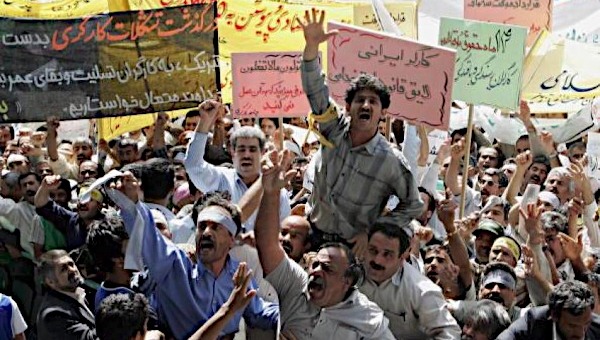
Popular protests and strikes in cities across the country have now entered their eleventh day. Despite an increasingly securitized atmosphere, the heavy deployment of police and security forces, and violent repression, the protests have continued to expand in both scope and form. According to reports, during this period, at least 174 locations in 60 cities across 25 provinces have witnessed protests, and hundreds of protesters have been arrested. Tragically, during this time at least 35 protesters – including children – have been killed.
From Dey 1396 (January 2018) to Aban 1398 (November 2019) and Shahrivar 1401 (September 2022), the oppressed people of Iran have repeatedly taken to the streets to demonstrate that they reject the prevailing economic and political relations and the structures built on exploitation and inequality. These movements have emerged not to restore the past but rather to build a future free from the domination of capital, a future grounded in freedom, equality, social justice, and human dignity.
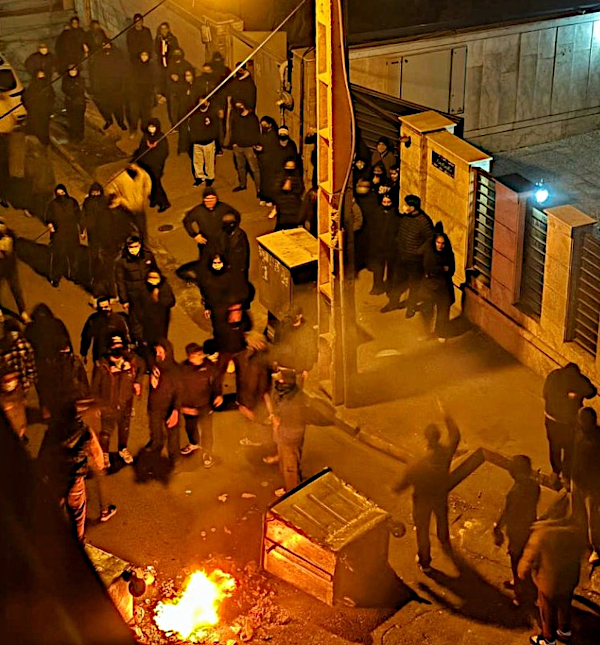
No More Authoritarianism
While expressing our solidarity with the people’s struggles against poverty, unemployment, discrimination, and repression, we clearly and unequivocally oppose any return to a past defined by inequality, corruption, and injustice. We believe that genuine liberation can only be achieved through the conscious, organized participation and leadership of the working class and oppressed people themselves – not through the revival of backward and authoritarian forms of power imposed from above. In this context, workers, teachers, retirees, nurses, students, women, and especially young people, despite widespread repression, arrests, dismissals, and severe economic pressure, remain on the front lines of these struggles. The Syndicate of Workers of Tehran and Suburbs Bus Company stresses the necessity of continuing independent, conscious, and organized protests.
We have stated repeatedly – and we reiterate once again – that the path to liberation for workers and the oppressed does not lie in imposing leaders from above, nor in reliance on foreign powers, nor through factions within the ruling establishment. Rather, it lies in unity, solidarity, and the creation of independent organizations in workplaces, communities, and at the national level. We must not allow ourselves to once again become victims of power struggles and the interests of the ruling classes.
The Syndicate also strongly condemns any propaganda, justification, or support for military intervention by foreign states, including the United States and Israel. Such interventions not only lead to the destruction of civil society and the killing of civilians but also provide yet another pretext for the continuation of violence and repression by those in power. Past experience has shown that dominant Western states place no value whatsoever on the freedom, livelihoods, or rights of the people of Iran.
We demand the immediate and unconditional release of all detainees and emphasize the necessity of identifying and prosecuting those who ordered and carried out the killing of protesters.
Long live freedom, equality, and class solidarity!
The solution for the oppressed lies in unity and organization! •
Syndicate of Workers of Tehran and Suburbs Bus Company
17 Dey 1404 (January 7, 2026)
Notes from Exile on the Iran Crisis
The BBC is shamelessly promoting Reza Pahlavi. Ironically, during the 1978–79 uprisings, the BBC worked extensively to project Khomeini and his movement as the leaders of the revolution and as the only alternative to the Pahlavi dictatorship, while leftist revolutionaries were either imprisoned or operated under severe restrictions. Western imperialist powers had already agreed that the Shah had no option but to go and that he should be replaced by anti-communist Islamist forces. They pursued the same strategy in Afghanistan and across much of the region.
Khomeini’s regime went on to execute tens of thousands of communists and progressives in the early to mid 1980s and to imprison hundreds of thousands more. In my own family and my partner’s immediate family alone, eight siblings, all communists, including one Islamic Marxist, were imprisoned. This severe repression left one of my sisters with serious mental health problems until her death years later, and one of my partner’s brothers continues to suffer from severe mental illness. They were all in their teens or early twenties at the time.
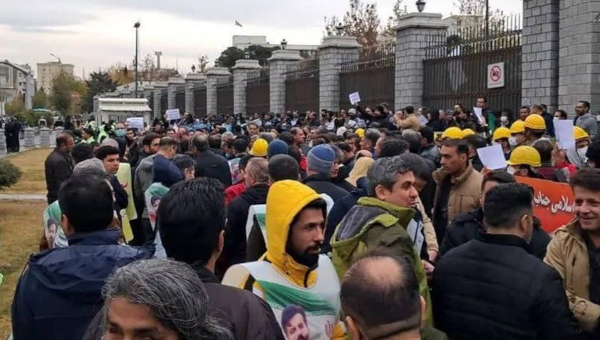
As a communist, a labour activist, an egalitarian human being, a Lur/Bakhtiari (an Iranian people living in southern and western Iran), partial Kurd, and a refugee, I want this regime to fall through grassroots and working-class movements. This can only be achieved without any Western intervention; otherwise, the outcome will be disastrous on many levels (a separate discussion). I have lived long enough to know that this can only happen through the intersection of street protests with working-class struggle and sustained labour and grassroots organizing. Street protests alone have never been enough, as they are usually brutally crushed. This is especially critical now, as monarchist forces – backed by Western media outlets such as the BBC and Iran International – are actively attempting to impose Reza Pahlavi as the leader of the uprising. They intervene by amplifying and inserting pro-Pahlavi discourses and slogans whenever possible, manipulating or selectively editing audio and footage, and focusing almost exclusively on pro-monarchy chants, despite being fully aware that the overwhelming majority of protesters are chanting against dictatorship, repression, the skyrocketing cost of living and massive corruption, inequality, and poverty.
Reza Pahlavi may be the leader of monarchists both in diaspora and inside the country, but working-class organizations, university students, the vast majority of feminists, socialists, and trade unionists, and most non-Persian peoples – who together make up the majority of Iran’s population – have no pleasant memories of the Pahlavi dictatorship. Under that regime, rights were stripped away, many lived in poverty, and a one-party authoritarian system was imposed. It was an absolute monarchy. Reza Pahlavi is openly favored by the genocidal Israeli regime, while US imperialism and its criminal president, Trump, may have other calculations as well. Regardless, the Iranian left in exile must continue to amplify what progressive forces inside the country have long been saying: exposing the dangers of a return to monarchy while clearly articulating left, collective, and egalitarian alternatives.
If you are a Western leftist, you have a great deal to contribute. Your understanding, empathy, solidarity, and support matter deeply. I believe we all need to genuinely listen to the Iranian left and the working class on the front lines of struggle inside the country. In the West, there is much work to be done: confronting the US and other imperialist governments, opposing the Israeli regime, and resisting any form of intervention are crucial. However, undermining the Iranian people’s legitimate struggle for justice, freedom, equality, and a better life is counterproductive. It only fuels the regime’s repression and provides justification for Western intervention.
We must also be clear that this struggle did not begin recently. It has continued since the very establishment of the capitalist Islamic Republic. Every few years, uprisings have erupted, usually followed by mass arrests, executions, and imprisonment. As the Tehran Bus Workers’ Syndicate stated in a recent statement:
“From Dey 1396 (January 2018) to Aban 1398 (November 2019) and Shahrivar 1401 (September 2022), the oppressed people of Iran have repeatedly taken to the streets to demonstrate that they reject the prevailing economic and political relations and the structures built on exploitation and inequality. These movements have emerged not to restore the past, but to build a future free from the domination of capital – a future grounded in freedom, equality, social justice, and human dignity… We have stated repeatedly – and we reiterate once again – that the path to liberation for workers and the oppressed does not lie in imposing leaders from above, nor in reliance on foreign powers, nor through factions within the ruling establishment. Rather, it lies in unity, solidarity, and the creation of independent organizations in workplaces, communities, and at the national level. We must not allow ourselves to once again become victims of power struggles and the interests of the ruling classes.”
We must forcefully push back against any hijacking of people’s struggles by right-wing forces. This is not a fight to return to monarchy or any other form of authoritarianism. If people in Iran wanted US or Israeli bombing, they would have staged mass protests during the Israeli and American bombing of Iran in June. No such protests occurred because the vast majority of people know well that US and Israeli intervention would bring only disaster – not real peace or freedom.
The struggle continues. •