
Enforcement Regime: Immigration hardliners in the US state
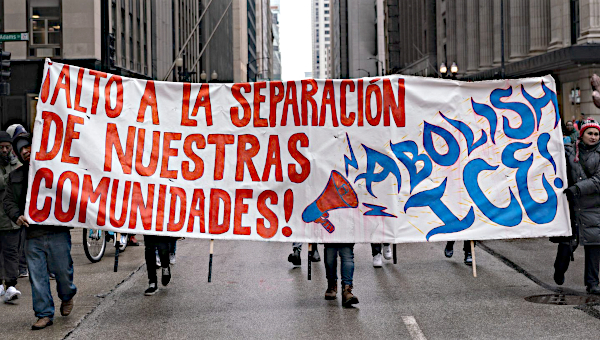
On September 30, hundreds of federal law enforcement officers raided a 130-unit apartment complex in Chicago’s South Shore neighborhood. After rappelling from a Black Hawk helicopter, rifle-wielding agents hurled stun grenades, kicked down doors and dragged residents out of their apartments, zip-tying and detaining some of them for hours. The operation, ostensibly targeting an alleged stronghold of Venezuela’s Tren de Aragua gang, resulted in thirty-seven arrests of mostly Venezuelan immigrants. Dramatic footage was posted by the Department of Homeland Security (DHS) on social media alongside the ominous caption: “To every criminal illegal alien: Darkness is no longer your alley. We will find you.” DHS later conceded that only two of those arrested actually belonged to any gang.
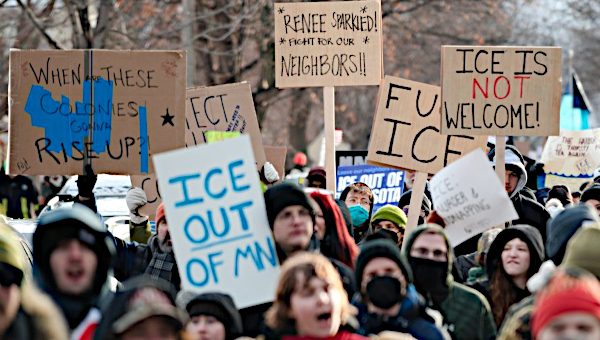
The South Shore raid is a microcosm of the new regime imposed by immigration hardliners at the DHS, the Justice Department, and the White House. Communities targeted by this enforcement blitz are familiar with its hallmarks, from indiscriminate force to the abandonment of due process, vacuous claims of criminality to theatrical violence. The fallout of such tactics is well-documented: a veteran attacked and dragged into a Portland Immigration and Customs Enforcement (ICE) field office; Congressional Candidate Kat Abughazaleh thrown to the ground outside an immigration processing facility in Chicago; a Mexican national fatally shot while driving away from ICE agents; a 79-year-old man body-slammed by Border Patrol agents; NYC Comptroller Brad Lander and Newark Mayor Ras Baraka arrested by ICE agents under false pretenses. And now, the brutal killing of Renee Nicole Good in Minneapolis, followed by the Trump administration’s attempts to smear her as a “domestic terrorist.”
Escalation of Crackdowns
ICE’s crackdowns and shock-and-awe operations are being carried out alongside more routine sweeps, in which facial recognition algorithms and the whims of street-level agents – rather than legal status, identification documents, or judicial process – increasingly decide who is detained and deported. With public opposition to the agency reaching fever pitch in many cities, it is worth pausing to ask whether this terrifying spectacle represents something genuinely new. From one perspective, the current enforcement regime reflects longstanding methods of US statecraft, accentuated by the Global War on Terror, including the interiorization of the border into the US mainland, racialized policing, the use of deportation against ideological enemies, and the frequent invocations of ill-defined emergencies or states of exception.
Yet these same methods have been transformed in recent decades by far-right organizational cultures operating within the state. The second Trump administration has harnessed them to build a domestic policing omniforce, based within DHS and given enormous resources by the One Big Beautiful Bill Act. By reconfiguring lines of authority and warping agency functions, it is mounting an existential challenge to the existing terms of order that govern the rights of noncitizens, while turning citizenship itself into a more flexible category. How should we understand this latest mutation in the domestic security apparatus created by the Bush administration, augmented by Obama, and left in place by Biden? What institutional dynamics are driving the escalating war on migrants?
To answer, we must first examine Trump’s immigration program to date: the extent to which the existing framework has been remade by this recent surge in detentions and deportations. We can then look at how the agencies themselves laid the groundwork for this project over the previous decades, as they morphed into rogue actors with increasingly radicalized unions – aiding the advance of the far right at the national level.
Interior Offensive
The administration’s opening salvo in the transformation of federal policing involved systematically removing legal and institutional barriers to immigration enforcement. Executive actions dismantled watchdog agencies, exposed sensitive data and spaces to immigration authorities, expanded “expedited” removal, and disregarded due process for legal residents and citizens. Millions have been made ineligible for bond and asylum hearings, while temporary protected status (TPS) has been revoked for one group after another. These moves came alongside a break with the fifteen-year-long trend away from interior enforcement. ICE has now shifted its attention away from the US-Mexico border and onto major cities, increasing the rate of interior arrests at an alarming clip, with government data showing ICE on track to deport upwards of 300,000 noncitizens this year.1
These institutional attacks were complemented by massive new investments in the domestic enforcement apparatus. Last summer, Trump’s signature domestic bill poured a staggering $171-billion into immigration enforcement through 2029. A glimpse of the line items reveals the sheer scale of the investment: $46.6-billion to complete the border wall; $45-billion to expand immigration detention centers; $18.2-billion for border facilities and initiatives; and $30-billion on top of ICE’s $9.6-billion base budget to bolster deportation and removal operations. ICE’s annual budget increased threefold to around $28-billion through 2029, making it the largest federal law enforcement agency in the country.2
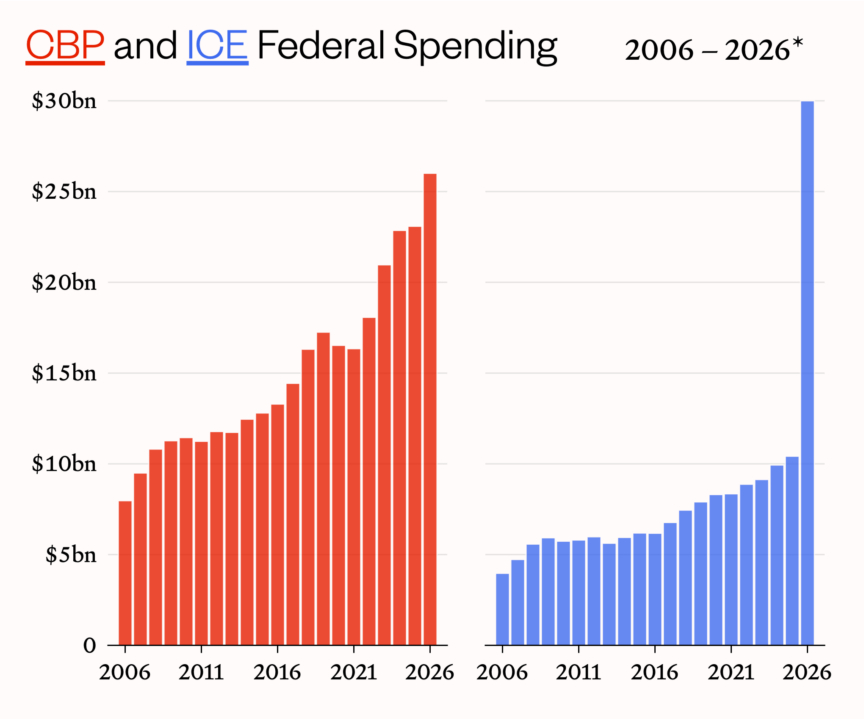
The legislation solved ICE’s looming “cash crisis” while increasing its army of lawyers, deportation officers, and other support personnel. It strengthened the material links connecting US immigration enforcement agencies as a constituency to the defense, technology, and private prison industries, and now promises to bring state and local police in cooperative districts deeper into the business of policing immigration.
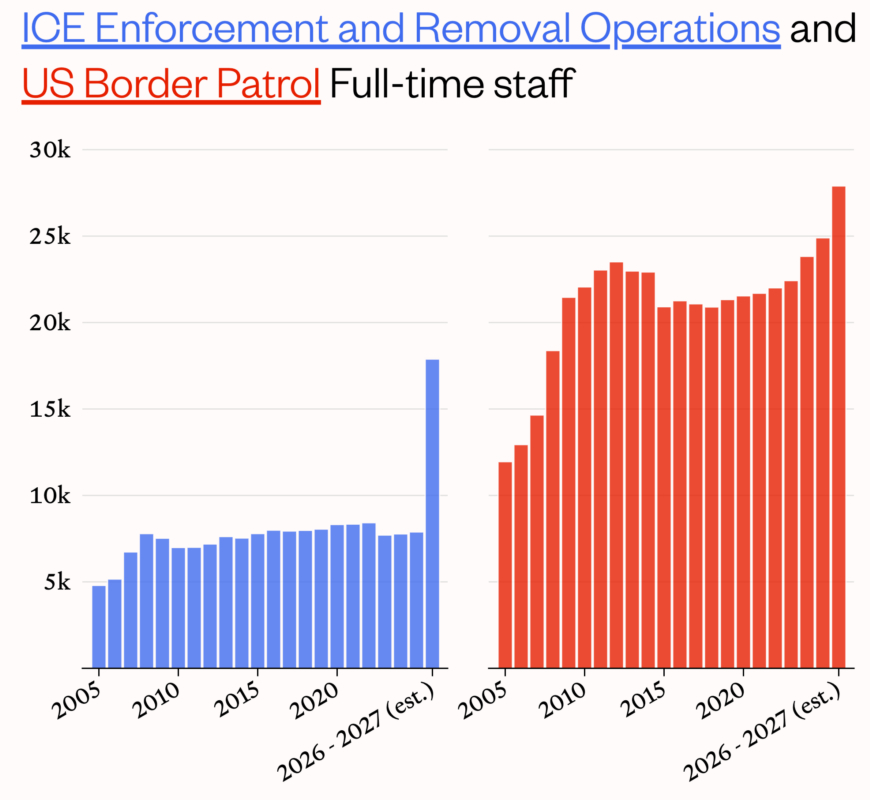
DHS wasted no time making use of the new funds. A slew of generous hiring incentives, including student loan forgiveness and a $50,000 signing bonus, were announced to facilitate the recruitment of 10,000 new ICE agents.3 By October. ICE was struggling to vet more than 150,000 applicants in their hiring pipeline. Assuming federal hiring targets are met, the total number of ICE Deportation Officers will increase from 6,000 to 16,000, while Border Patrol Agents rise from roughly 20,000 to 23,000. These increases are largely in keeping with the agencies’ history of periodic funding spurts at times when border politics moves up the headlines; yet they mark a new era for ICE’s Enforcement and Removal (ERO) team, whose staffing levels had plateaued since the previous interior enforcement surge under Bush and Obama.
Federal spending records show that, as of October, ICE had also increased weapons spending by 600 percent compared to 2024, mostly on small weapons and armor. Another $25-million in contracts has gone to facial-recognition and monitoring software to find and detain the agency’s growing list of targets. These investments reflect not just an expanding force but also an increasingly militarized and technologized one, planning for sustained operations in US cities. It has become routine for immigration agents and allied federal law enforcement officers to use crowd-control tactics like tear gas, flash bang grenades, and rubber bullets alongside excessive physical force to “manage” protesters and apprehend noncitizen targets.
Quantity to Quality
While the above figures are impressive by any standard, the shift here is not merely quantitative. The emerging enforcement regime melds federal law enforcement and other personnel into an inter-operational whole, focused on mass deportations and ideological policing. The White House has detailed at least 33,000 additional federal employees for ICE and Customs and Border Protection (CPB) duties, taking them from the Justice Department] the Bureau of Prisons; Drug Enforcement Administration; FBI; US Marshal Service; and Alcohol, Tobacco, Firearms and Explosives. FEMA employees are now tasked with sorting through thousands of ICE job applications, while the agency’s emergency funds have been siphoned to fund detention camps. A December report released by Senate Democrats shows that $2-billion in Pentagon funds have been diverted for immigration enforcement. The number of deputized immigration agents is even higher when counting National Guard troops occupying US cities or local police who have been pulled into immigration task forces.
These moves have already compromised DHS’s other competing obligations, including those most closely aligned with the administration’s own moral justifications for mass deportations, like combatting drug or sex trafficking rings. Even US Citizenship and Immigration Services – the agency tasked with processing citizenship, asylum, and work authorization claims – has been transformed into an enforcement wing, with no compunction in detaining even immigrants when they arrive for naturalization ceremonies.
The crackdown also benefits from the longstanding flexibility in the remits of ICE and Border Patrol itself. In theory, ICE’s jurisdiction is the “interior” – jails, workplaces, and communities – while CBP’s is the “border.” In practice, though, their activities often overlap. Whereas Biden rushed interior resources to the border, Trump has diverted resources from there to boost interior removals. This not only allows for additional manpower; Border Patrol agents can also operate with little transparency or oversight, enjoying special authority to interrogate and detain individuals within an expansive 100-mile “border zone” occupied by over 200 million people. In other words, as long as things remain quiet at the border, this fluid interoperability allows both agencies to focus their efforts on the interior.
Detention data indicates the full extent of this interior surge. When the detainee numbers are broken down by the arresting agency, we see that the proportion of ICE arrests increased from 28 percent of total detained in January to 82 percent as of December 13. The same data shows that the total number of average detainees reached 50,000 in June, a figure not seen since 2019, and exceeded 65,000 by the end of last year – the highest in recorded history.
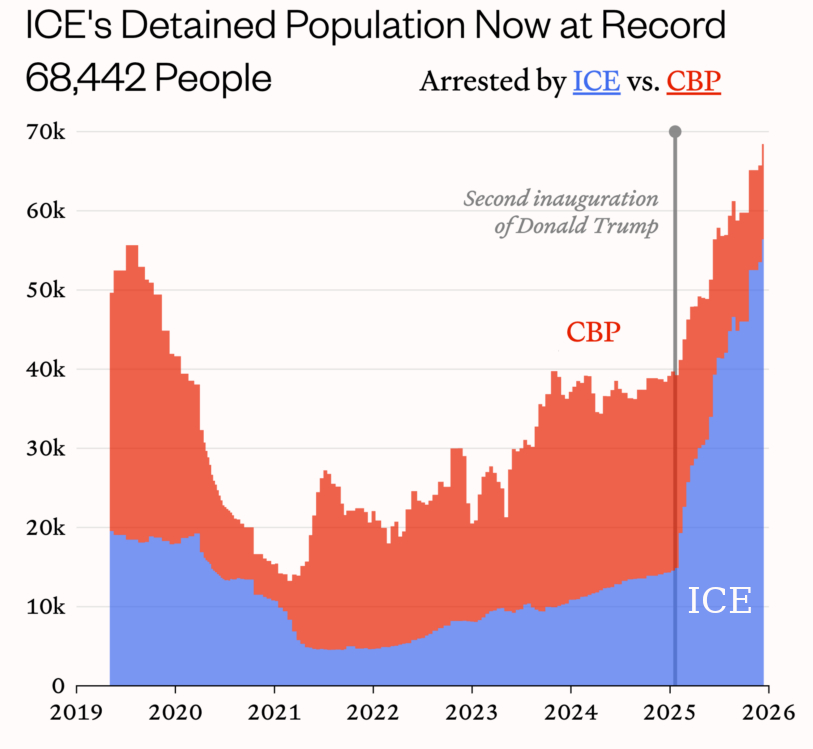
The new detainees have so far been crammed into what was already a sprawling system of poorly maintained and jerry rigged detention centers, far exceeding the maximum population capacity of 41,500 justified by ICE’s previous budget. While it is estimated that $45-billion in additional funding will expand detention capacity by “at least 116,000 beds,” these resources are unlikely to improve conditions for inmates. Egregious treatment is baked into the institutional design of the detention system. Because immigration proceedings can take months or even years, suspended bond hearings are now funneling more detainees into already overcrowded detention centers. This, in turn, puts more stress on ICE’s Custody Management and Health Services teams. Supposedly responsible for maintaining detention standards and administering medical aid, they have a long track record of neglect and abuse – which will surely be exacerbated as ICE’s for-profit partners scramble to staff up rapidly expanding private prisons.
New funding lines have also ushered in an era of immigration federalism. ICE heavily relies on cooperation from state, and local law enforcement offices to do its work (hence “Border Czar” Tom Homan’s vocal frustration with sanctuary city measures). Programs like 287(g) agreements create such federal-to-local links by subsidizing detention costs and empowering local authorities to make immigration arrests. In practical terms, these efforts multiply the possible locations – such as traffic stops, public spaces, and jails – in which an individual might encounter an immigration authority. Alongside $10-billion in reimbursements for “border states,” an additional $3.5-billion in state and local reimbursements through 2029 are empowering cooperative states to invest in immigration enforcement. The flood of resources could fund thousands of enforcement initiatives in cash-strapped red counties, with at least 730 new agreements inked since January 2025.4
Redefining Criminality
In April, Homan attempted to blackmail cities by promising more collateral arrests if local authorities did not cooperate with ICE: “Sanctuary cities are going to get exactly what they don’t want – more agents in your community because … now we have to send a whole team to look for the bad guy.” This offer was clearly disingenuous. The notion that sanctuary cities could escape ICE by sacrificing “criminal” immigrants was contradicted both by the Trump administration’s staggering deportation quotas – statistically impossible without noncriminal arrests – and the high percentage of detainees without criminal records. Of those arrested and detained by ICE since the beginning of October, 72 percent have committed no criminal offences. Many more detainees have been caught in the crosshairs for minor infractions like parking tickets or nonviolent drug charges. The administration’s recent threats to “denaturalize” foreign-born citizens on ideological grounds suggest that acts of protest or civil disobedience could soon spell deportation for tens of millions of Americans.
This is part of a wider systematic attempt to redefine criminality so as to implicate larger numbers of immigrants and activists – for instance, by expanding the legal definition of “terrorism” to include various forms of political dissent, or by designating fentanyl a “weapon of mass destruction.” Along with these language games, the new enforcement regime has adopted a more expansive view of immigration police work. As an ICE Field Director boasted at a hiring event in Arlington last year, what makes the agency different from other law enforcement is that “[ICE] is an expert in stopping the creation of victims … we stop things … before they happen.”
“Criminality” has long been the conceptual hinge for the contradictions of the immigration system. For decades, pro-immigration legislators won partial reforms by separating “bad” immigrants from “good” ones, targeting the former for harsh criminal penalties or deportation, while increasing inflows of the latter. There were two benefits to this approach: first, legislative crackdowns on “criminal” immigrants allowed policymakers to pursue expansionary immigration policies by bargaining away the rights of non-citizens; second, it afforded executives greater administrative discretion to use deportations as a form of political currency: increasing or decreasing the rate depending on what happened to be expedient at a given moment. This arrangement suited migrant-dependent business owners, who retained access to a large reserve of non-citizen workers. Without recourse to law, the over nine million undocumented workers in the US are largely under the power of employers.
These dynamics deepened the legal division between citizens and noncitizens in the decades leading up to the War on Terror. Thereafter, new investments in border security allowed immigration agencies to flourish as unaccountable incubators of a hard-right agenda within DHS. This is the foundation on which the Trump administration has built. With organized capital no longer exerting a moderating influence on immigration policy – instead favoring tax cuts, deregulation, and backroom deals on immigration enforcement – the forces now operating the machinery of the state have abandoned the status quo of selective enforcement and pivoted to a scorched-earth strategy of mass deportations. To fully understand this transition, we must look more closely at the institutional politics of ICE and Border Patrol, as it developed from the Bush era onward.
Rogue Agencies
Lax oversight and weak internal controls have plagued DHS since its foundation. Beyond carrying out publicly controversial policies such as family separation, Border Patrol agents have been implicated in numerous scandals, including abductions and sexual violence, unreasonable use of force, minor abuse, posting racist messages on private social media pages, and widespread corruption.
The crisis of discipline is an outgrowth of a domestic security state that was revamped to meet the demands of the War on Terror. As investigative journalist Garrett Graff has documented, the rapid expansion of ICE from 9,000 agents before 9/11 to 21,000 during Obama’s presidency led to a dramatic reduction in hiring standards, while the CBP lacked a coherent internal affairs process until 2014. A ProPublica report notes that misconduct investigations became contests between “local CBP supervisors; CBP’s nationwide internal affairs unit; the Homeland Security Department’s inspector general; the civil rights office at Homeland Security; and, in certain cases, the FBI and US Department of Justice.” CBP’s own understaffed internal affairs department was ill-equipped to handle the agency’s growing volume of disciplinary investigations.
The absence of accountability tallied with a crisis of authority in DHS. While both ICE and CBP have benefitted from DHS’s remaking of the security state, it would be wrong to view these agencies as passive beneficiaries of the reforms set in motion by the War on Terror. If anything, the relationship has often been the other way around: militant actors within ICE and Border Patrol have exploited the political contention over immigration to increase their resources, autonomy, and power within DHS – actively shaping the Department in their own image. This political mobilization took place primarily through their respective labor unions, the National ICE Council (NIC) and National Border Patrol Council (NBPC). As organizations mandated to advance the material interests of rank-and-file agents, both became incubators for far-right projects. Both also found an obvious ally in Trump, who, in turn, saw the unions as a potential power base in DHS.
Insurrectionary energies within NIC and NBPC became especially pronounced during Obama’s first term, as the precarious balance between protecting and punishing immigrants began to falter. Even as Obama ordered record interior removals in a futile attempt to build a coalition around comprehensive immigration reform, key figures within ICE and Border Patrol raged against what they saw as overly accommodationist “open border” policies. This rift set the stage for a protracted power struggle within immigration agencies between more pragmatic factions and radical ones who no longer saw a place for amnesty in the larger calculus of the US immigration system.
In 2010, ICE’s union chief, Chris Crane, filed a “no confidence” vote against then-ICE Director John Morton, citing his support for amnesty reforms as well as inadequate staffing. Crane would later go on to sue the Obama administration over the Deferred Action for Childhood Arrivals (DACA) executive order, and had to be forcibly escorted out of a 2013 Senate news conference where immigration compromise legislation was being announced. Border Patrol meanwhile came to feel increasingly hamstrung by institutional constraints as it was plagued by repeated corruption and abuse scandals, prompting it to escalate tensions with the Obama White House.
A turning point came in 2016, amid the growing politicization of rank-and-file agents, when the NIC and NBPC decided to cast their lot with Trump: their first ever political endorsements. “[A]ll the people responsible for the problems plaguing America today are opposing Mr. Trump,” claimed the NBPC, warning that “if we do not secure our borders, American communities will continue to suffer at the hands of gangs, cartels and violent criminals preying on the innocent.” The NIC likewise denounced Hillary Clinton as an “open-border radical” whose policies would force officers to “violate their oaths to uphold the law.”
The gambit paid off when Trump won the election and rewarded the agencies with greater enforcement powers, resources, and prestige. But although it saw the new administration as an ally, NIC did not shy away from criticizing Trump when he allegedly conceded to pro-immigration forces. Union representatives claimed the Trump administration had “betrayed” its promises by leaving Obama’s ICE team in place (this included Homan, then ICE’s Acting Director, who was accused of waste and mismanagement). Crane published an open letter claiming that Trump was continuing Obama-era policies of understaffing, political correctness, and deals with sanctuary cities. “I don’t believe you will find a group of law enforcement officers,” he wrote, “more hated by their own leadership and managers than the officers of ICE’s Enforcement and Removal Operations.”
In 2017, NBPC wielded its now considerable influence to oust Mark Morgan, a reform-minded director and the agency’s first outsider, after only seven months, resenting his alleged support for Comprehensive Immigration Reform’s pathway to citizenship provisions. At the time, the union’s president, Brandon Judd, remarked in an interview with Fox News that immigrants are “worse than animals, in my opinion … Animals do not treat other animals the way MS-13 treats other human beings.” Such dogged commitment to anti-migrant politics on the part of these powerful organizations arguably helped to push the first Trump administration further to the right.
Indeed, the crisis of authority at DHS had by this time begun to worry even the most zealous practitioners of the War on Terror. At the peak of the Black Lives Matter protests of June and July 2020, the Bush-era DHS chief, Michael Chertoff, warned of growing politicization within his former agency, cautioning that DHS personnel had begun “operating in camouflage uniforms with no clear identifying insignia.” Chertoff also claimed that immigration officials had been willfully overlooking DACA applications, in open defiance of a Supreme Court ruling.
This view was quietly endorsed by a bipartisan group of several former and acting Homeland Security secretaries who served as advisors on a 2020 Atlantic Council study on the “Future of DHS.” The report detailed a crisis of morale stemming from criticism of family separation, internal dissatisfaction with so-called catch-and-release policies, and ICE and CBP deployment at Black Lives Matter protests. It also considered whether “a change in Border Patrol culture would be beneficial,” citing Graff’s 2019 exposé on dissent among CBP’s rank and file:
“Most Border Patrol agents serving today signed up for a tough job in a quasi-military agency protecting the country against terrorists and drug dealers. They’ve found themselves instead serving as a more mundane humanitarian agency – the nation’s front-line greeter for families of migrants all too happy to surrender themselves after crossing the border. CBP doesn’t have the culture to meet this challenge, nor does it have the manpower or support from the rest of government.”
After the 2020 election, the Trump administration tried to use ICE and CBP unions as a lever to undermine the incoming Biden administration.5 Acting Deputy of Homeland Security Ken Cuccinelli, a future architect of Project 2025, unilaterally declared that all DHS policy changes affecting agents would have to be approved by ICE’s union. When that gambit failed, ICE agents nonetheless continued to defy the new administration’s federal enforcement guidance. In 2022, NIC filed a Labor Department complaint seeking “autonomy” from the American Federation of Government Employees and requesting an audit of its parent organization, the AFL-CIO, which Crane argued were “far-left organizations” with “anti-law enforcement” biases.
Hypertrophy
How should we understand the endgame of the ICE and Border Patrol unions? What is striking about these organizations is the extent to which their material and ideological investments in immigration policing tend to reinforce one another. Opponents of immigration have long argued that restricting numbers will help protect the labor interests of native citizens. Often the connection between the two is highly uncertain. But for ICE and border agents – whose livelihoods literally depend on the level of immigration enforcement – it could not be clearer. For those on the frontlines of the war on immigrants, nativist politics combines with direct material incentives to support zero-tolerance policies that seek to eliminate all forms of amnesty. This is precisely the institutional culture that the Trump administration has sought to tap into by shutting down DHS’s civil rights division and the detention ombudsman’s office.

In late October 2025, a major purge of ICE leadership across the US – said to have been orchestrated by informal Trump advisor Corey Lewandowski – handed greater control of deportation operations to Border Patrol personnel. As a result, the man now leading the charge is Gregory Bovino, a Border Patrol veteran who exemplifies the agency’s cowboy culture and whose no-holds-barred immigration raids in rural California had impressed the administration. With the Supreme Court’s blessing, Bovino has brought his trademark style of indiscriminate arrests and aggressive racial profiling to “enemy” sanctuary cities.
The change came amid removal numbers that fell short of the administration’s stated goal. It suggests that even as ICE racks up formal arrest numbers in the US interior, it is Border Patrol that is set to become the dominant force within the expanded enforcement regime. ICE’s numerical expansion will serve as the vehicle for extending CBP’s paramilitary mentality across the interior. As a DHS spokesperson remarked to NBC News: “The administration thinks ICE isn’t getting the job done,” whereas CBP “does what they’re told.”
The close relationship between ICE/CBP and Trump has now, paradoxically, begun to limit Trump’s own room for maneuver. His instinct to insulate farmers and hotel operators from excessive enforcement was scuttled by Stephen Miller, who quickly retracted an order to “hold off on work site enforcement.” Shortly after, the White House made an about-face and emphasized the need to “massively expand” such worksite enforcement absent a congressional “deal.” The episode suggested that the lines of authority connecting Trump to immigration enforcement have undermined the president’s own directives. Now, as Bovino takes the reins, this dynamic is surely set to deepen.
While the reality of the immigration system has long been hidden from swaths of the US population, shifts in public opinion suggest that many are now seeing how radical the existing framework really is. Recent events in Minneapolis and elsewhere reflect its wild extrajudicial excesses, with tactics that exceed the demands of the mission and punishments meted out for their own sake. Trump’s immigration agenda – lawlessness achieved through the hypertrophy of law enforcement – has been laid bare. As ICE and CBP continue to grow in strength and autonomy, various groups (legal residents, federal workers, activists) have come to resemble the traditional targets of immigration clampdowns, unable to rely on rules that might constrain the hard power of the state.
The longstanding practices of these agencies are well-suited to our present moment of flexible citizenship and vanishing due process. Their dramatic expansion marks an unprecedented enhancement of the domestic security apparatus. But while this development is deeply troubling, it is not sudden or inexplicable, nor is it merely a top-down project of the Trump administration. The unconditional flow of money, equipment, and resources to DHS and its immigration sub-agencies – overseen by multiple previous administrations – had already allowed them to operate with minimal accountability for decades. This, in turn, nourished an increasingly assertive anti-migrant politics among the agency’s rank-and-file, whose militant unions fought to override resistance from employers and policymakers alike. Both Democrats and Republicans, following this bipartisan logic, spent years lurching rightward on immigration. Unconstrained resources have thus enabled the growth of the far-right enforcement regime; reckoning with its budgetary and institutional foundations will be necessary to stop it. •
This article first published on the Phenomenal World website.
Endnotes
- Many commenters have noted that recent government data should be seen as untrustworthy and unverifiable. Aaron Reichlin-Melnick of the National Immigration Council notes that a December DHS press release boasting 605,000 “deportations” since January is artificially inflated by administrative returns at the border and self-reported departures using the US Customs and Border Protection (CBP) Home app, neither of which constitute formal “removals.” A more realistic number reflected in an August report nonetheless suggests that removals in Trump’s first year have well exceeded the 218,000 average annual interior removals under Obama’s first term.
- This number will increase to $30-billion annually if the President’s FY2026 budget is approved.
- Border Patrol applicants likewise see incentives up to $30,000 depending on their location assignment.
- This makes for a total of 866 compared to 135 active agreements at the end of FY2024. Many localities have struggled in the past with inadequate federal reimbursement for the policing and detention costs created by these federal partnerships. To put this number in perspective, North Carolina’s Mecklenburg and Alamance Counties spent $5.3 and $4.8-million respectively in their first year operating the 287(g) program, while in Virginia’s Prince William County annual immigration enforcement costs of $6.4 million forced the city to raise property taxes and draw from a “rainy day” fund.
- The ICE union praised Trump for promoting “core policies needed to restore immigration security – including… increased interior enforcement and border security, an end to Sanctuary Cities, an end to catch-and-release, mandatory detainers… and the canceling of executive amnesty and non-enforcement directives.”