
The Fight for Housing in Toronto’s Downtown East
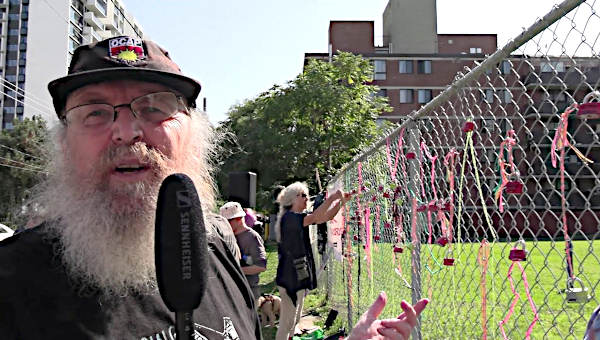
230 Fightback is locked in a struggle to ensure that social housing will be built at 214-230 Sherbourne instead of yet another luxury condo development. In this, we are up against the greed and power of the developers and the complicity of the politicians at every level of government, who act as their agents.
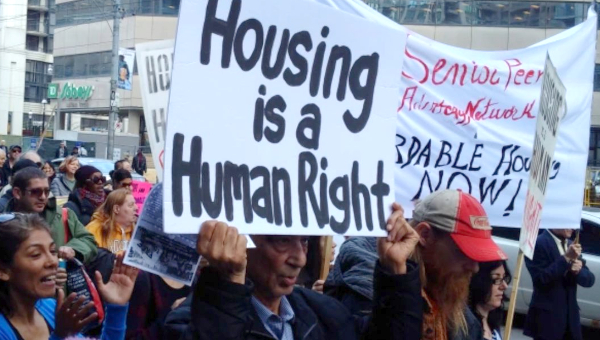
Indeed, as we continue with this fight, we are very well aware that it is but one part of a battle to decide whether housing will be provided in the interests of profit-hungry developers, investors, and corporate landlords or in order to meet the needs of our communities. In this regard, the campaign we have taken up in the heart of Toronto’s poor working-class Downtown East is an important part of the fight for housing justice.
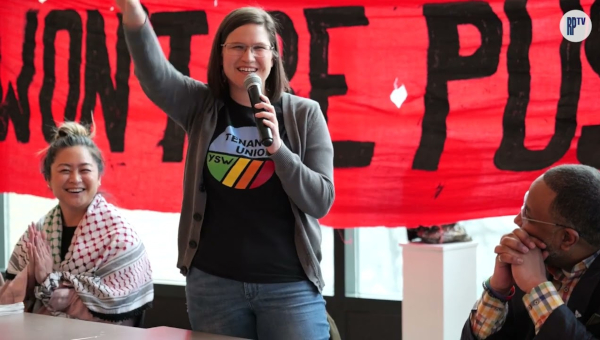
We have mobilized local people and allies to confront KingSett Capital, the present owner of the site, and the politicians and bureaucrats at City Hall to demand the property be used to meet the housing needs of the community. As part of this, we demanded a meeting with CreateTO, the municipal agency that does much to oversee development and housing provision in this city. It took a couple of disruptive actions to achieve this, but on November 25, a meeting with the senior representatives of the agency took place.
The meeting was a significant step, in that CreateTO’s CEO, Vic Gupta, acknowledging that the present condo crash had halved the value of the property since KingSett bought it, responded to our case for the city to ensure the property becomes a social housing site by undertaking to contact both political decision makers and the developers and to report back to us. He also agreed to set up a meeting between our organization and the Housing Secretariat and the Toronto Community Housing Corporation (TCHC) to pursue this further.

Struggle for Local Community
At the heart of the case that we made that day was the proposition that the contested site is located at the corner of Dundas and Sherbourne and that adequate housing provision at that location is an absolutely vital question for the local community. If the fight is won, it will do a great deal to strengthen a community that is under attack and to meet its pressing needs. Should luxury housing be built at this location, however, the disastrous driving out of vital services and the pushing up of rents that will ensue will be a death blow.
It would be fair to say that the CreateTO officials were impressed by the historical background we were able to provide. Indeed, they requested that we provide them with a written summary of this information. We felt this was worth sharing because it shows how the struggles of the present moment are rooted in the development of the community over decades.
Our fight against upscale redevelopment and the ‘commodification of housing’ that is at work today flows out of a long history that we need to understand.
Why are vacant lots at 214-230 Sherbourne so important to the Dundas and Sherbourne community?
1. The historic importance of Dundas and Sherbourne to the unemployed and unhoused
Prior to the summer of 2008, the vacant lots at 214-230 Sherbourne were home to four rooming houses that had housed low-income people for decades. Three of the rooming houses were subsequently demolished. The fourth, an old Victorian rooming house at 230 Sherbourne, which has now been boarded up for 17 years, was saved from demolition due to its historical value. The old home had functioned as a rooming house as far back as 1911, offering rooms for rent to reservists before being shuttered.
214-230 Sherbourne is located in one of Toronto’s oldest working-class neighbourhoods, situated in the heart of ‘skid row’ and surrounded by a large infrastructure of social services which does not exist in other parts of the city. Low-income people, the unemployed, and the unhoused have been coming to Downtown East Toronto as far back the mid-19th century when they came to the city looking for work.
“The Report of the Committee on Homeless and Transient Men” released in June of 1960 notes that men entering the city looking for work were drawn to the Dundas and Sherbourne area because of the emergency services established there:
“The problem of the homeless or transient man … in its present form is a product of the industrial revolution of the past two centuries … the demands of the primary and transportation industry for mobile, seasonal, and casual labour, continuing changes in demands for labour (business cycles), technological changes have all been factors in the displacement of men from their place of birth and upbringing … Increasingly, the homeless transient man has turned to large cities where opportunities for work are more available and where resources to meet their needs in times of emergency exists in greater abundance… Having few resources, the homeless men congregate in older and poorer sections of the city, known generally as “skid row.”
In 1970, the Dundas and Sherbourne area had one of the largest concentrations of hostel beds, including Seaton House, Canada’s largest men’s hostel. At the time, there were an estimated 3,000 rooms in South Carlton, renting for $10 to $25 a week. There were also estimated to be 500 flophouse beds in the area that were renting for about $1.00 to $1.25 per night. A bed count done by the city in May 1977 found that there were an estimated 1,773 men staying in hostels, flop houses, halfway houses, parks, and hallways.
In the mid 1960s, affluent young professionals and their families began buying up rooming houses in the Dundas and Sherbourne area. The city, by 1977, had recognized that many of the rooming houses and flophouses that had traditionally served as accommodations for a large number of the homeless men were disappearing due to gentrification. The loss was of serious concern for the city because thousands of single adults were dependent on the cheap accommodations. During that period, the City of Toronto Planning Board recommended that the city buy up rooming houses and flophouses and allow the private independent operators to run them.
Recognizing the importance that rooming houses played in housing single adults in the early 1970s, the city bought 25 rooming houses in 1973 that were due to be demolished to make room for several large apartment towers. Mayor Crombie was photographed standing in front of Enoch House, one of the houses to be demolished, announcing the city’s purchase of the 25 rooming houses on Sherbourne Street, just north of Dundas Street East. The rooming houses later became part of the Dan Harrison Housing Project, owned and operated today by TCHC.
2. 230 Sherbourne, the death of Drina Joubert and housing for single adults
In December of 1985, the death of Drina Joubert, a homeless woman who froze to death in an abandoned truck at the back of 230 Sherbourne, was the catalyst for protests and an inquest that led to the creation of 3000 units of housing for single adults across Ontario. Sixty-one of these subsidized units were constructed across the street from 230 Sherbourne behind All Saints Church in the late 1980s. The inquest also led to changes in the welfare system. These changes would allow every single adult in the province to be eligible for subsidized housing.
3. 214 -230 Sherbourne and The City
Starting in 2013, the Ontario Coalition Against Poverty launched a campaign to have the city expropriate or buy the properties at 214-230 Sherbourne to build social housing on the vacant lots. In 2018, the City of Toronto began to work on its 5-year plan to revitalize the Dundas and Sherbourne neighbourhood. The goal of the project was to “improve housing conditions within the existent Dundas-Sherbourne neighbourhood.” At the heart of the plan was the redevelopment of Dan Harrison, a housing complex consisting of 370 units of social housing owned by the city, and the acquisition of 214-230 Sherbourne, which was privately owned. A 2019 city report highlights the importance of acquiring 214-230 Sherbourne to the implementation of the city’s plans. The report states:
“The 214-230 Sherbourne Street site provides a strategic opportunity to acquire property for the development of much-needed affordable and supportive housing. The development of the site also presents the unique opportunity to unlock the new housing and community revitalization solutions that are to address the social, economic, and physical challenges facing the Dan Harrison complex and local neighbourhood.”
The strategic importance of the acquisition of 214-230 Sherbourne is again mentioned in a city report released in the early winter of 2022. In the report, staff are directed to “review the feasibility of leveraging 214-230 Sherbourne Street property with the intention to achieve the Dan Harrison and Housing Now objectives.”
When the properties came up for sale in March of 2022, the city bid for 214-230 Sherbourne but was outbid by Kingsett Capital, who later put in an application to build a condo tower on the site. Soon after KingSett bought the properties, the acquisition of 214-230 Sherbourne was removed from the official plans for Dundas and Sherbourne without any explanation as to how or why the acquisition of the vacant lots was no longer needed.
In the fall of 2022, a campaign calling on the city to purchase or expropriate 214-230 Sherbourne, which had now sat vacant for more than 14 years, was taken up by 230 Fightback. Partly as a result of this, KingSett Capital, in February of 2023, offered to sell the properties back to the city, but after more than a year of negotiations, they could not agree on a price.
In the fall of 2024, KingSett Capital received approval from city council for the construction of a 46-story condo tower on the site. However, recent developments in the pre-construction condo sales market and the condo crash have again opened an opportunity for the city to try and reach a deal with KingSett to purchase or expropriate the properties. 230 Fightback recently attended KingSett’s head office, and Bill Logard confirmed that KingSett’s offer to sell 214-230 Sherbourne to the city was still on the table.
4. Why the acquisition of 214-230 Sherbourne for social housing is important to the neighbourhood
The vacant lots are at the epicentre of the city’s housing crisis. The transformation of the Dundas East corridor, which began in the 1990s with construction of Dundas Square and the redevelopment of Regent Park starting in 2005, is threatening the fragile infrastructure of affordable housing and social services that have existed in the Downtown East since the mid-1900s. Plans to build more than 6,300 condo units along the Dundas Street East Corridor, many of which have been completed, are transforming one of Toronto’s oldest working-class neighbourhoods. Dundas and Sherbourne is the last intersection along the Dundas Street East Corridor that has not been developed.
There is an urgent need to protect low-income housing in the area, such as social housing owned by the city (which has been allowed to deteriorate over the years) and other privately owned properties that continue to house low-income people. The city’s own reports have shown that it is key to preserving and stabilizing low-income housing stock at Dundas and Sherbourne.
The proposed construction of a condo tower at 214-230 Sherbourne would cause irreparable harm to the fragile infrastructure of one of the city’s oldest working-class neighbourhoods. It would continue the mass displacement of low-income people from Downtown East Toronto.
The recent condo crash presents a perfect opportunity for the city and KingSett Capital to enter into new negotiations. The vacant lots at 214-230 Sherbourne have become a symbol of the developer’s need to make profits and the city’s inability to address its housing crisis in one of Toronto’s poorest neighbourhoods.
We continue to be perplexed by KingSett Capital’s decision to bid against the city in March of 2022, given its long business relationship with the city. KingSett would have been well aware of the city’s plans to acquire 214-230 Sherbourne as part of its plans to secure affordable housing in the Dundas and Sherbourne area. We also continue to be perplexed at the city’s inability to reach a deal with one of its key business partners.
The harm caused by having left 214-230 Sherbourne vacant for 17 years is immeasurable. The visible poverty and destitution at Dundas and Sherbourne are impossible to ignore. People’s lives are at stake. The thought of leaving these properties vacant for another three to five years is inconceivable and would be detrimental to the ability of low-income people to live in the community. One cannot stress the importance and urgency with which we believe that KingSett and the city must renew their negotiations on the future of 214-230 Sherbourne. •