
Breaking the Stasis: The Left Writes a New Chapter in Peru
On June 10, 2021, the National Office of Electoral Processes (ONPE) published the results of the second round of elections to elect the new president of Peru, with the winner being Pedro Castillo, the candidate for the leftist party Peru Libre (PL). Castillo obtained 8,800,486 votes against the 8,730,712 garnered by his ultra-right opponent Keiko Fujimori of the Popular Force (FP). Fujimori – using the pattern followed by the political Right in Latin America – has raised allegations of irregularities and fraud in the electoral process. Her attempts to overturn the legitimate results are borne out of personal necessity.
Fujimori is facing a potential 30 years sentence, mainly for receiving illegal campaign money from some of the most powerful local business tycoons, including top bankers. During her political career, she’s been credibly connected to cocaine trafficking and corruption networks deeply embedded in different branches of the country’s government, among them the notorious “Cuellos Blancos” inside the judiciary. Winning the presidency would have stalled the criminal process against her for another five years. Now, she can’t run scot-free; the lead prosecutor in the corruption case has already requested preventive imprisonment for her.
Change in the Correlation of Forces
The victory of Castillo is an important one; it breaks the stasis within the country’s political framework. Peru held its previous presidential election in 2016, and has had four presidents since then: Martín Vizcarra replaced Pedro Pablo Kuczynski in March 2018 and was impeached by a hostile Congress in November 2020; his successor, Manuel Merino, lasted merely five days, amid popular uproar at Vizcarra’s ouster, and was replaced by Francisco Sagasti, a US-educated technocrat. The political elites of Peru had synthetically created an electoral vacuum where they remained cognizant of nothing other than their own opportunistic tactics. Congress had been largely reduced to an association of charlatans, mafia men, evangelical sects and robber barons.
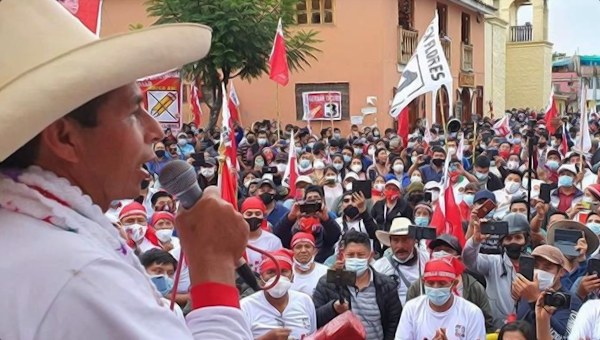
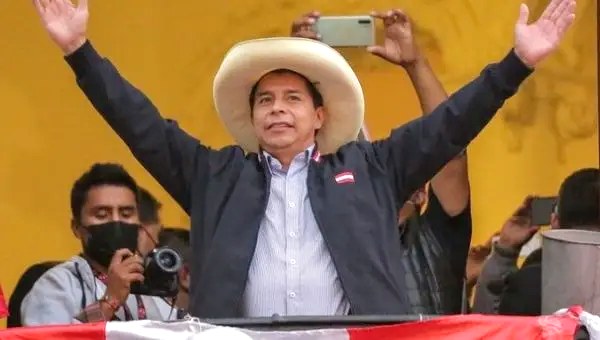
The triumph of the Left has ushered in a new correlation of forces. Pedro Castillo, son of peasant farmers in the Chota province located in the Northern Andean region of Cajamarca, comes from the teachers’ union, the largest trade union in Peru, having between 300,000 and 400,000 members. Instead of trying to appeal to the elite in Lima, he ran a working-class campaign, intended to reach the impoverished communities of the rural areas. A post-neoliberal program has been put forward including state regulation of the market, state planning, nationalization of strategic sectors, improvement of tax collection through a progressive tax scheme, renegotiation of legal contracts with transnational capital, and controls over the repatriation of profits.
On the foreign policy front, Castillo has supported an anti-imperialist posture. In his first 100 days, he has promised to expel the United States Agency for International Development (USAID), a de facto US intelligence operation masquerading as charity, and to close the US military bases in the country, as well as to withdraw Peru from the Lima Group – the bloc of right-wing governments in the region established in Peru’s capital that have attempted to overthrow the socialist government of Venezuela.
A New Chapter in Peruvian History
The outcome of the 2021 presidential election also has historical importance, resetting a politico-economic trajectory primarily marked by elite dominance and a weak subaltern movement. Peru’s postwar development consolidated the economic position of established elites, with relatively limited state intervention during the first phase of the period. By the 1960s, however, the weakening of export growth encouraged policymakers to reconsider this orientation and experiment with stronger forms of economic intervention. The 1959 Industries Law reflected this emerging shift by encouraging industrial development, although manufacturing remained comparatively small and depended heavily on foreign capital, particularly investment originating in the United States.
Fernando Belaunde’s presidency between 1963 and 1968 introduced a reformist orientation centred on economic diversification and agrarian reform. His government, however, failed to overcome the political resistance surrounding these projects. The military takeover of 1968 opened the way for General Juan Velasco Alvarado, whose government pursued a far more extensive programme of social and economic transformation. Agrarian reform became one of its central instruments. By transferring land away from the traditional landed oligarchy and extending redistribution into both the Andean highlands and the commercially productive coastal valleys, the regime substantially weakened the institutional foundations of the old agrarian order. Yet the transformation remained largely directed from above, with the military state retaining decisive control over its implementation.
Velasco’s programme extended beyond agrarian reform. His government brought major sectors of the economy under public ownership, particularly areas such as mining, petroleum, and banking that had previously been dominated by foreign or private interests. As the state assumed a larger economic role, established elites lost some of the institutional leverage they had exercised over national policy and the media. At the same time, the reforms stimulated popular mobilization that increasingly exceeded the military government’s capacity to direct it. Institutions such as the National System of Support for Social Mobilization (SINAMOS) were created to channel this participation, yet organized demands for social transformation acquired a momentum of their own. Socialist politics consequently expanded among rural communities, industrial workers, and residents of the rapidly expanding peripheral settlements surrounding Peru’s major cities. The resulting tensions contributed to the conservative military reaction that removed Velasco in 1975 and redirected the country away from his reformist project.
The post-Velasco period witnessed a gradual restoration of elite economic power. General Francisco Morales Bermúdez shifted the military government toward a more liberal economic orientation, and Belaunde’s return to civilian office in 1980 continued this trajectory. The combination of the 1982 debt crisis, severe climatic disruptions, and the expansion of the Sendero Luminoso insurgency subsequently placed the economic order under intense pressure. Alan García’s presidency initially moved in the opposite direction: his government sought to stimulate domestic consumption while restricting debt payments to international creditors. The strategy produced severe macroeconomic instability, culminating in hyperinflation and a profound economic crisis.
Alberto Fujimori abandoned García’s heterodox economic course soon after assuming the presidency in 1990. Working with the backing of Washington and the international financial institutions, his administration introduced a sweeping programme of market restructuring. Public enterprises were transferred into private hands on a large scale, regulations governing economic activity were dismantled, and Peru was rapidly integrated into international markets. The government also sought to attract overseas capital through generous investment conditions, with mining becoming one of the principal beneficiaries of this new economic orientation. The resulting transformation established the foundations of Peru’s neoliberal order for the following decades.
The economic transformation was accompanied by a profound authoritarian reconfiguration of the Peruvian state. On April 5, 1992, Fujimori carried out the autogolpe, suspending the 1979 Constitution and closing Congress and the judiciary. The institutional checks on presidential authority were consequently weakened for much of the remainder of his tenure. His regime later became associated with extensive corruption and serious human-rights violations. Fujimori was convicted for his role in killings and kidnappings connected with the Grupo Colina death squad, while his government also implemented a coercive sterilization programme that disproportionately affected Indigenous and poor women. These policies formed part of a broader authoritarian project that combined neoliberal restructuring with intensified state control.
Peru’s Left entered the neoliberal period in a severely weakened condition. Izquierda Unida, which had previously represented a significant electoral force, was fractured by internal disputes and struggled to formulate a coherent response to the transformation of the economy. Trade unions were similarly weakened as employment conditions deteriorated and public enterprises were privatized. The armed conflict involving Sendero Luminoso compounded these difficulties by destroying organizational networks that the Left had established in rural areas over preceding decades. At the same time, the violence enabled the political Right to present itself as the defender of social order, thereby strengthening the conditions under which Fujimori consolidated his political dominance.
The restoration of electoral democracy after 2000 left the basic economic settlement largely untouched. Alejandro Toledo introduced several democratic reforms during his presidency, yet preserved the market-oriented framework inherited from the Fujimori period. Alan García subsequently deepened this orientation by pursuing policies aimed at expanding trade and attracting international investment. Ollanta Humala initially campaigned against neoliberalism and drew considerable support from voters dissatisfied with the established economic order, but his administration soon moderated its programme after taking office. Against this longer trajectory, Castillo’s victory carries particular significance. His election represents the emergence of a rural and working-class political force capable of challenging an economic model that had remained remarkably durable across successive governments. •